Green Passport Carbon , Singapore
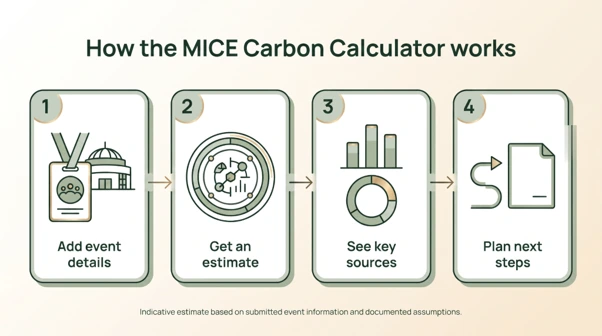
Estimate the carbon footprint of your Singapore MICE or corporate event using practical planning inputs. See an indicative total, estimated emissions per attendee and the categories that may contribute most.
Indicative planning estimate based on submitted event information and documented assumptions. A reviewed footprint may require additional data.
AI is transforming how businesses operate, but the computing power behind AI also consumes significant energy. As customers, investors and organisations pay closer attention to environmental impact, AI and technology companies are increasingly expected to understand and communicate the carbon footprint associated with their operations.
Watch this video to learn how the Carbon Calculator works and how your event’s carbon emissions are calculated.


Find quick answers about the Event Carbon Calculator, your emissions estimate, and what happens next.
The GHG Calculator is a simplified tool for estimating the greenhouse gas emissions associated with an event. It uses event activity data on major categories such as energy consumption, travel, waste, water, food and beverage, and refrigerants, together with relevant emission factors to estimate emissions in kg CO₂ equivalent (CO₂e).
The calculator is designed to provide a practical estimate where detailed event-level data may not be available.
The calculator prioritizes Singapore-specific emission factors where available, supplemented by internationally recognized sources where Singapore-specific factors are unavailable.
A free, simplified calculator cannot require users to provide detailed information such as every attendee’s origin and destination, individual flight routes, or detailed waste-treatment data.
The calculator therefore uses predefined assumptions and secondary emission factors. These assumptions are applied consistently so that users can obtain a reasonable estimate without needing specialist carbon-accounting data.
Users with more detailed primary data can go for a tailored customisation.
International air-travel emissions are estimated using the number of passengers, an assumed one-way flight distance, the round-trip multiplier, and the applicable DEFRA passenger-kilometre emission factor. Because the free version does not collect individual origin-destination pairs, predefined distances are used for short-haul and long-haul international flights.
Food and beverage emissions can be estimated based on the number of meals served. This approach avoids requiring event organizers to enter the weight of every ingredient used in catering.
Where actual activity data are unavailable, the user may use an estimate or a representative value for that activity. For a more accurate event footprint, users should replace assumptions with actual invoices, utility bills, travel data, catering records, waste records, or other primary activity data wherever possible.
No. The result of the free version is an estimate of the event’s GHG emissions, not a measurement with zero uncertainty.
The accuracy of the result depends on the quality and completeness of the activity data entered and the emission factors available.
The calculator’s boundary is event-focused. It covers relevant emission sources associated with the event, including direct fuel use and refrigerants, purchased energy, and selected value-chain activities such as attendee travel, food and beverage, waste, and water.
The calculator does not automatically assume zero emissions or add an emissions category when no data is provided. Predefined assumptions are used only where they are built into a selected input option, for example, an assumed distance within a selected flight haul band. Where appropriate, users may voluntarily enter an estimate based on available information. If no data or estimate is provided for a category, that category is excluded from the calculation.

Green Passport Carbon
Quick Links
More Information