Carbon neutral vs net zero: what’s...
Carbon neutral vs net zero: two terms, both sound green, both are...

Green Passport Carbon , Singapore

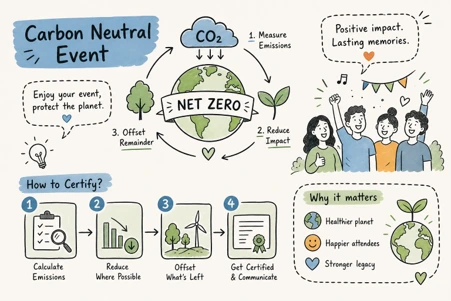
The term “carbon-neutral event” is appearing with increasing frequency on Singapore MICE brochures and event briefs, yet many organisers struggle to explain what it actually requires beyond recycling bins and plant-based menus. The label carries real weight in ESG reporting and procurement, and getting it wrong exposes organisations to greenwashing risk, a risk that is increasingly scrutinised by clients, third-party assurers, and regulators in Singapore.
This article breaks down the definition clearly, explains which international standards apply, and walks through the certification process step by step. For Singapore event planners responding to growing pressure from clients, sponsors, and bodies like the Singapore Tourism Board, understanding the mechanics behind a genuine carbon-neutral event is no longer optional. Green Passport Carbon, a Singapore-based carbon solutions specialist focused on the MICE sector, works through exactly these mechanics daily.
A carbon-neutral event is one where the net carbon dioxide equivalent (CO2e) emissions attributable to the event are zero. This is achieved by measuring the total footprint, reducing emissions where practical, and retiring verified carbon credits to cover what remains. It is not a synonym for “eco-friendly” or “low-waste.” The definition is specific and measurable, without a calculated footprint and documented credit retirement, the term cannot be used credibly.
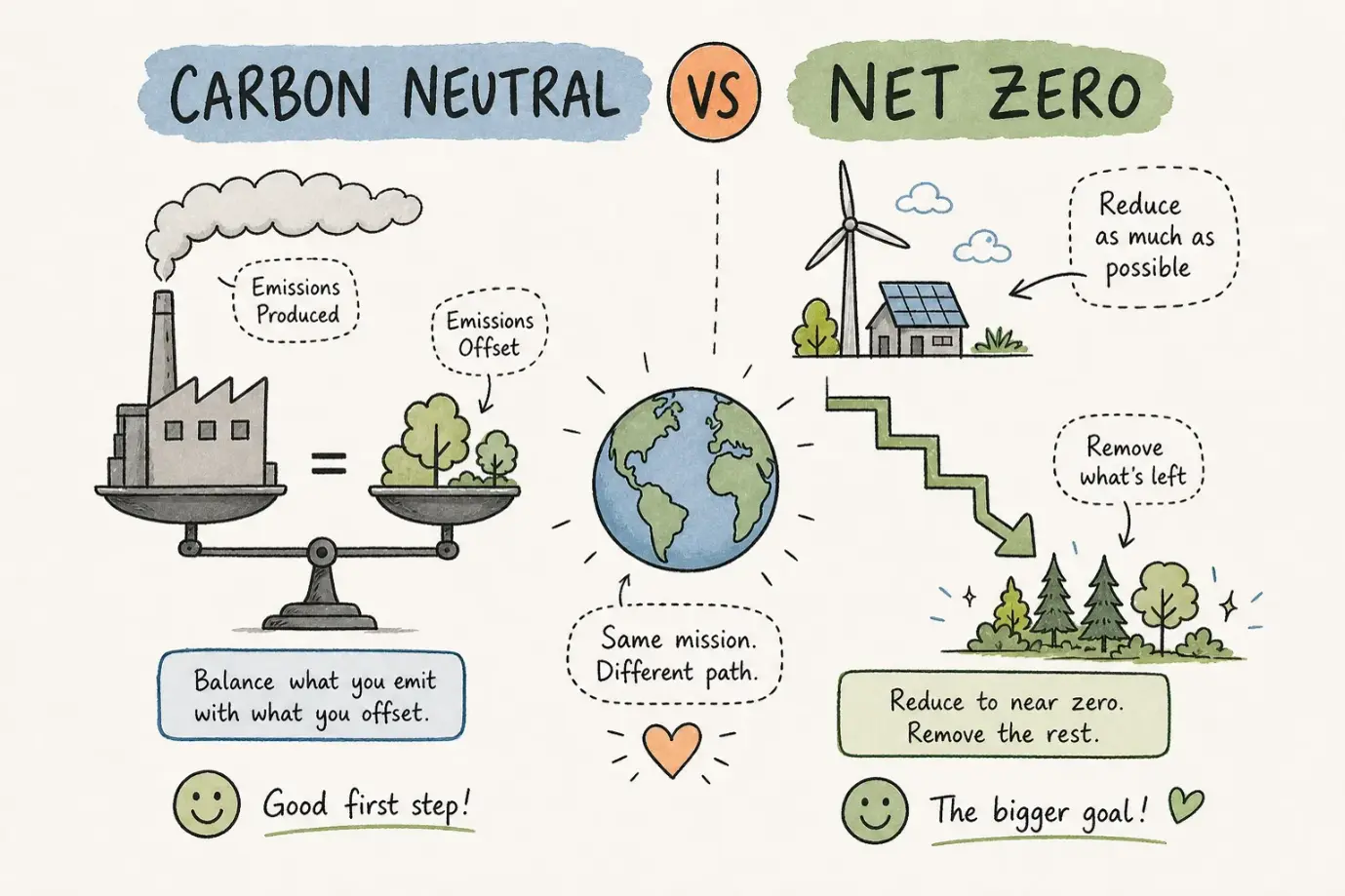
Carbon neutral and net zero are related but not interchangeable, and the distinction matters in practice. Carbon neutrality is typically achieved at the event level by offsetting residual emissions with quality credits. Net zero, by contrast, requires deep decarbonisation across an organisation’s entire value chain, with offsets playing a much smaller role and permanent carbon removals doing the heavy lifting at the end. For a Singapore event organiser, carbon neutrality is the achievable near-term goal; net zero is an organisational commitment that extends well beyond any single event.
ESG reporting teams and procurement leads are increasingly alert to the difference between these two terms, which means using them interchangeably creates both credibility risk and potential disclosure problems. Getting the language right starts with understanding the measurement behind it.
The single most important insight in event carbon accounting is this: attendee travel dominates almost every event footprint. Industry modelling for conferences with substantial international attendance suggests transportation can account for over 85% of an event’s total carbon footprint, with air travel alone contributing more than 80%. Decisions about attendee origins, whether an event draws regional or local delegates, and the transport modes they use have far more impact on total emissions than almost any other variable the organiser controls.
After travel, the next significant sources are venue electricity and cooling, and hotel accommodation. Food and beverage, printed materials, freight, and waste contribute smaller but still measurable shares. Singapore’s STB baseline puts average venue-related emissions at Singapore’s six purpose-built MICE venues at 14.13 kg CO2 per attendee, with 94% of that figure coming from energy consumption alone. Understanding which categories are largest for a specific event is the starting point for any credible carbon reduction strategy, and the split varies considerably between a single-day conference and a multi-day exhibition.
This source breakdown has direct practical consequences. If you spend most of your sustainability budget on plant-based catering while flying in 500 delegates from across the region, you have addressed perhaps 2 to 3% of your footprint. The data should drive where you focus first, and that focus is what separates a meaningful low-carbon events strategy from one that is largely cosmetic.
ISO 14068-1, published in 2023 and revised in September 2026 as ISO 14068:2026, is the primary international standard for carbon neutrality claims. It defines requirements for quantifying, reducing, and offsetting greenhouse gas emissions, and it sets out what organisations must demonstrate before they can legitimately claim carbon neutrality. For Singapore event organisers, aligning with ISO 14068-1 is increasingly what clients and ESG reporting frameworks require as evidence that a claim is substantiated rather than self-declared. Singapore’s STB has applied ISO 14068-1 to its own participation at international trade shows such as IMEX Frankfurt, IMEX Americas and IBTM World, which signals the direction of travel for the broader MICE sector.
ISO 14068-1 does not prescribe a single calculation tool; it works alongside the GHG Protocol, which provides the accounting structure for classifying emissions into Scopes 1, 2, and 3, and for applying recognised emission factors. For events, almost all emissions fall into Scope 3, value chain emissions, which is why the methodology must extend beyond the venue’s own energy use to cover travel, accommodation, catering, and supply chain contributions. Any carbon-neutral claim that only measures the venue’s electricity bill is incomplete by definition.
Singapore also has a locally relevant layer: Workshop Agreement (WA) 4 on Sustainable MICE provides guidelines specifically for carbon emissions management across the MICE supply chain, covering measurement, reduction, verification, and offsetting. The Singapore MICE Sustainability Certification (MSC) Framework, developed with SACEOS and supported by STB, is GSTC-Recognised and provides the broader sustainability certification context within which carbon neutrality sits.
Carbon-neutral event certification follows three distinct phases, each building on the last. Skipping any one of them means the claim cannot be substantiated. The phases are more structured than many planners initially expect, but that structure is precisely what makes the resulting certificate defensible.
The first phase involves collecting activity data across all material emission sources: attendee travel modes and distances, hotel room nights, venue energy consumption, meal counts, material quantities, and waste volumes. Recognised emission factors are applied to each data point, and the output is a total event footprint in tonnes of CO2e, broken down by category. This is the evidence base for everything that follows, so data quality and methodology transparency are non-negotiable. A vague estimate is not a footprint; it is a guess.
Once the footprint is calculated and reduction opportunities have been applied, the remaining emissions are addressed by retiring an equivalent quantity of verified carbon credits. Green Passport Carbon retires eligible carbon credits with documented retirement records. The retirement is permanent and traceable, not a future promise, and the documentation should record the credit type, vintage, project, and registry reference. Where a client specifically needs Article 6-authorised credits with a corresponding adjustment, that status should be confirmed and documented for the specific credits before retirement. For organisations whose sustainability disclosures face third-party assurance, that paper trail is what makes the credit defensible.
The third phase produces a branded Green Passport Carbon certificate with a unique certificate ID and verification link, documenting the carbon action taken for the event. This certificate gives event organisers a documented, communicable output for sustainability reports, client communications, and procurement responses. It is not an ISO certification or an independent third-party verification; organisers who need a verified ISO 14068 claim can add independent verification. Green Passport Carbon’s end-to-end Calculate, Retire, and Certify model handles all three phases as a single service, so that organisers do not have to piece together a calculator, a credit registry, and a certificate provider independently. The calculator itself is free and gives a Free Event Carbon Estimate; the Full Event Carbon Assessment, carbon-credit retirement and the Green Passport Carbon Event Certificate are provided as part of Green Passport Carbon’s quote-based service.
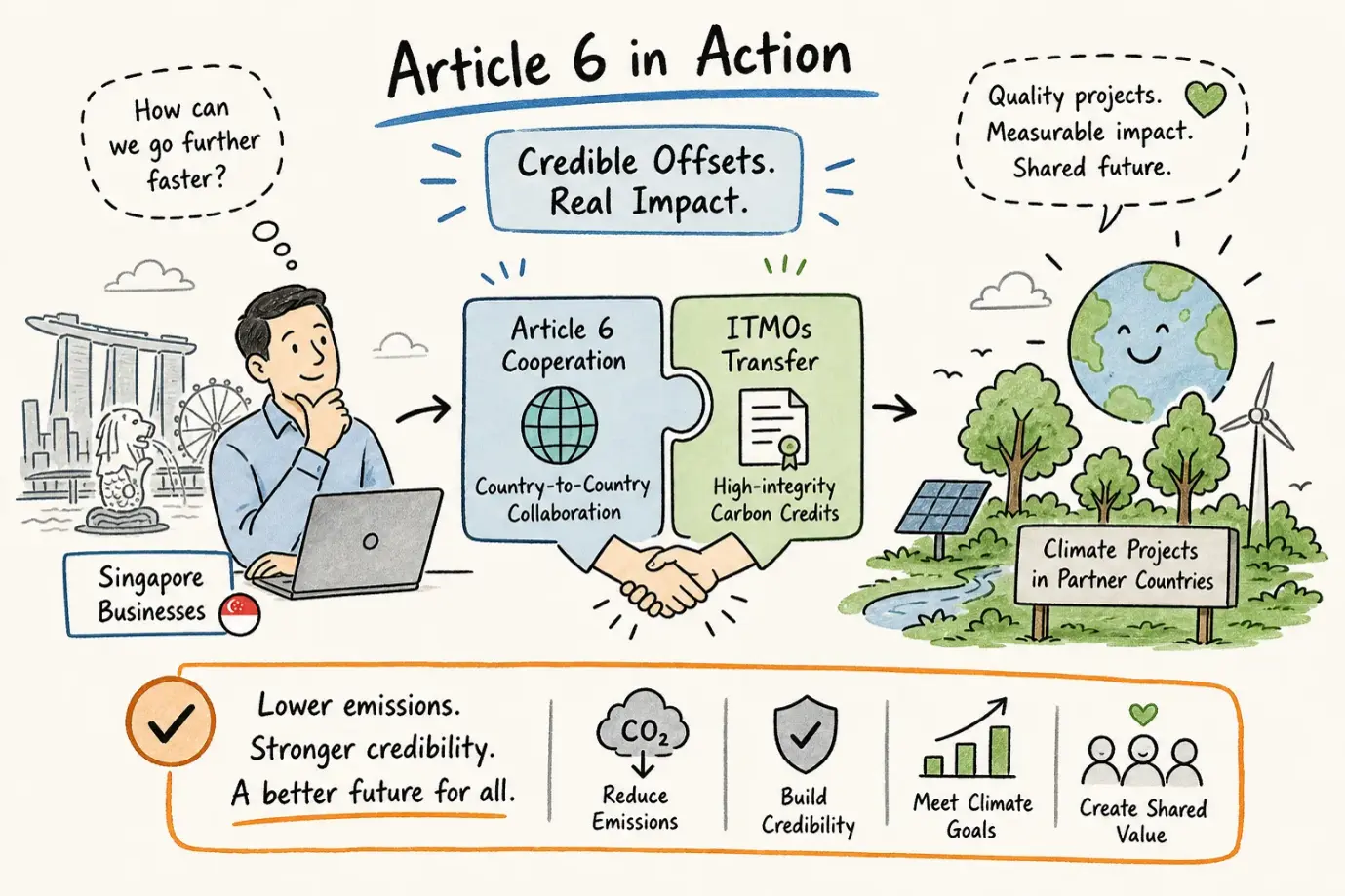
Not all carbon credits are equal, and the distinction matters more than most event planners realise. Standard voluntary credits vary widely in quality, additionality, and permanence. Article 6 of the Paris Agreement establishes a framework for internationally transferred mitigation outcomes (ITMOs), and credits aligned to Article 6 are subject to governmental authorisation and corresponding adjustments, a mechanism that prevents the same emission reduction from being counted twice across different national inventories.
Singapore is an active participant in Article 6 bilateral agreements, making Article 6-aligned credits particularly relevant for Singapore-based organisations making carbon-neutral claims. Well-established voluntary standards such as Verra VCS and Gold Standard provide strong project-level verification, but they do not automatically carry the corresponding adjustment that Article 6 alignment requires. For organisations whose ESG disclosures face third-party assurance, this distinction should be disclosed clearly. Singapore’s October 2025 guidance on carbon credits states that corresponding adjustment requirements do not apply to corporate buyers meeting voluntary climate commitments, and that a corresponding adjustment does not by itself indicate the quality of a credit, which must be assessed separately. Buyers should still disclose whether their credits include one.
When a sustainability team includes event carbon neutrality in an annual report, the underlying credit quality is reviewable. Assurers look at whether credits are verified, whether retirement is documented, and whether the vintage and project type are disclosed. Using lower-grade credits to support a carbon-neutral claim creates audit risk. Using high-integrity credits with full retirement documentation turns the claim into a defensible disclosure rather than a liability.
For corporate event managers and sustainability teams, a carbon-neutral event certification provides a documented, standards-aligned output that can be included directly in Scope 3 emissions disclosures and annual sustainability reports. As ESG reporting requirements tighten in Singapore, particularly for MNCs and GLCs facing stakeholder or regulatory scrutiny, having an auditable event-level carbon-neutral claim is meaningfully different from a narrative description of sustainability efforts. Narrative does not pass an assurance review; documentation does.
For event organisers pitching to clients or sponsors, a certified carbon-neutral event is a concrete differentiator. Clients increasingly include sustainability credentials in event procurement criteria, and a certificate backed by a documented methodology informed by ISO 14068-1 and documented credit retirement answers that requirement directly. It also gives attendees a clear, honest signal: this event measured its impact, took it seriously, and addressed it credibly. That transparency builds the kind of trust that vague sustainability branding cannot.
A carbon-neutral event is not a marketing label you apply after adding a recycling station. It is the result of a defined process: calculating the full event footprint using a recognised methodology, reducing emissions where practical, retiring verified carbon credits for the residual, and documenting the outcome against an international standard. For Singapore event organisers, that process is increasingly a concrete requirement in client briefs, ESG disclosures, and procurement frameworks.
As a practical starting point, your event sustainability checklist should cover four areas: data collection for all material emission sources, methodology alignment with ISO 14068-1 and the GHG Protocol, credit quality and retirement documentation, and a certification output suitable for external reporting. Green Passport Carbon’s Calculate, Retire, and Certify model is purpose-built for the MICE sector, handling the full process end-to-end so that event planners and sustainability teams receive a branded certificate with a verification link without assembling the components themselves.
If you are planning your next event and want to understand what achieving carbon-neutral status would involve for your specific footprint, contact us directly. That conversation begins with your numbers, not with paperwork.
Carbon neutral vs net zero: two terms, both sound green, both are...
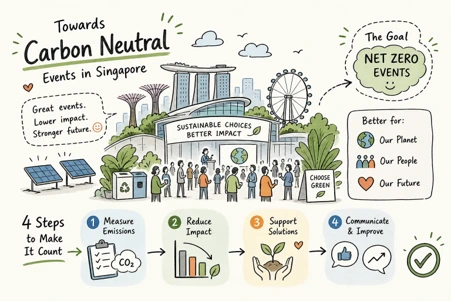
Carbon neutrality claims are increasingly visible in Singapore's events industry. Conference programmes...

Carbon offset solutions for hotel ballrooms and event spaces in Singapore are...
Find quick answers about the Event Carbon Calculator, your emissions estimate, and what happens next.
There is no official threshold. The most cited reference is approximately 14.13 kg CO2 per attendee for venue-related emissions, with energy the dominant contributor. Note this excludes attendee travel, so a full-scope per-attendee figure will typically be higher. Treat it as a comparative benchmark for the venue category rather than a pass mark for the whole event.
Yes. SACEOS has published WA 4: Sustainable MICE — Guidelines for Carbon Emissions Management, a Singapore Standards workspace agreement covering measurement, reduction, calculation, verification and offset. Separately, the Singapore MICE Sustainability Certification (MSC) provides GSTC-Recognised organisational certification, and STB and SACEOS will develop a MICE Decarbonisation Framework by 2028.
Air-conditioning, lighting and audiovisual systems run continuously through operating hours regardless of attendee behaviour, making venue energy a structural and relatively predictable load. In Singapore’s climate, cooling demand is both unavoidable and substantial. This is why the MICE Venue Sustainability Playbook points to emissions per square foot of venue area as a comparable metric.
Yes — and then raised them. By 2025 the original roadmap targets were exceeded, with all purpose-built MICE venues and over 80% of SACEOS member companies certified. Roadmap 2.0, unveiled in July 2026, commits to a MICE Decarbonisation Framework by 2028 and net zero by 2050.
No. MSC certifies the organisation across domains including carbon, waste, energy, water, social responsibility, HR competency and procurement, valid for two years. It does not produce a per-event footprint figure or evidence that a specific event’s emissions were addressed. Those are separate exercises.
Article 6-aligned offsets are no longer just a conference talking point; they...
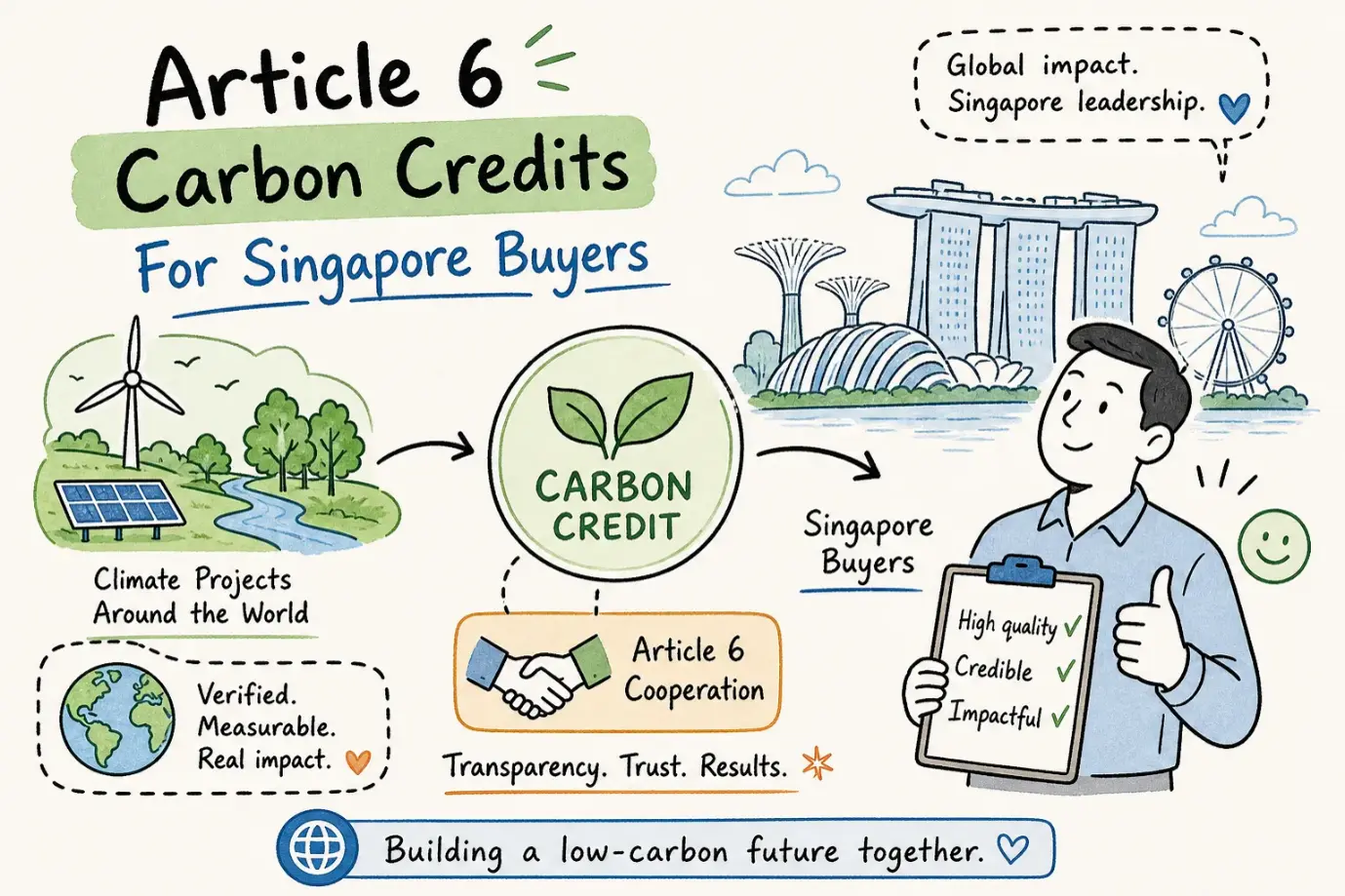
Article 6 carbon credits are fundamentally different from standard voluntary offsets, and...
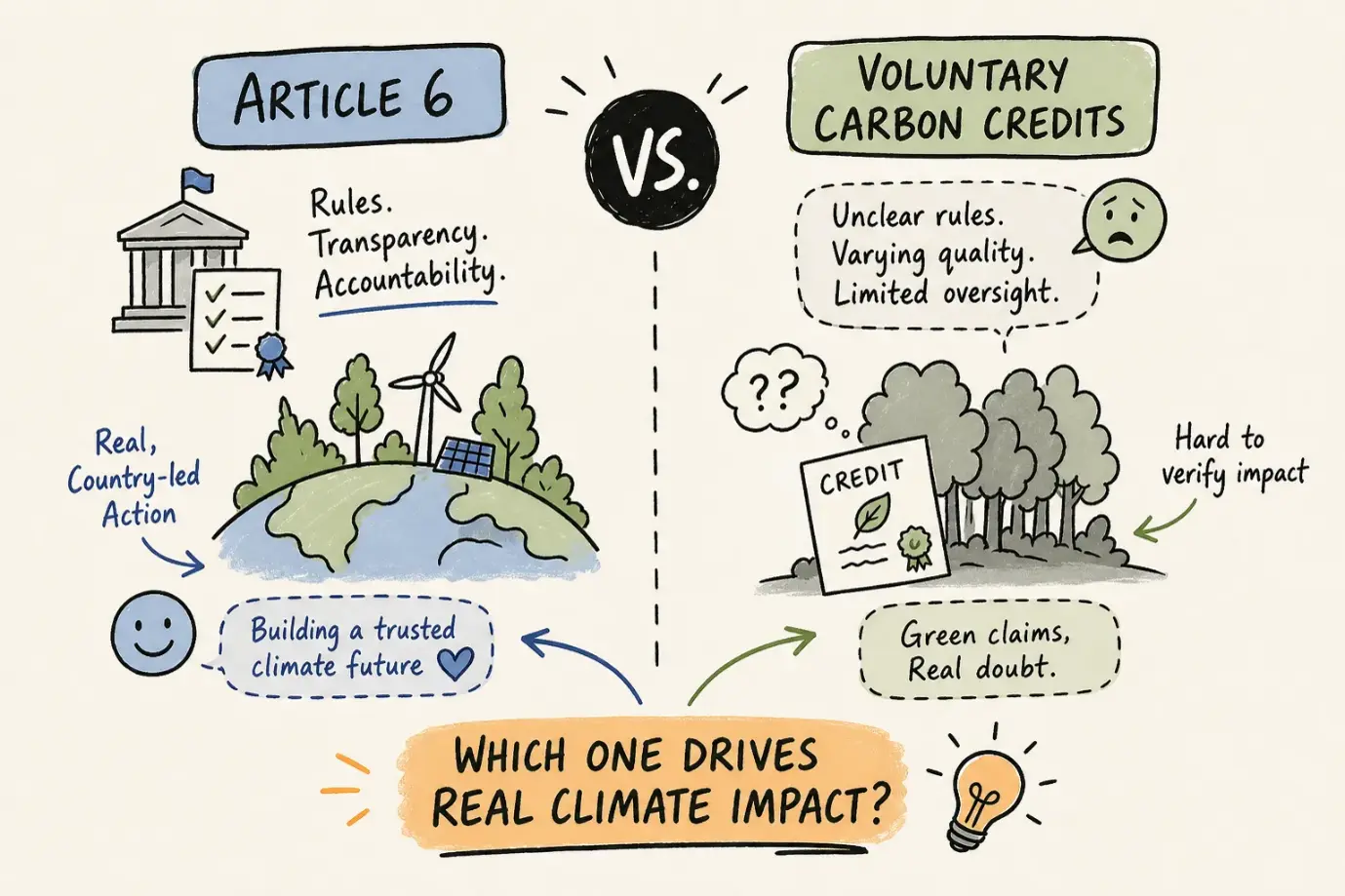
Understanding the difference between Article 6 and voluntary carbon market credits is...
Carbon neutral vs net zero: two terms, both sound green, both are...
For Singapore businesses, Article 6 carbon credits explained properly can mean the...
Carbon neutrality claims are increasingly visible in Singapore's events industry. Conference programmes...

Green Passport Carbon
Quick Links
More Information
 Optimized by Seraphinite Accelerator