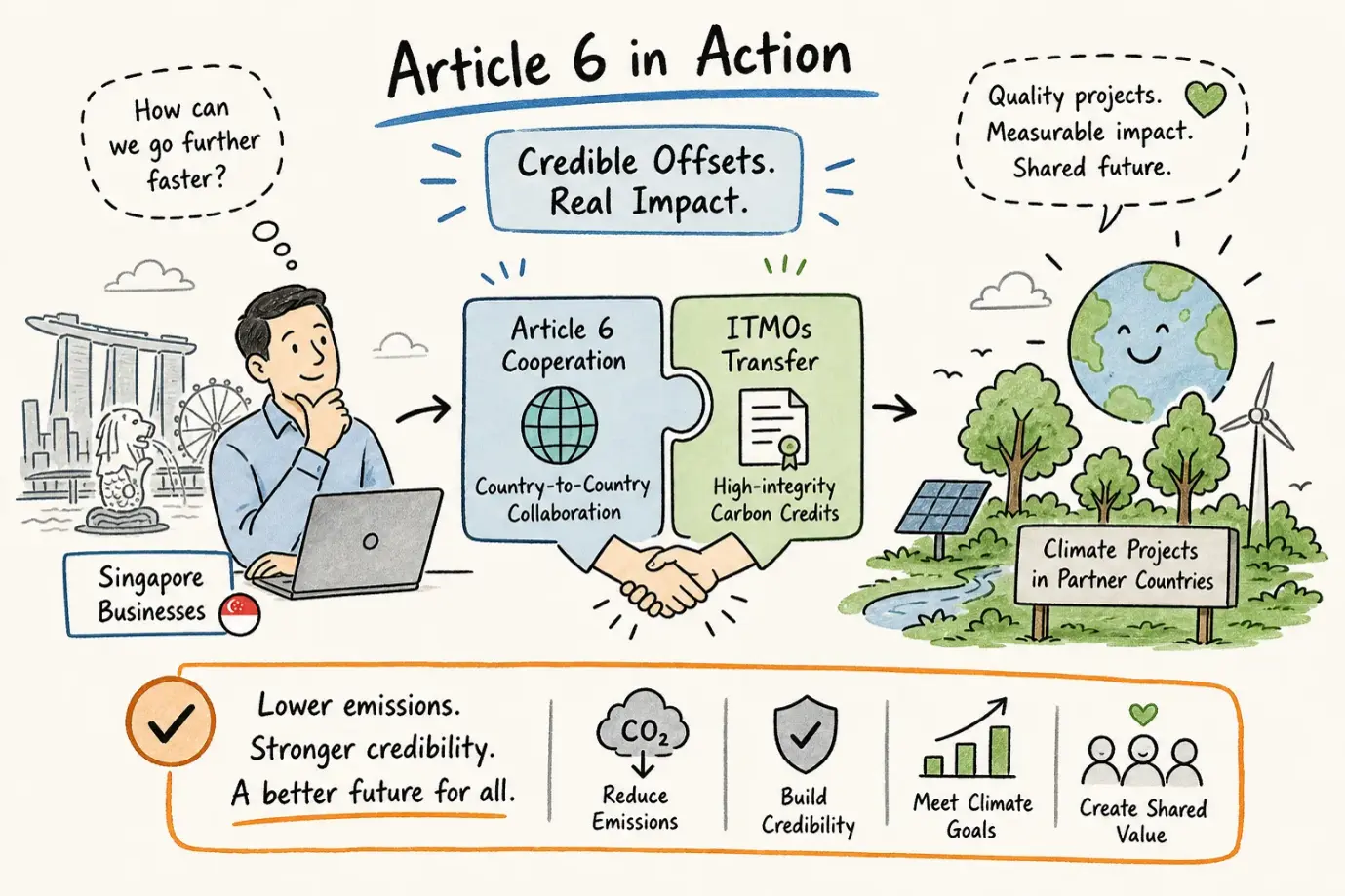
Article 6-aligned offsets explained for Singapore...
Article 6-aligned offsets are no longer just a conference talking point; they...

Green Passport Carbon , Singapore

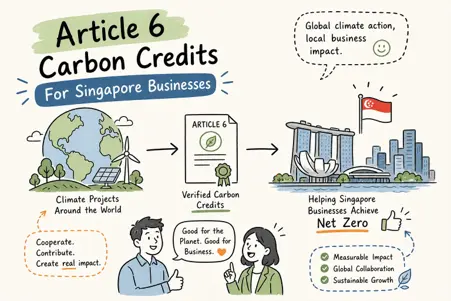
For Singapore businesses, Article 6 carbon credits explained properly can mean the difference between ESG claims that hold up under scrutiny and ones that quietly unravel at audit. “Article 6” gets mentioned constantly at sustainability conferences, ESG panels, and procurement briefings across the city. What gets mentioned far less often is what it actually means for the corporate ESG teams, event organisers, and sustainability leads who are expected to act on it. That gap between the jargon and the practical reality is where carbon credit purchases go wrong.
Singapore is not a passive observer here. The country has signed bilateral Article 6.2 implementation agreements with 12 countries as of October 2026, from Vietnam and Thailand to Ghana and Papua New Guinea, and has embedded Article 6 requirements directly into its carbon tax offset framework. The rules around international carbon credits are changing in real time, and businesses that treat this as background noise are taking on accounting and reputational risk they probably have not priced in.
Providers such as Green Passport Carbon now offer event carbon services in Singapore that combine an emissions estimate with the retirement of eligible carbon credits, which makes credible carbon action more practical than it used to be. This article explains what Article 6 means mechanically, why it matters for your ESG reporting, and what due diligence looks like before you retire a single credit.
Article 6 of the Paris Agreement is not one policy. It is a framework with three distinct mechanisms, each with different governance structures, and only two of them involve carbon credit trading at all.
Article 6.2 allows countries to cooperate bilaterally to transfer what the Agreement calls internationally transferred mitigation outcomes, or ITMOs. It is an accounting framework rather than a centralised market: two countries agree the rules between themselves, and the transfers are tracked accordingly. This is the mechanism most directly relevant to Singapore’s current activity. The critical concept here is the corresponding adjustment: when a host country transfers a mitigation outcome, it deducts that reduction from its own national accounting, so the same tonne of CO₂e cannot be counted twice, once by the seller country and once by the buyer.
Article 6.4 creates a centralised, UNFCCC-governed crediting system comparable in design to the Kyoto Protocol’s Clean Development Mechanism. Projects generate credits through independently verified emission reductions, registered under UN oversight and subject to approved methodologies. The mechanism began issuing credits in February 2026, when the first issuance was approved for a cookstove project in Myanmar, and it will matter increasingly as institutional infrastructure matures. Unlike 6.2, it is standardised and institutionally controlled rather than bilateral.
Article 6.8 covers non-market cooperation: technology transfer, policy coordination, finance, and adaptation collaboration. No credits are issued and no trading occurs. This dimension is worth understanding because it shapes how host countries approach bilateral negotiations, even if it produces no tradeable instruments. For practical credit decisions, most businesses can focus on 6.2 and 6.4.
Singapore has moved faster on Article 6.2 implementation agreements than most countries in Asia. As of October 2026, Singapore had signed or substantively concluded Implementation Agreements with Papua New Guinea, Ghana, Bhutan, Chile, Peru, Rwanda, Paraguay, Thailand, Vietnam, Mongolia, the Philippines, and Lao PDR. That breadth matters because it means Singapore-recognised Article 6 credits carry a government-to-government framework behind them, not just a private standard body’s approval.
Under Article 6.2, a credit only qualifies as genuinely Article 6-aligned if the host country has formally authorised it for international transfer. Without that authorisation, the host country may still count the same emission reduction toward its own nationally determined contribution (NDC). That is the double counting concern. It is decisive for compliance use, while for voluntary claims Singapore’s guidance asks buyers to disclose whether a corresponding adjustment applies. Host-country authorisation, tracked in registry records, is the first quality signal a buyer should check before any purchase or retirement.
Singapore’s integrity criteria for eligible international carbon credits (ICCs) require Article 6-aligned credits to carry the corresponding adjustment. Credits eligible for Singapore’s carbon tax have therefore passed both project-integrity and national-accounting checks. For businesses making public ESG claims, this can be a useful signal that the reduction is not counted by two countries. However, Singapore’s October 2025 guidance also states that a corresponding adjustment does not by itself indicate credit quality, and that it is not required for voluntary corporate claims.
Scrutiny around greenwashing has intensified significantly over the past two years. Standard voluntary carbon market credits have faced credibility challenges because, in principle, the same emission reduction can be counted by the project developer, the buyer, and the host country simultaneously. Corresponding adjustments under Article 6 eliminate that problem at the sovereign level.
When a business retires a standard voluntary credit, the host country of the underlying project may still count that same reduction toward its own NDC. The physical emission reduction may well have occurred, but the claim that the buyer has “offset” a tonne of CO₂e is contested at the accounting level. Investors, report reviewers, and standard-setters are increasingly scrutinising exactly this point, and companies that cannot demonstrate clean audit trails are finding their climate claims challenged.
For Singapore businesses reporting under SGX or preparing disclosures aligned with ISSB climate standards, using Article 6-aligned credits with verified corresponding adjustments can give the carbon claim a cleaner audit trail. Under timelines revised by ACRA and SGX RegCo in August 2025, all listed companies report Scope 1 and 2 emissions from FY2025, while full ISSB-based climate disclosures apply first to STI constituents, with other listed companies following from FY2028 or FY2030, and MAS guidance for financial institutions emphasises that gross and net emissions metrics should be presented separately so that carbon credit use does not obscure actual emissions performance. Whatever credits are used, they should be disclosed separately from gross emissions, together with whether they carry a corresponding adjustment.
A common misconception is that Article 6 credits are a route around Singapore’s carbon tax. They are not. The carbon tax is the primary domestic price signal, and Article 6 credits fit into it as a capped compliance flexibility, not a replacement.
From 1 January 2024, companies liable under Singapore’s carbon tax regime can use eligible ICCs to offset up to 5% of their taxable emissions per year. Those credits must satisfy Singapore’s seven environmental integrity principles: not double counted, additional, real, quantified and verified, permanent, free from net harm, and free from leakage. With the carbon tax at S$45/tCO₂e in 2026 and 2027, with a view to reaching S$50 to S$80/tCO₂e by 2030, the compliance cost relief from this 5% allowance is real money for larger emitters. The 5% cap also means the carbon tax remains the dominant domestic signal, by design.
Businesses that are not carbon tax-liable but want to make carbon neutrality claims for events, products, or corporate reports sit in the voluntary category. For them, Article 6-aligned credits are not a compliance requirement, but they are a quality marker. Using them voluntarily can show stakeholders that the credits have met government eligibility checks, although a corresponding adjustment does not by itself determine credit quality, so project-level due diligence is still needed.
The risks here are manageable with proper due diligence, but they are real enough that buying the wrong credits can create legal exposure, accounting complications, and reputational damage. Treat this as a checklist, not a theoretical exercise.
Additionality means the emission reduction would not have happened without the carbon project’s revenue. If the underlying project was financially viable independently of carbon credit income, the credit does not represent a genuine climate benefit. Vintage refers to when the reduction occurred: Singapore’s framework requires credits representing reductions between 1 January 2021 and 31 December 2030. Credits outside that window are ineligible for the compliance offset regime, and older vintages deserve extra scrutiny for voluntary claims.
Before retiring any credit, confirm three things in the relevant registry:
The credit has been issued and not previously retired.
The host country has provided formal authorisation and corresponding adjustment documentation.
The emission reductions have been independently validated and verified under the crediting programme’s methodology.
These checks are basic but frequently skipped by buyers sourcing credits through brokers who do not surface the underlying documentation. If the seller cannot provide registry evidence for each of these points, that is a clear signal to walk away.
Using Article 6-aligned credits to support a carbon neutrality claim is defensible when framed correctly. Using them to imply that a company has decarbonised when gross emissions are not actually falling is not. Frame claims transparently: the credits represent verified offsetting of residual emissions, not a substitute for internal reduction. Disclosing the project type, vintage, registry, and corresponding adjustment status alongside your claim is both good practice and increasingly expected by report reviewers and investors.
The due diligence described above sounds demanding, and for most businesses, especially those managing events rather than building a dedicated carbon programme, sourcing, verifying, and retiring Article 6-aligned credits through separate registries and intermediaries is genuinely complex. Most event organisers and corporate sustainability teams do not have the specialist knowledge to navigate host-country authorisation records, ITMO tracking, and retirement documentation alongside their core responsibilities.
Providers such as Green Passport Carbon can absorb much of that complexity. Built specifically for Singapore’s MICE and events sector, Green Passport Carbon integrates an emissions estimate, the retirement of eligible carbon credits with documented retirement records, and a branded Green Passport Carbon certificate into one Calculate, Retire, Certify process. Event organisers and corporate sustainability teams do not need to source credits and reconcile retirement records separately. The certificate carries a unique ID and verification link and can support ESG reporting; it is not an ISO certification or an independent third-party verification. Where a client specifically needs Article 6-authorised credits with a corresponding adjustment, that status should be confirmed and documented for the specific credits before retirement. The calculator itself is free and gives a Free Event Carbon Estimate; the Full Event Carbon Assessment, carbon-credit retirement and the Green Passport Carbon Event Certificate are provided as part of Green Passport Carbon’s quote-based service.
For organisations hosting annual conferences, corporate meetings, or recurring MICE events, this reduces the specialist knowledge needed for the credit-sourcing step. Get in touch with the Green Passport Carbon team to find out how the service applies to your specific event type and reporting requirements.
For Singapore businesses, Article 6 carbon credits explained above are not an abstract concept for climate negotiators. Singapore is actively building them into its domestic carbon framework, and the distinction between Article 6-aligned credits and standard voluntary credits is becoming material for ESG reporting, compliance planning, and stakeholder credibility right now.
Three principles cut through the complexity. Corresponding adjustments prevent double counting at the national accounting level. Host-country authorisation is the first quality check before any purchase or retirement. Singapore’s seven integrity criteria set a clear bar for eligible credits, and the 5% offset allowance under the carbon tax gives liable businesses a concrete compliance use case worth calculating. For voluntary buyers, particularly in the events space, Article 6-aligned credits can add credibility, but their quality still needs to be checked project by project.
Working with providers who document credit selection and retirement clearly is the most practical starting point for businesses that want credible carbon action without building specialist sourcing capability from scratch. The framework exists, the bilateral agreements are in place, and the credits are accessible. What remains is choosing to use them properly.
Article 6-aligned offsets are no longer just a conference talking point; they...
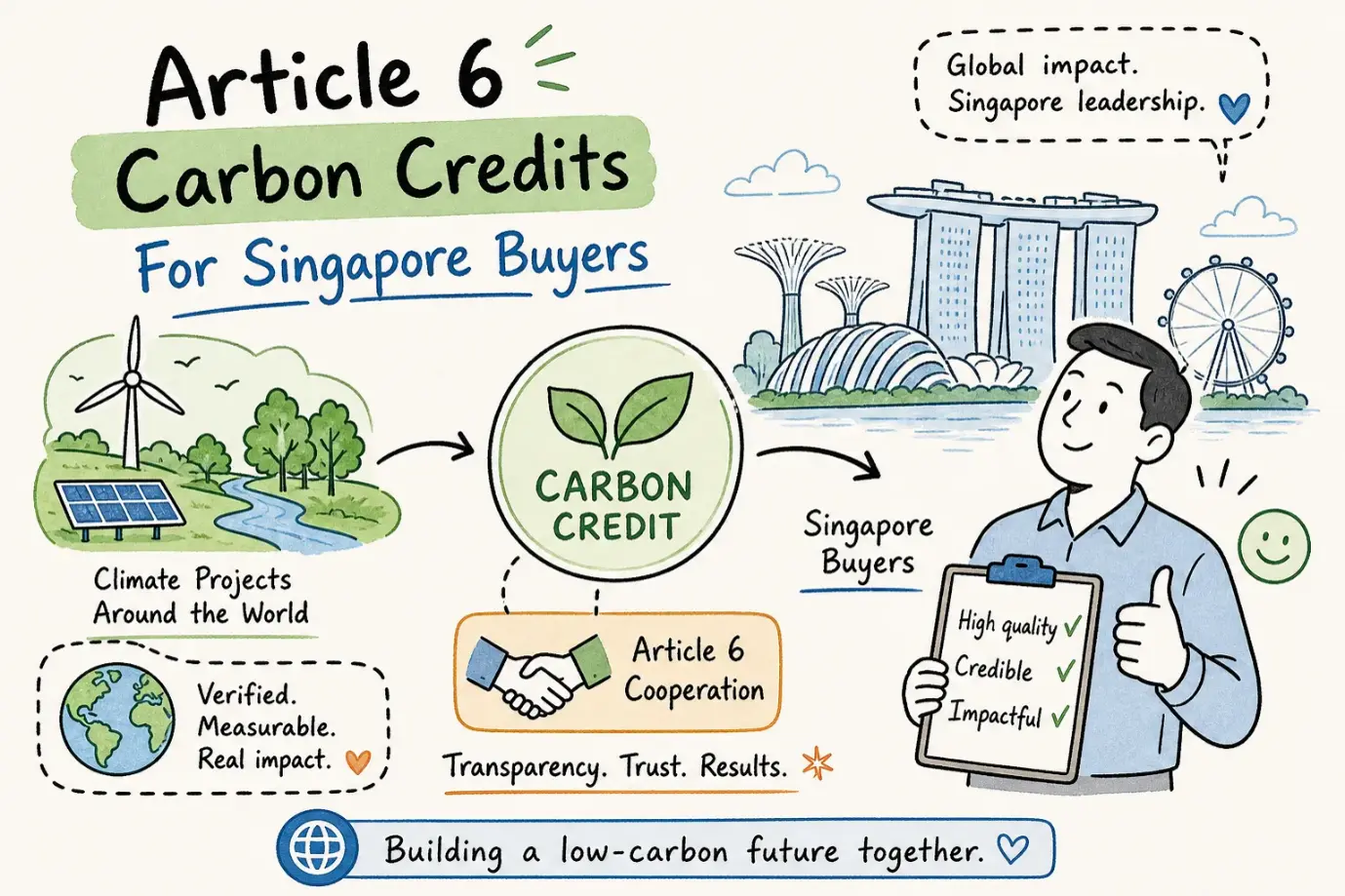
Article 6 carbon credits are fundamentally different from standard voluntary offsets, and...
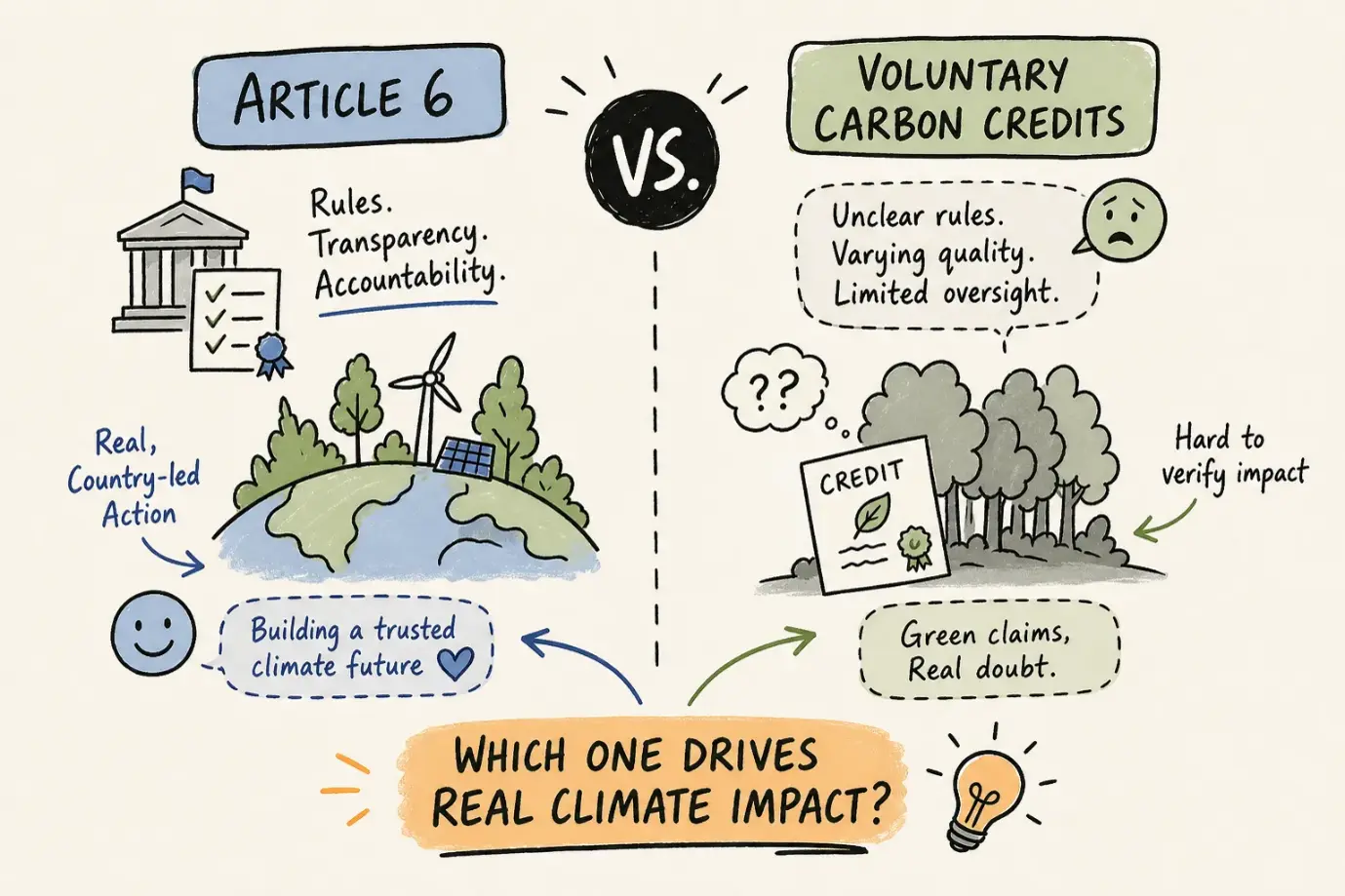
Understanding the difference between Article 6 and voluntary carbon market credits is...
Find quick answers about the Event Carbon Calculator, your emissions estimate, and what happens next.
There is no official threshold. The most cited reference is approximately 14.13 kg CO2 per attendee for venue-related emissions, with energy the dominant contributor. Note this excludes attendee travel, so a full-scope per-attendee figure will typically be higher. Treat it as a comparative benchmark for the venue category rather than a pass mark for the whole event.
Yes. SACEOS has published WA 4: Sustainable MICE — Guidelines for Carbon Emissions Management, a Singapore Standards workspace agreement covering measurement, reduction, calculation, verification and offset. Separately, the Singapore MICE Sustainability Certification (MSC) provides GSTC-Recognised organisational certification, and STB and SACEOS will develop a MICE Decarbonisation Framework by 2028.
Air-conditioning, lighting and audiovisual systems run continuously through operating hours regardless of attendee behaviour, making venue energy a structural and relatively predictable load. In Singapore’s climate, cooling demand is both unavoidable and substantial. This is why the MICE Venue Sustainability Playbook points to emissions per square foot of venue area as a comparable metric.
Yes — and then raised them. By 2025 the original roadmap targets were exceeded, with all purpose-built MICE venues and over 80% of SACEOS member companies certified. Roadmap 2.0, unveiled in July 2026, commits to a MICE Decarbonisation Framework by 2028 and net zero by 2050.
No. MSC certifies the organisation across domains including carbon, waste, energy, water, social responsibility, HR competency and procurement, valid for two years. It does not produce a per-event footprint figure or evidence that a specific event’s emissions were addressed. Those are separate exercises.
Article 6-aligned offsets are no longer just a conference talking point; they...
Article 6 carbon credits are fundamentally different from standard voluntary offsets, and...
Understanding the difference between Article 6 and voluntary carbon market credits is...
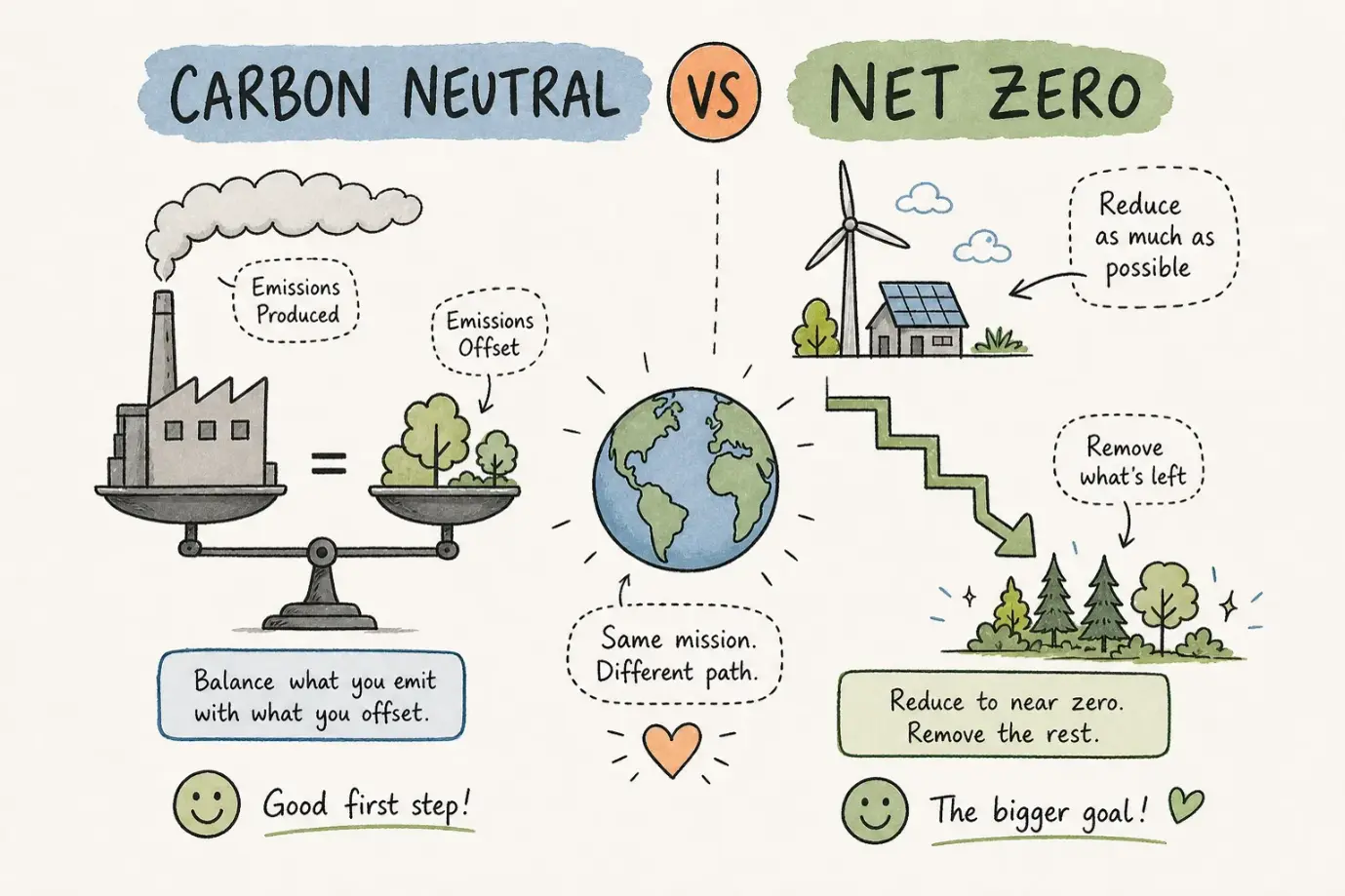
Carbon neutral vs net zero: two terms, both sound green, both are...
For Singapore businesses, Article 6 carbon credits explained properly can mean the...
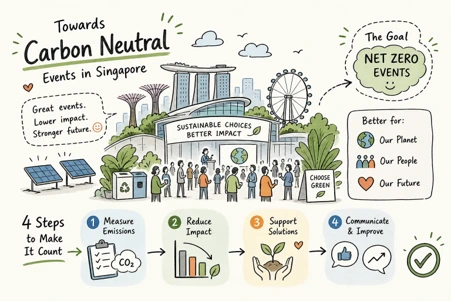
Carbon neutrality claims are increasingly visible in Singapore's events industry. Conference programmes...

Green Passport Carbon
Quick Links
More Information
 Optimized by Seraphinite Accelerator