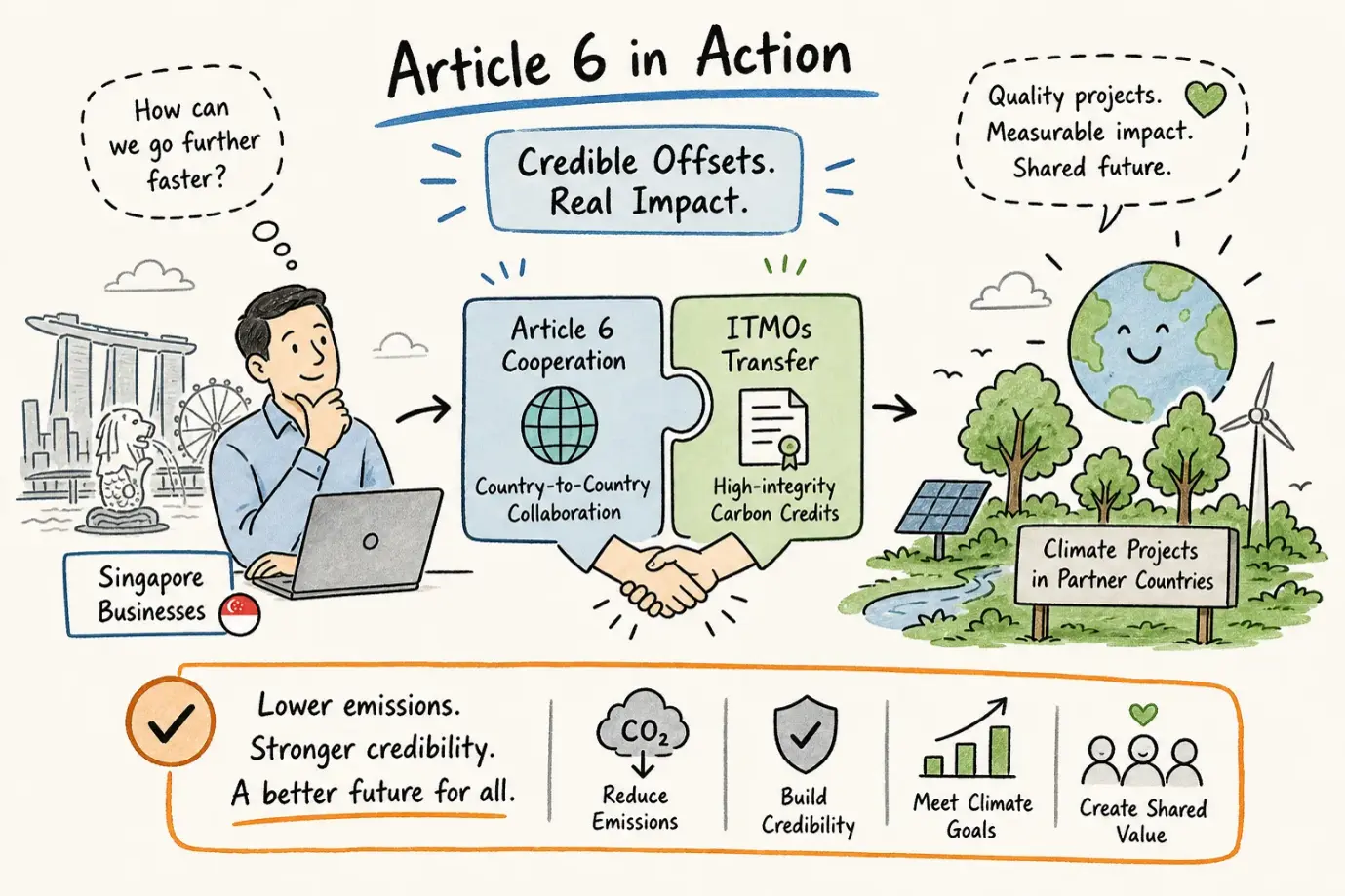
Article 6-aligned offsets explained for Singapore...
Article 6-aligned offsets are no longer just a conference talking point; they...

Green Passport Carbon , Singapore

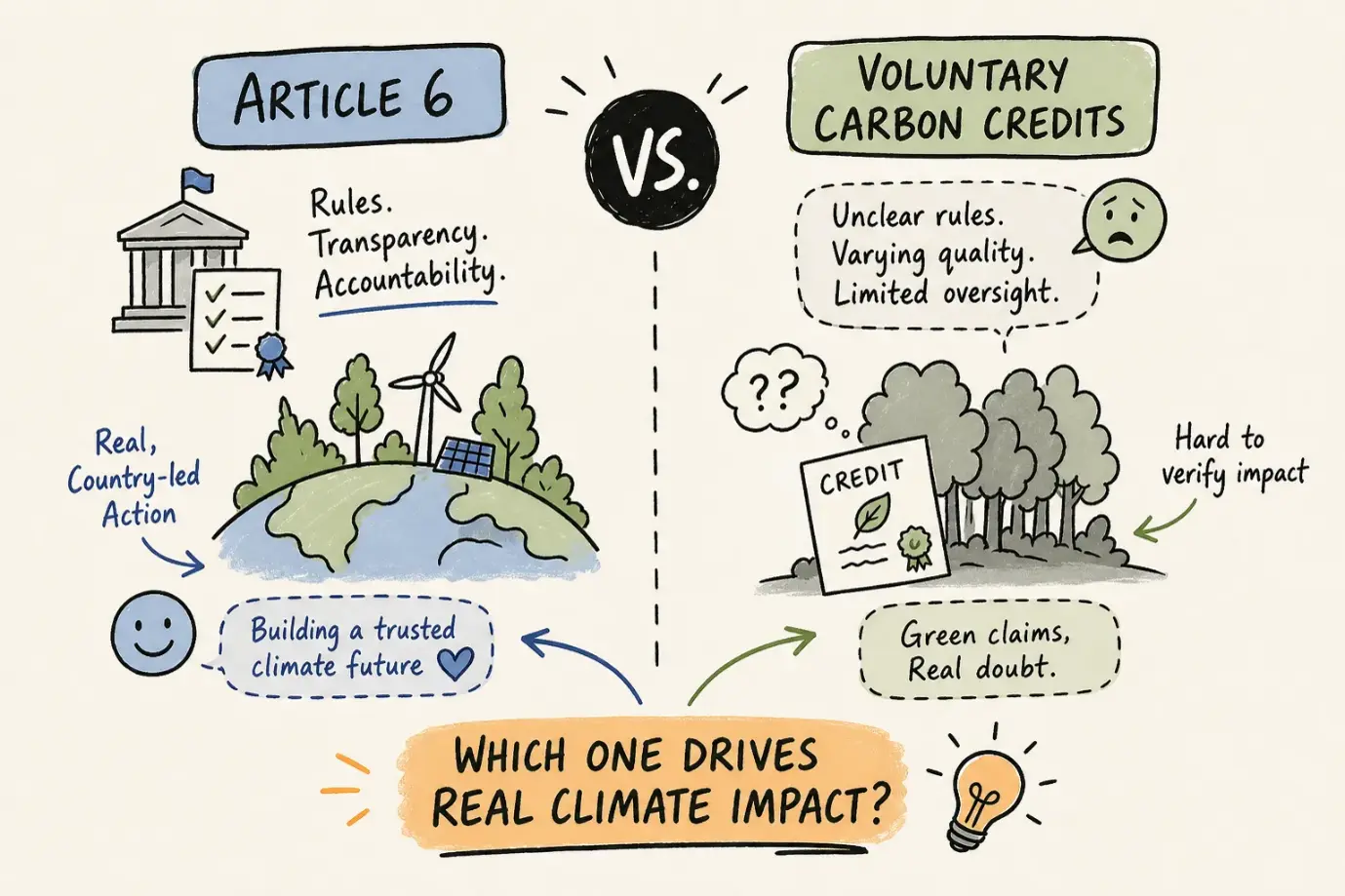
Understanding the difference between Article 6 and voluntary carbon market credits is more consequential than most buyers realise. Many organisations purchasing carbon credits assume all offsets work the same way. They don’t. The label “carbon credit” covers instruments with fundamentally different governance frameworks, accounting rules, and levels of credibility for ESG disclosure. Confusing them is one of the most frequently cited sources of greenwashing risk in sustainability reporting, and it is a risk that is getting harder to ignore as regulators pay closer attention.
For Singapore companies navigating SGX and ACRA climate reporting requirements and Green Plan 2030 commitments, retiring the wrong type of credit and then discovering the claim doesn’t hold is not a theoretical problem. It is a compliance and reputational one. At Green Passport Carbon, we help clients understand these differences before credits are retired against their event footprint, because the differences are material. This article explains what those differences are, plainly and without the jargon.
By the end, you’ll be able to explain both credit types, spot the quality signals that separate credible claims from weak ones, and ask the right questions before your next carbon procurement decision.
Article 6 of the Paris Agreement created the rules for countries to cooperate on climate action across borders. Credits issued under this framework are not a private market product. They are instruments that sit inside national greenhouse gas accounting, authorised at the sovereign level and tracked through UNFCCC-linked registries. Voluntary carbon market (VCM) credits, by contrast, are issued by private standards bodies and generally operate outside that treaty framework. The distinction matters, and it shows up in pricing, accountability, and the defensibility of any ESG claim built on these credits.
Article 6 of the Paris Agreement created the rules for countries to cooperate on climate action across borders. Credits issued under this framework are not a private market product. They are instruments that sit inside national greenhouse gas accounting, authorised at the sovereign level and tracked through UNFCCC-linked registries.
Article 6.2 allows countries to transfer Internationally Transferred Mitigation Outcomes (ITMOs) to help each other meet their Nationally Determined Contributions (NDCs). The defining feature is that the host country formally authorises the credit and applies a corresponding adjustment to its own national accounts. The first completed ITMO transfer occurred between Switzerland and Thailand in January 2024. Singapore has since signed bilateral implementation agreements with 12 countries as of October 2026, including Papua New Guinea, Thailand and Lao PDR, making it one of the most active Article 6.2 participants in the region.
The Paris Agreement Crediting Mechanism (PACM), operating under Article 6.4, is the centralised, UN-supervised track. Think of it as the successor to the Clean Development Mechanism, but with stricter oversight, tighter baseline rules, and clearer accountability structures. The first credits under this mechanism were approved for issuance in February 2026 for a cookstove project in Myanmar, a milestone that confirmed the mechanism is now operational. Both Article 6.2 and Article 6.4 share the corresponding adjustment requirement when credits are used for international purposes, which is what separates them from ordinary VCM credits.
Voluntary carbon market credits are issued by private standards bodies: Verra’s Verified Carbon Standard, Gold Standard, and others. These are credible organisations with rigorous methodologies. But they operate outside the Paris Agreement’s accounting framework. There is no treaty obligation, no host-country authorisation requirement, and historically, no mandatory corresponding adjustment.
The governance gap is real and specific. VCM credits are verified by third-party auditors against a private standard. Article 6 credits are authorised by sovereign governments and tracked through UNFCCC-linked registries. The underlying emission reduction can be identical in both cases. The difference is entirely about who governs it, who stands behind it, and how it is accounted for across national borders.
VCM credits have faced serious scrutiny over the past three years. Over-crediting, weak additionality, and business-as-usual baselines have undermined confidence in older credits, particularly avoidance-based credits in forestry and cookstoves. Gold Standard’s response has been unambiguous: credits with a vintage from 1 January 2026 onwards must be quantified using Paris Agreement-aligned methodologies, with stronger additionality rules and updated baselines. That is an acknowledgement that the old rules were not sufficient.
The corresponding adjustment (CA) is the single most important concept in this comparison. It is the mechanism that prevents one emission reduction from being counted twice: once by the host country toward its NDC, and again by the corporate buyer for its own ESG claim.
When a country authorises a credit for international use, it adds that mitigation outcome back to its own emissions tally. The buyer country or corporate buyer then subtracts it from theirs. One reduction. One claim. No overlap. Without this step, both sides are effectively counting the same tonne of CO₂, which is precisely what double counting means. The corresponding adjustment is the accounting guardrail that closes that gap.
For purely voluntary claims, a corresponding adjustment is not legally required today. Singapore’s October 2025 guidance confirms this and adds that a corresponding adjustment does not by itself indicate credit quality. Some stakeholders still see the absence of one as a credibility question. If the host country also counts the same reduction toward its own NDC, the corporate buyer’s claim is built on contested ground. As regulatory scrutiny of ESG disclosures tightens across Singapore and internationally, this is exactly the type of integrity gap that leads to greenwashing findings. This is why buyers should disclose the corresponding-adjustment status of their credits and avoid overstating what an offset claim represents.
The governance and accounting differences described above translate directly into ESG reporting credibility. Singapore’s regulatory environment is moving quickly: SGX and ACRA climate reporting requirements and mounting pressure from international business partners all mean that the quality of your carbon claim will be scrutinised, not simply accepted at face value.
Singapore is an active participant in Article 6 bilateral agreements, and that participation has a direct bearing on domestic credibility. Article 6-aligned credits, backed by corresponding adjustments and sovereign authorisation, are preferred by some buyers and international initiatives for offsetting claims. Singapore’s own voluntary carbon market guidance, however, states that corresponding adjustments do not apply to voluntary corporate commitments and do not by themselves indicate credit quality. In practice, credits with a corresponding adjustment can strengthen some claims, while every credit still needs project-level due diligence and transparent disclosure.
Prices vary widely and change quickly, so any figure should be checked at the time of purchase. As one public reference point, Singapore’s September 2025 contract for 2.175 million tonnes of Article 6-aligned nature-based credits was valued at about S$76 million, or roughly S$35 per tonne, while many older voluntary avoidance credits have traded far lower. The gap partly reflects authorisation, accounting and project-quality requirements, and a significantly cheaper credit often signals weaker integrity rather than a bargain. Durable carbon removal credits, such as biochar, usually cost considerably more because of their permanence. Removal credits address permanence; Article 6 authorisation addresses national accounting. Both matter, and neither replaces project-level due diligence.
Before purchasing and retiring any carbon credits for an ESG disclosure or event carbon neutrality certificate, ask these questions. They are designed to surface the quality signals that separate Article 6-aligned credits from weaker VCM alternatives, and to protect your claim from the integrity gaps described above. Understanding how Article 6 differs from voluntary carbon market credits is only useful if that understanding translates into better procurement decisions.
Is the credit authorised by the host country under Article 6 rules?
Has a corresponding adjustment been applied by the host country?
Which registry tracks the credit, and how is retirement documented?
What methodology version was used, and is it Paris Agreement-aligned for 2026 vintages?
Can the provider supply a Letter of Authorisation from the host government?
Watch for unusually cheap credits with limited project or registry documentation. Watch for credits from projects flagged for over-crediting, such as older forestry REDD+ schemes or unverified cookstove programmes operating under pre-2026 methodologies. Watch for providers who cannot confirm registry retirement details or sovereign authorisation. These are not fringe scenarios. A substantial segment of the current VCM spot market consists of credits that look adequate on paper until a regulator or auditor examines the underlying documentation.
Green Passport Carbon’s carbon retirement process is designed with the ESG credibility risk described throughout this article in mind. When the integrity of a carbon claim matters for an annual report, a client pitch, or a public-facing sustainability communication, the foundation of that claim has to hold up.
When Green Passport Carbon retires eligible credits on behalf of an event organiser or corporate client, the retirement is documented and linked to the event record. Where a client needs Article 6-authorised credits, their host-country authorisation, corresponding-adjustment status and UNFCCC-linked registry record should be confirmed for the specific credits before retirement. That gives the claim, whether for a Green Passport Carbon certificate, an ESG report or a sustainability communication to attendees, a documented foundation. The calculator itself is free and gives a Free Event Carbon Estimate; the Full Event Carbon Assessment, carbon-credit retirement and the Green Passport Carbon Event Certificate are provided as part of Green Passport Carbon’s quote-based service.
ISO 14068-1, the international standard for carbon neutrality claims (revised in September 2026 as ISO 14068:2026), requires reductions to be prioritised and residual emissions to be offset with carbon credits that meet quality criteria and are retired. Article 6-aligned credits can help meet those expectations, but the standard does not require them, and a Green Passport Carbon certificate is not an ISO certification. Organisations that want to state conformity with the standard need to meet all of its requirements and, if they want independent assurance, commission verification from a competent third party. For Singapore organisations demonstrating carbon action across MICE events, corporate meetings or annual conferences, the credits you retire and how you document them determine how well the claim holds up.
Article 6 credits sit inside the Paris Agreement’s international accounting framework. They require sovereign authorisation and carry a corresponding adjustment that prevents double counting. VCM credits are governed by private standards, serve voluntary claims, and generally do not carry that accounting protection, creating real ESG credibility risk as regulatory scrutiny increases.
The difference between Article 6 and voluntary carbon market credits is not theoretical. It shows up in pricing, registry documentation, regulatory recognition, and the defensibility of your sustainability claims. For Singapore organisations navigating SGX and ACRA climate reporting, Green Plan 2030 commitments, or MICE event carbon certification, choosing the right credit type is a decision that matters. Getting it wrong is not a technicality; it is a material risk to the credibility of everything your sustainability programme is trying to demonstrate.
If you’re unsure whether your current carbon credits meet this standard, Green Passport Carbon offers a straightforward way to assess your position and retire eligible carbon credits with documentation your ESG report can rely on. Get in touch with our team to find out where your current approach stands.
Article 6-aligned offsets are no longer just a conference talking point; they...
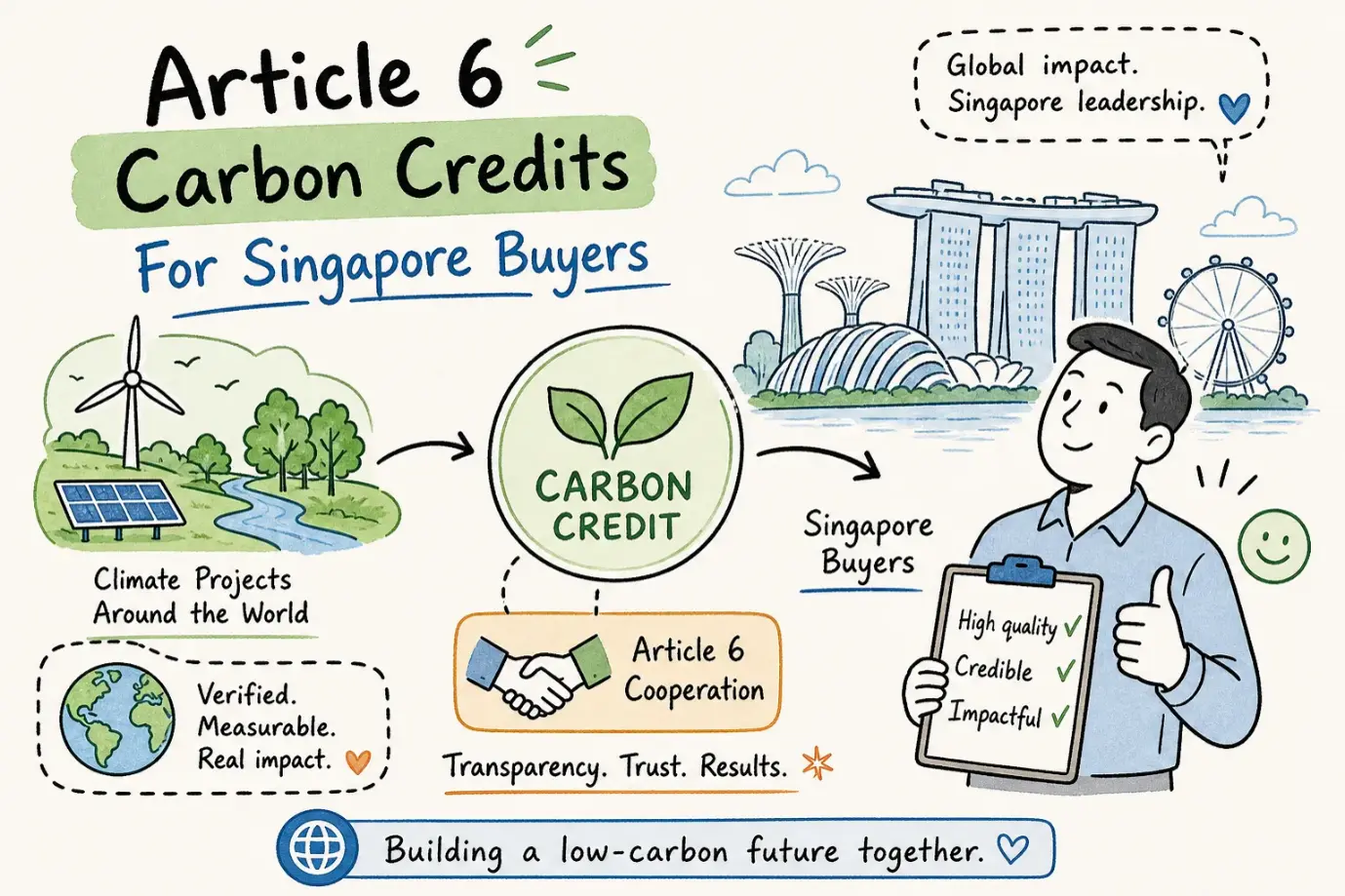
Article 6 carbon credits are fundamentally different from standard voluntary offsets, and...
For Singapore businesses, Article 6 carbon credits explained properly can mean the...
Find quick answers about the Event Carbon Calculator, your emissions estimate, and what happens next.
There is no official threshold. The most cited reference is approximately 14.13 kg CO2 per attendee for venue-related emissions, with energy the dominant contributor. Note this excludes attendee travel, so a full-scope per-attendee figure will typically be higher. Treat it as a comparative benchmark for the venue category rather than a pass mark for the whole event.
Yes. SACEOS has published WA 4: Sustainable MICE — Guidelines for Carbon Emissions Management, a Singapore Standards workspace agreement covering measurement, reduction, calculation, verification and offset. Separately, the Singapore MICE Sustainability Certification (MSC) provides GSTC-Recognised organisational certification, and STB and SACEOS will develop a MICE Decarbonisation Framework by 2028.
Air-conditioning, lighting and audiovisual systems run continuously through operating hours regardless of attendee behaviour, making venue energy a structural and relatively predictable load. In Singapore’s climate, cooling demand is both unavoidable and substantial. This is why the MICE Venue Sustainability Playbook points to emissions per square foot of venue area as a comparable metric.
Yes — and then raised them. By 2025 the original roadmap targets were exceeded, with all purpose-built MICE venues and over 80% of SACEOS member companies certified. Roadmap 2.0, unveiled in July 2026, commits to a MICE Decarbonisation Framework by 2028 and net zero by 2050.
No. MSC certifies the organisation across domains including carbon, waste, energy, water, social responsibility, HR competency and procurement, valid for two years. It does not produce a per-event footprint figure or evidence that a specific event’s emissions were addressed. Those are separate exercises.
Article 6-aligned offsets are no longer just a conference talking point; they...
Article 6 carbon credits are fundamentally different from standard voluntary offsets, and...
Understanding the difference between Article 6 and voluntary carbon market credits is...
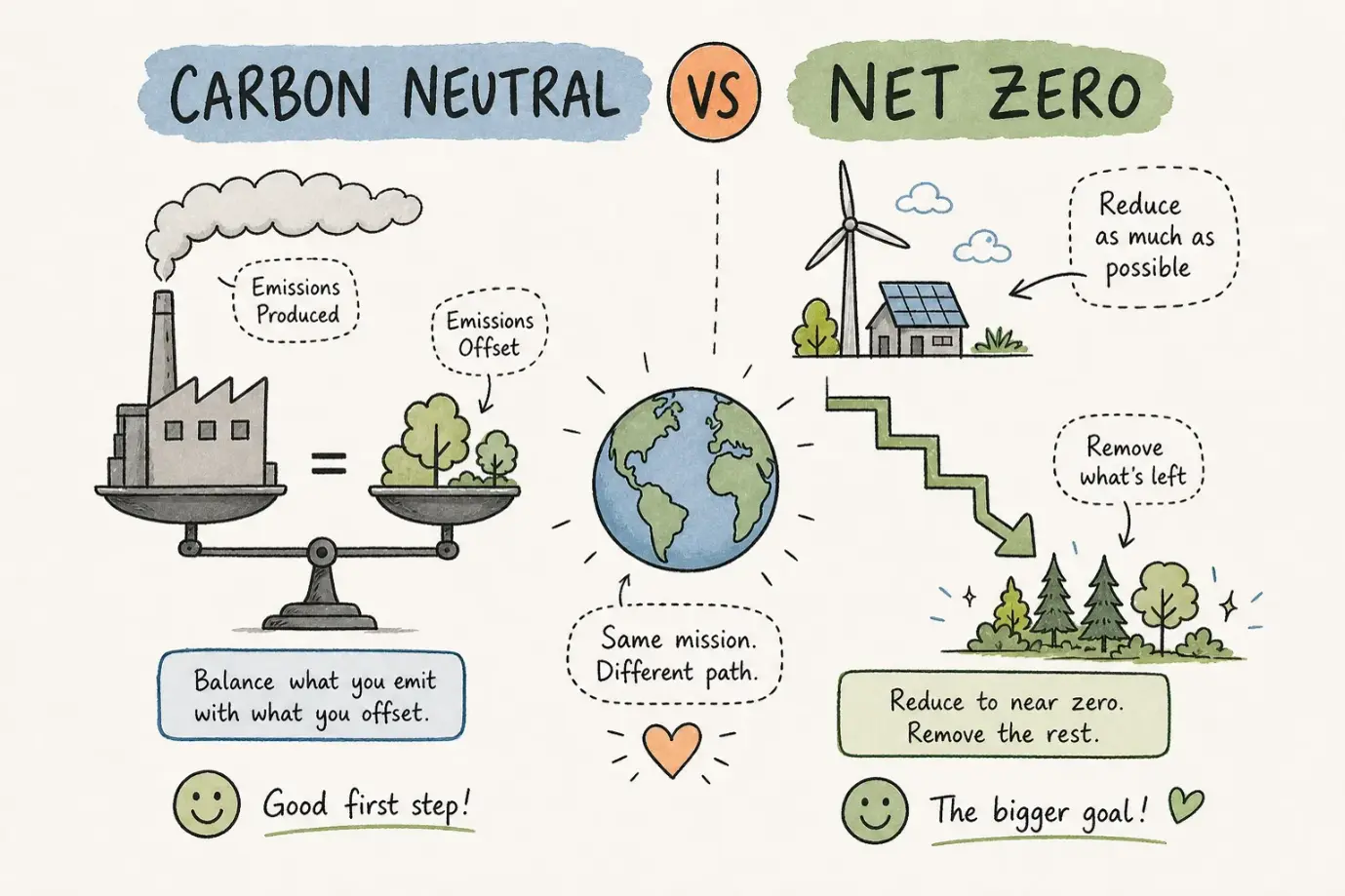
Carbon neutral vs net zero: two terms, both sound green, both are...
For Singapore businesses, Article 6 carbon credits explained properly can mean the...
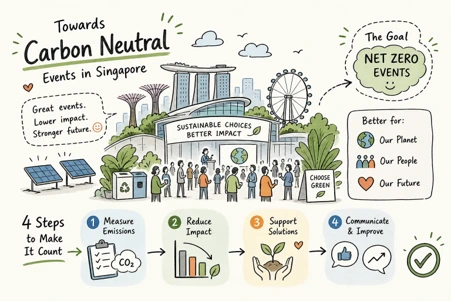
Carbon neutrality claims are increasingly visible in Singapore's events industry. Conference programmes...

Green Passport Carbon
Quick Links
More Information
 Optimized by Seraphinite Accelerator