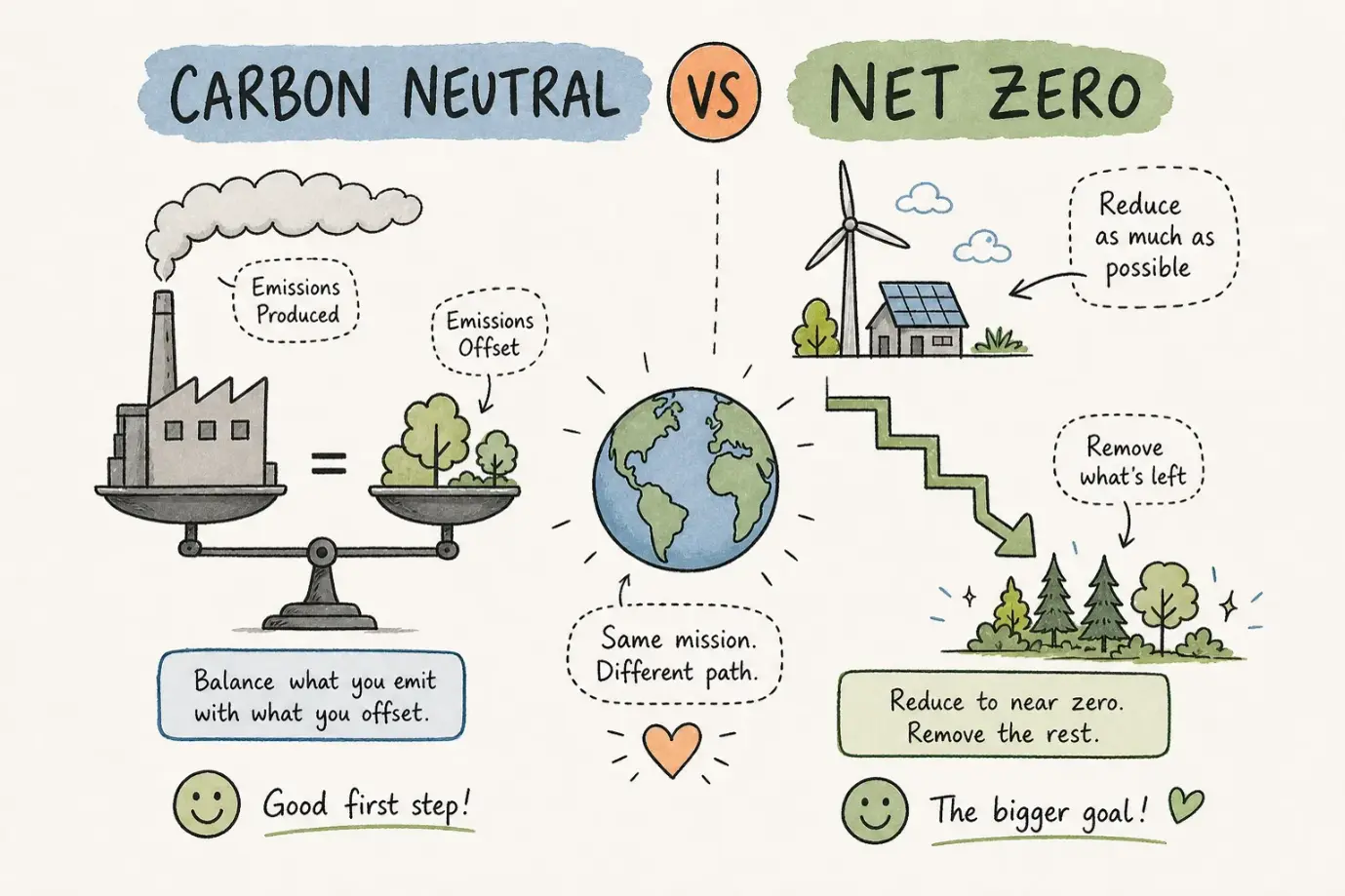
Carbon neutral vs net zero: what’s...
Carbon neutral vs net zero: two terms, both sound green, both are...

Green Passport Carbon , Singapore

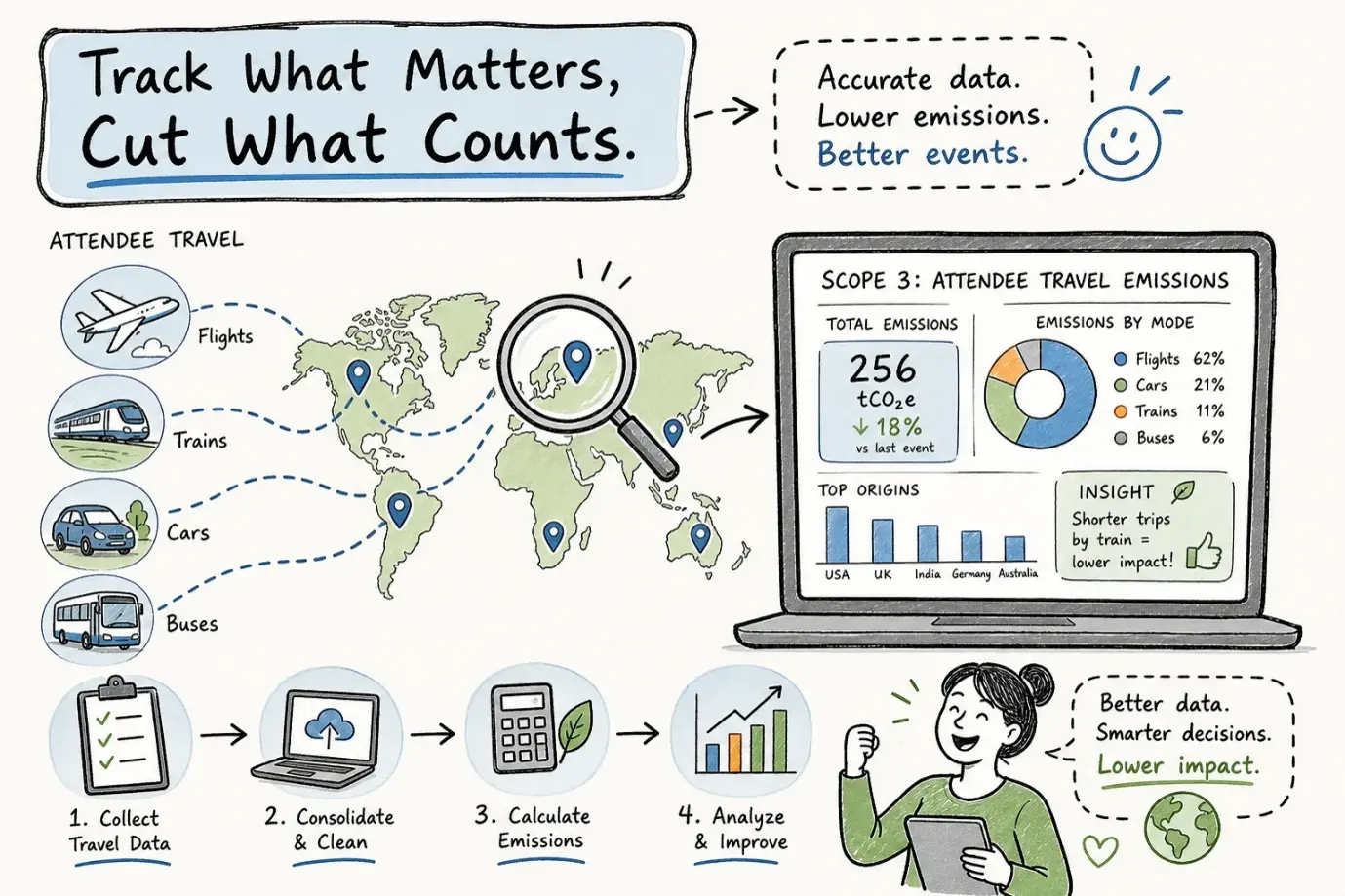
How do I accurately track Scope 3 emissions from attendee travel at a corporate event? It is one of the most common questions sustainability teams face, and one of the most poorly answered. Attendee travel is frequently a major source of emissions at a corporate event, often the largest single contributor when delegates are flying internationally. For a mid-sized Singapore conference with a significant share of international attendees, delegate travel can account for a substantial portion of the total event carbon footprint, though the precise share varies depending on event type, format, and the geographic spread of your audience. Yet tracking Scope 3 emissions from attendee travel accurately is the category most sustainability teams either skip entirely or handle with methodology that some assurance reviewers would question. The problem isn’t only that data is hard to collect. It starts earlier: with a classification error that many teams make before they’ve captured a single response.
At Green Passport Carbon, a Singapore-based carbon solutions provider focused on the MICE sector, attendee travel is treated as a core component of event carbon calculations, with an approach informed by GHG Protocol guidance and ISO 14068-1 principles. This guide walks through a robust methodology: how to classify attendee travel correctly, how to build a data collection workflow that holds up in practice, how to select emission factors and model complex itineraries, and how to document uncertainty in a way that satisfies ESG reporting standards.
The most common classification mistake in event carbon reporting is treating all travel as Category 6: Business Travel. Category 6 covers transportation of employees of the reporting company travelling for business-related activities in third-party vehicles. That definition does not stretch to cover external attendees. If your delegates are not on your company’s payroll, Category 6 does not apply to their travel.
The GHG Protocol Scope 3 Standard does not include transportation of event attendees in its standard list of 15 categories. The GHG Protocol FAQ explicitly names “transportation of attendees to conferences/events” as a Scope 3 activity that sits outside the category list and should be reported separately, typically under an “other” Scope 3 category or as an event-specific disclosure. Category 7 (Employee Commuting) is equally inapplicable because attendees are not travelling between home and a worksite of the reporting company.
Classifying attendee travel as “other Scope 3” requires deliberate, event-specific methodology rather than slotting numbers into a standard template. It also creates a documentation obligation. GHG Protocol guidance recommends transparent methodology statements when reporting outside the standard 15 categories; placing attendee travel in Category 6 without explanation is likely to draw questions from assurance reviewers, who will typically expect to see a clear rationale for the classification approach used. A methodology statement explaining why attendee travel is reported separately and what method was applied is what makes the disclosure credible and ready for review.
The biggest driver of inaccuracy when tracking Scope 3 emissions from attendee travel is not methodology. It is data quality. A technically correct calculation applied to poor inputs still produces a poor output. The most effective approach is a hybrid workflow that draws on several sources, each serving a distinct role.
Embedding travel-origin questions in the event registration or RSVP form typically yields higher completion rates than post-event surveys, because attendees are completing the form anyway to secure their place. The fields to capture at this stage are: home city or postcode, likely travel mode, and whether travel will be international or domestic. Registration data serves as a baseline, not a final figure. Accuracy is lower at this stage because plans change, and some attendees genuinely don’t know yet how they’ll travel.
Post-event surveys ask attendees what they actually did, making them the most accurate self-report method available. The trade-off is response rate. Industry benchmarks for corporate MICE post-event sustainability surveys typically cluster between 10 and 20 percent, with 20 to 30 percent achievable when surveys are sent quickly, kept short, and embedded in the post-event thank-you email. Keeping the survey under five questions and tying completion to something tangible, such as receiving a conference summary or a sustainability impact report, improves completeness. Attendees who don’t respond are handled through extrapolation using the documented defaults covered later in this guide.
Where attendees booked travel through a managed travel platform or corporate travel agency, booking export data provides an objective source: confirmed origin, travel mode, cabin class, and travel dates from actual reservations rather than self-report. Check-in systems, whether QR, RFID, or app-based, confirm actual attendance and can be linked to registration records to eliminate no-shows from the calculation. Neither source replaces survey data entirely, but together they close the gaps that surveys leave and improve dataset completeness considerably.
Emission factor selection is where technically sound work either holds up or falls apart. The factors you choose, and whether they include aviation radiative forcing, will materially affect the accuracy of your event travel emissions calculation. For Singapore-based events, a combination of DEFRA/DESNZ international benchmarks and local factors from Singapore’s Emission Factors Registry (SEFR) provides a defensible approach.
Aviation emissions at altitude have a warming effect beyond the direct CO₂ released. This is captured by the radiative forcing index (RFI). The DEFRA/UK Government conversion factor datasets publish aviation emission factors in two versions: without RF and with RF already embedded. Use the “with RF” version directly and do not apply a separate multiplier on top. According to DEFRA/DESNZ conversion factor guidance, combining the two results in double-counting. If you’re working with a CO₂-only aviation factor from another source, DEFRA’s 2025 methodology recommends a central multiplier of 1.7, applied to the CO₂ component only. DEFRA publishes separate flight factor sets, including flights to and from the UK and international flights between other countries, and the values differ, so state which set you used. Indicative with-RF figures from the DEFRA 2025 dataset: long-haul economy at approximately 0.117 kg CO₂e per passenger-km, short-haul economy at approximately 0.126 kg CO₂e per passenger-km, and domestic flights at approximately 0.229 kg CO₂e per passenger-km.
Rail, coach, car, and taxi factors are applied per passenger-kilometre with no radiative forcing adjustment. Indicative DEFRA-aligned figures: national rail at approximately 0.031 kg CO₂e per passenger-km, coach at approximately 0.028 kg CO₂e per passenger-km, and taxi at approximately 0.149 kg CO₂e per passenger-km. Car factors are typically published per vehicle-kilometre, so occupancy must be treated as a separate input.
Singapore’s SEFR (Singapore Emission Factors Registry) is the appropriate local reference for MRT journeys, at roughly 0.01 kg CO₂e per passenger-km; check the current value in the registry before applying it. For modes where no Singapore-specific factor is available, DEFRA factors serve as a recognised international benchmark, and this choice should be documented explicitly in your methodology statement.
Most attendee journeys are not a single straight-line trip. A delegate flying from London to a Singapore conference may connect through Dubai, take a taxi from Changi to the hotel, and return via a different route. Treating the entire journey as one data point introduces significant error. The leg-by-leg method resolves this by isolating each segment, allowing the correct distance measurement and emission factor to be applied at every stage.
The correct approach is to calculate emissions for each segment of a trip independently, then sum those segment figures to produce the total trip emissions for that attendee. For each leg: identify the mode, determine the distance using great circle distance for flights or mapped route distance for surface travel, apply the appropriate emission factor, and record the result. Summing across all legs gives the full trip total. Summing across all attendees gives the event total for this emissions source.
For shared modes like coaches or rideshares, vehicle-level emissions are divided across the number of occupants to arrive at a per-passenger figure. Car trips require an explicit occupancy assumption when attendee data doesn’t provide one. For aviation, cabin class matters significantly. DEFRA 2025 with-RF factors show long-haul business class at approximately 0.339 kg CO₂e per passenger-km compared with 0.117 kg CO₂e per passenger-km for long-haul economy. When booking data is available and includes cabin class, applying class-specific factors is not optional for a rigorous calculation. For international MICE events where a substantial portion of attendees fly business class, this adjustment can shift your final figure meaningfully.
You will never achieve 100 percent data completeness. The question is not whether to use default assumptions, but which defaults are defensible and how to document them so your Scope 3 inventory holds up under scrutiny.
When attendee origin is missing, a documented default distance assumption is acceptable if it is grounded in something verifiable. The US EPA’s Center for Corporate Climate Leadership event emissions guidance suggests a 12-mile one-way local travel assumption for attendees without stated origin, based on average local travel distances from US travel statistics. This figure may not translate directly to a Singapore context, so it should be treated as a reference point rather than a default to adopt uncritically, document your reasoning if you adapt it for local conditions. The key requirement is that the assumption is plausible for your specific event context, stated explicitly, and applied consistently across all cases with missing data, not selectively. Using a conservative default for some attendees and a generous one for others without documented justification undermines the credibility of your entire inventory.
A credible Scope 3 inventory entry for attendee travel should document the following:
• The share of attendees with incomplete travel data
• The default assumption applied to each missing field
• The basis for that assumption
• The uncertainty treatment used (sensitivity analysis or scenario range)
• The resulting emissions range under alternative assumptions
Presenting a single point estimate without any uncertainty range implies false precision. A short methodology section in your ESG report covering these points is the minimum standard for a defensible disclosure that will satisfy a sustainability assurance reviewer.
Working through all of the above for every event, every year, carries a real operational load. Many organisations report this as one of the main reasons attendee travel ends up being handled inconsistently, the data-gathering, leg-by-leg modelling, factor selection, and documentation steps each take time, and without a structured process, the calculation can start to unravel by the time it reaches the ESG reporting team.
Green Passport Carbon structures its event carbon calculation to include attendee flights as a defined component of the event footprint, alongside accommodation, electricity, food and beverages, and materials. The calculator produces an indicative estimate, which can then be reviewed and refined with the kind of attendee data and documented emission factors described in this guide, so the travel figure is consistent with the rest of the event inventory. The approach is informed by recognised carbon-accounting principles, including ISO 14068-1, the internationally recognised standard for carbon neutrality claims, which was revised in September 2026 as ISO 14068:2026.
The output from a structured calculation process is not just a number. It includes a methodology statement, a breakdown by emissions source including delegate travel, documentation of default assumptions and data coverage, and, where credits are retired, a branded Green Passport Carbon certificate with a unique certificate ID and verification link. The certificate documents the carbon action taken; it is not an ISO certification or an independent third-party verification. For sustainability teams preparing annual ESG disclosures or responding to client procurement questionnaires, having this documentation already structured and ready for review removes a significant amount of downstream work. Attendee travel, correctly classified, calculated, and documented, stops being a gap in your Scope 3 inventory and becomes a credible, reportable figure. The calculator itself is free and gives a Free Event Carbon Estimate; the Full Event Carbon Assessment, carbon-credit retirement and the Green Passport Carbon Event Certificate are provided as part of Green Passport Carbon’s quote-based service.
The workflow is straightforward once the pieces are in place. Classify attendee travel correctly as “other” Scope 3, not Category 6. Build a hybrid data collection approach anchored in registration forms and post-event surveys, supplemented by booking exports and check-in verification. Use a travel emissions calculator or leg-by-leg modelling approach to handle complex itineraries, use “with RF” aviation factors, and factor in cabin class where the data supports it. Document your defaults and uncertainty transparently so the inventory stands up to review.
Accurately tracking Scope 3 emissions from attendee travel at corporate events is becoming a procurement and regulatory priority for Singapore-based organisations, not just a best-practice aspiration. ESG disclosure expectations are tightening, client procurement questionnaires are becoming more specific, and Singapore’s Green Plan 2030 is creating broader pressure on organisations that host or attend large-scale events to account for the full picture of their emissions. Organisations that get ahead of this now, with structured, documented, assurance-ready event travel emissions reporting, are better positioned as those expectations firm up.
If you want to explore how Green Passport Carbon’s end-to-end event carbon process handles attendee travel calculation as part of a complete event footprint assessment, contact our team to discuss your next event.
Carbon neutral vs net zero: two terms, both sound green, both are...
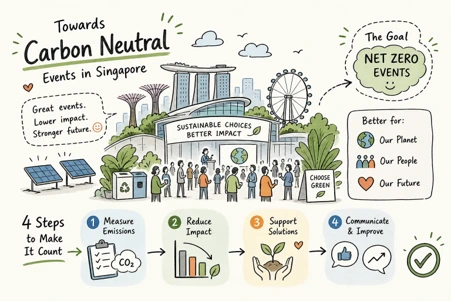
Carbon neutrality claims are increasingly visible in Singapore's events industry. Conference programmes...

Carbon offset solutions for hotel ballrooms and event spaces in Singapore are...
Find quick answers about the Event Carbon Calculator, your emissions estimate, and what happens next.
There is no official threshold. The most cited reference is approximately 14.13 kg CO2 per attendee for venue-related emissions, with energy the dominant contributor. Note this excludes attendee travel, so a full-scope per-attendee figure will typically be higher. Treat it as a comparative benchmark for the venue category rather than a pass mark for the whole event.
Yes. SACEOS has published WA 4: Sustainable MICE — Guidelines for Carbon Emissions Management, a Singapore Standards workspace agreement covering measurement, reduction, calculation, verification and offset. Separately, the Singapore MICE Sustainability Certification (MSC) provides GSTC-Recognised organisational certification, and STB and SACEOS will develop a MICE Decarbonisation Framework by 2028.
Air-conditioning, lighting and audiovisual systems run continuously through operating hours regardless of attendee behaviour, making venue energy a structural and relatively predictable load. In Singapore’s climate, cooling demand is both unavoidable and substantial. This is why the MICE Venue Sustainability Playbook points to emissions per square foot of venue area as a comparable metric.
Yes — and then raised them. By 2025 the original roadmap targets were exceeded, with all purpose-built MICE venues and over 80% of SACEOS member companies certified. Roadmap 2.0, unveiled in July 2026, commits to a MICE Decarbonisation Framework by 2028 and net zero by 2050.
No. MSC certifies the organisation across domains including carbon, waste, energy, water, social responsibility, HR competency and procurement, valid for two years. It does not produce a per-event footprint figure or evidence that a specific event’s emissions were addressed. Those are separate exercises.
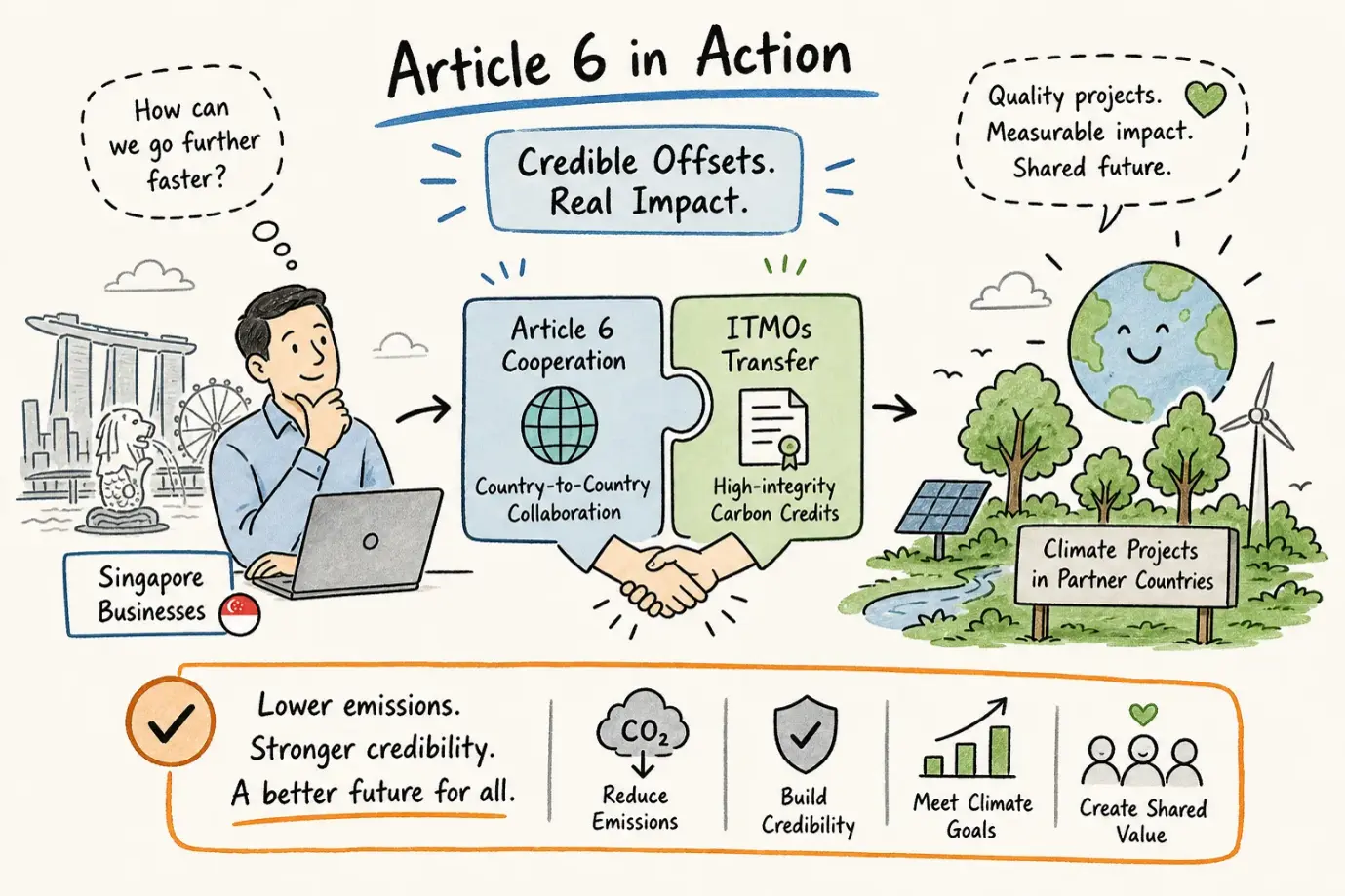
Article 6-aligned offsets are no longer just a conference talking point; they...
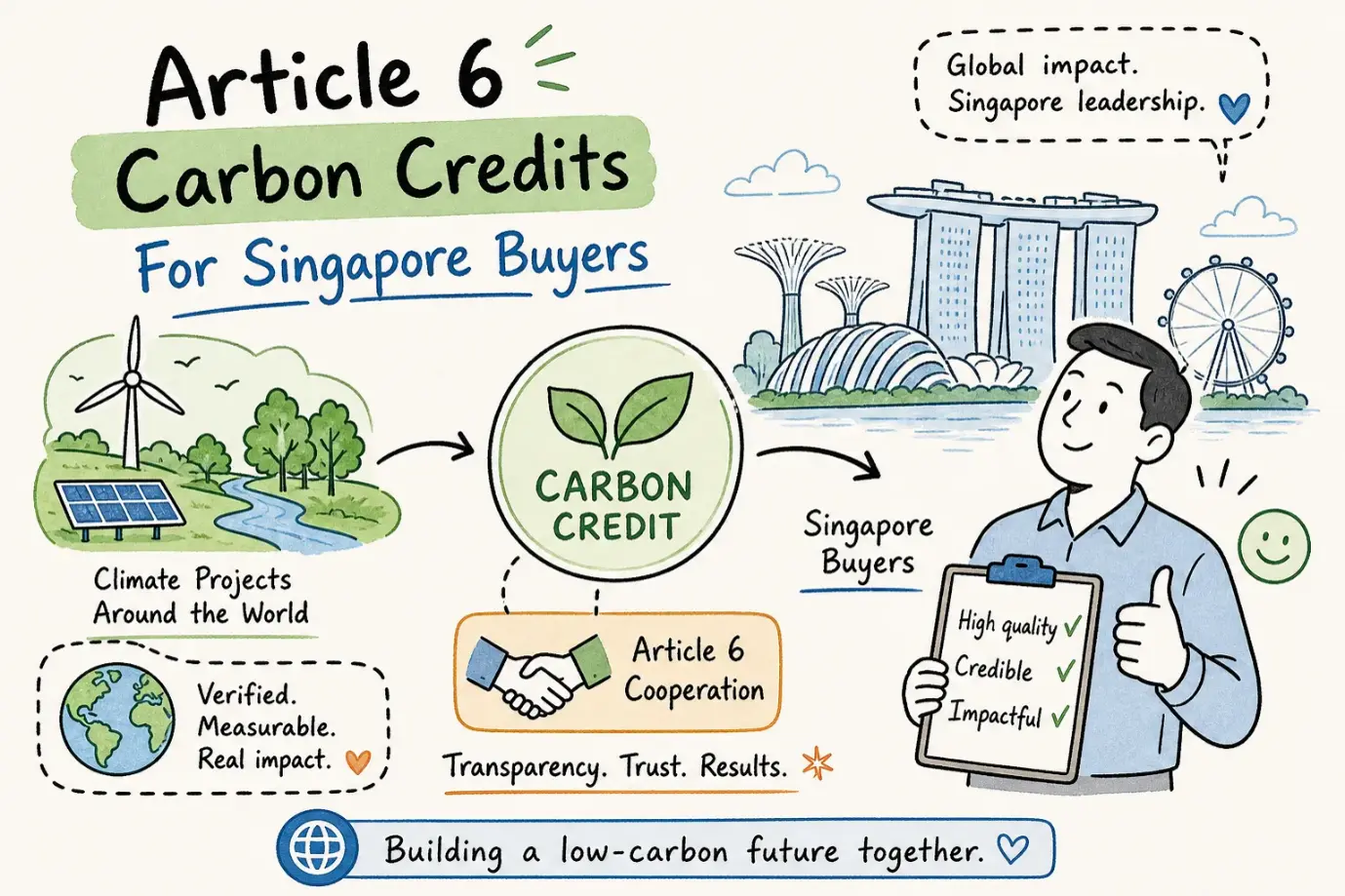
Article 6 carbon credits are fundamentally different from standard voluntary offsets, and...
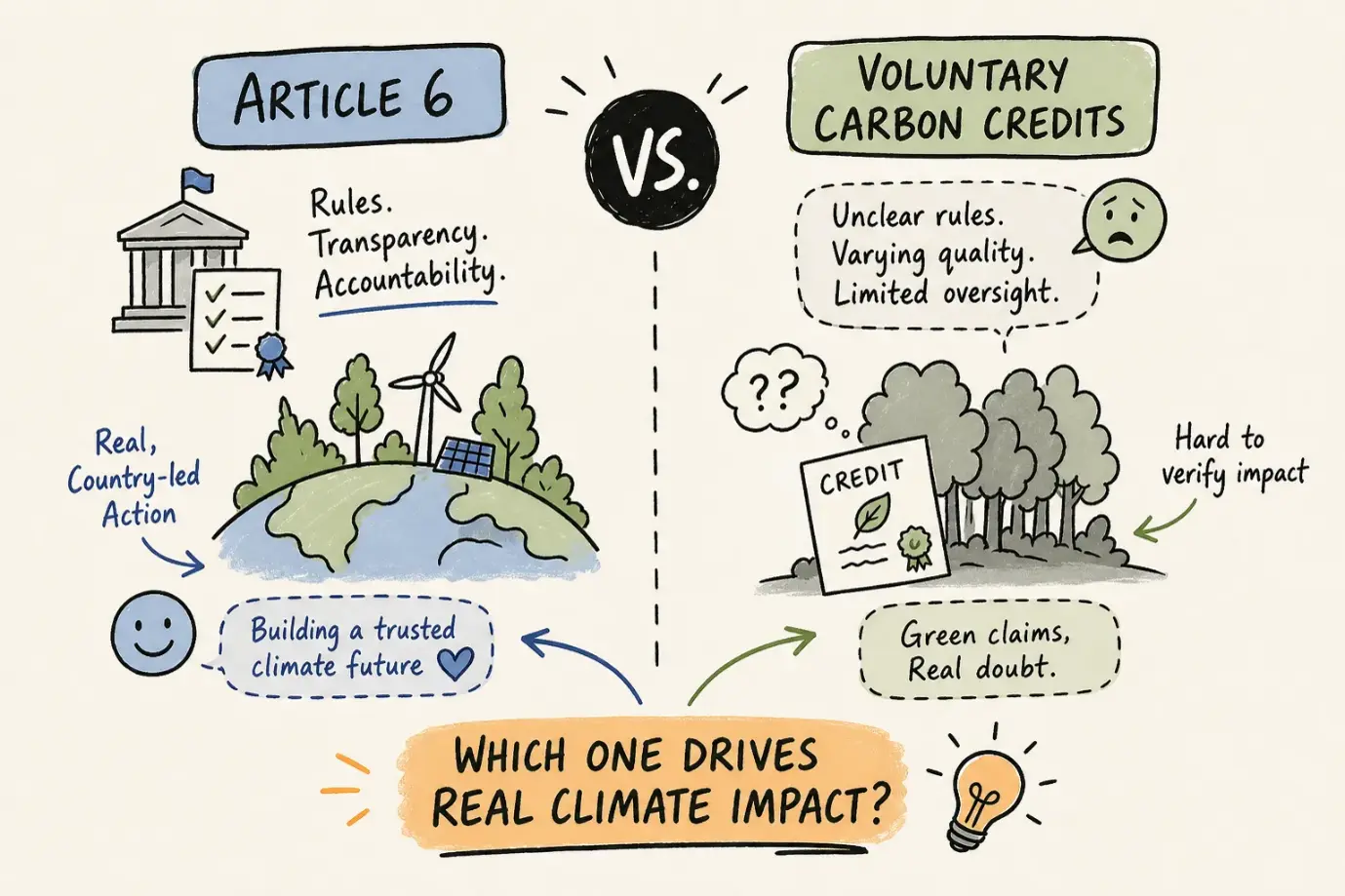
Understanding the difference between Article 6 and voluntary carbon market credits is...
Carbon neutral vs net zero: two terms, both sound green, both are...

For Singapore businesses, Article 6 carbon credits explained properly can mean the...
Carbon neutrality claims are increasingly visible in Singapore's events industry. Conference programmes...

Green Passport Carbon
Quick Links
More Information
 Optimized by Seraphinite Accelerator