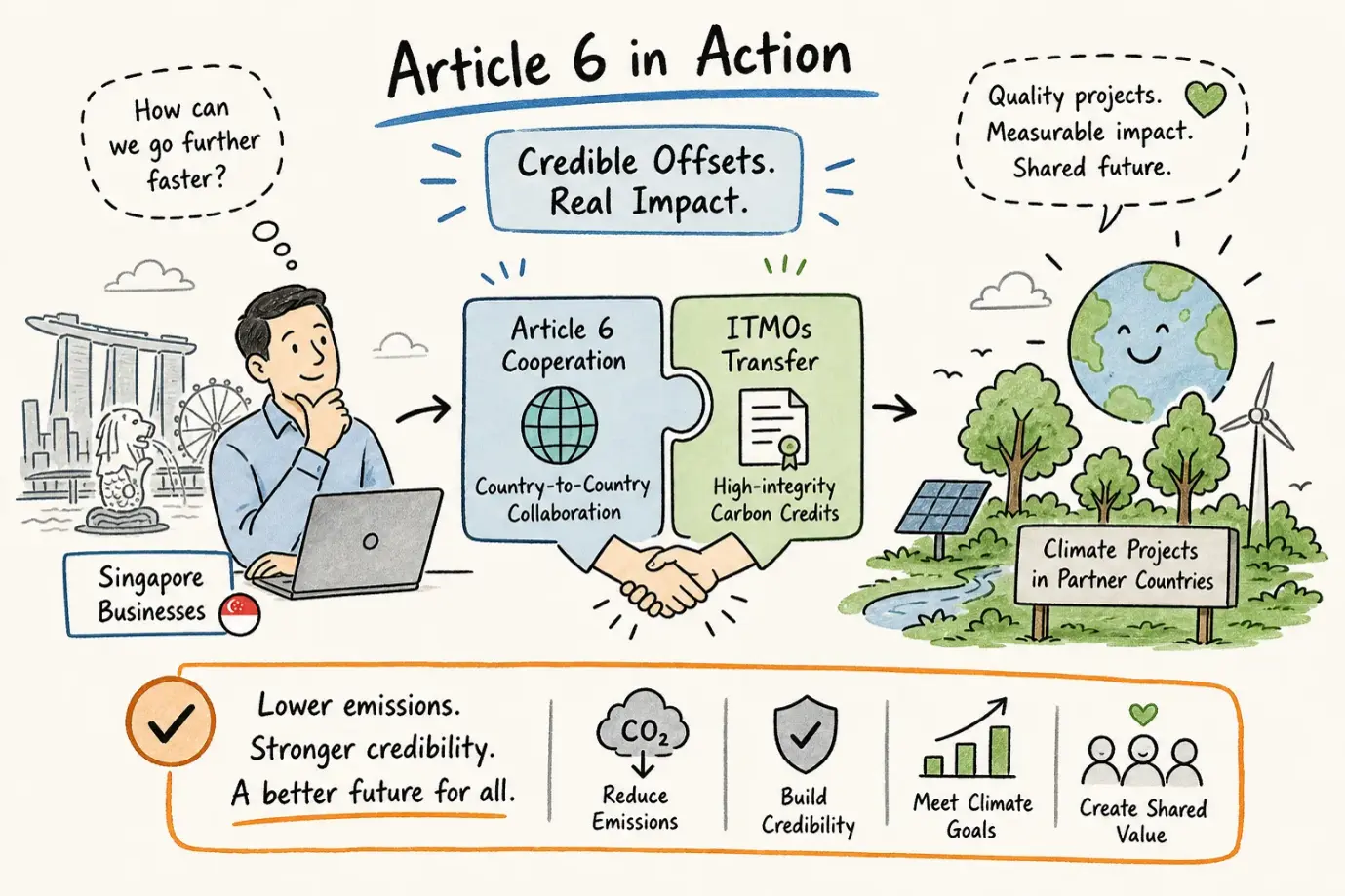
Article 6-aligned offsets explained for Singapore...
Article 6-aligned offsets are no longer just a conference talking point; they...

Green Passport Carbon , Singapore

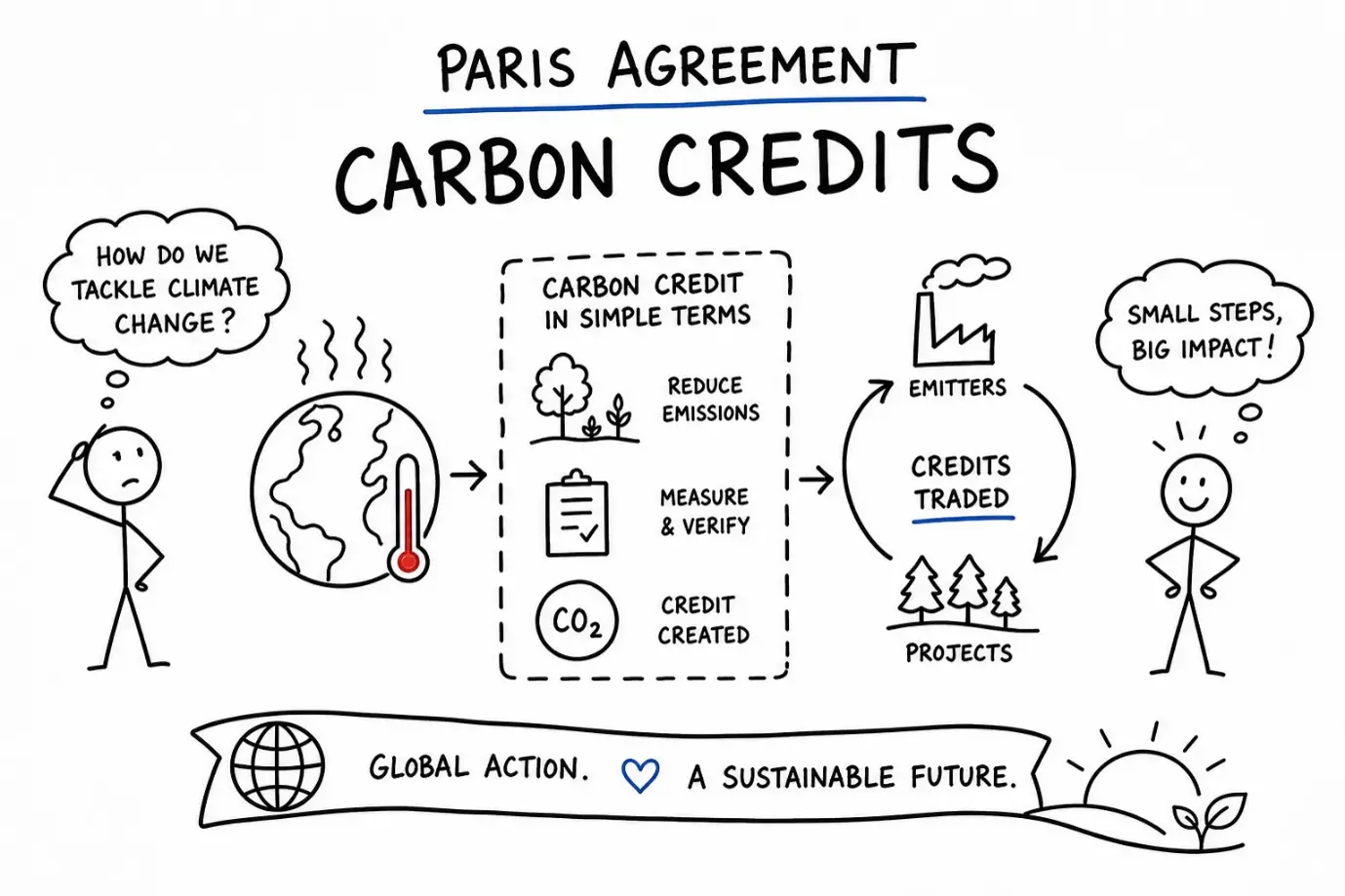
Paris Agreement credits solve a structural problem that affected many carbon credits bought over the past decade, one that few buyers knew about. When a company purchased a voluntary carbon credit and claimed an offset, the host country where the project was located could simultaneously count the same emission reduction toward its own national climate target. One tonne of reduction, two claims. That is not a paperwork error. It is a fundamental flaw baked into how the old voluntary carbon market was designed.
Article 6 of the Paris Agreement was written specifically to fix this. By creating enforceable accounting rules at the treaty level, it establishes a framework where international credit transfers require a corresponding adjustment from the host country, eliminating the double-count at source. The Paris Agreement Crediting Mechanism (PACM), created under Article 6.4, is the centralised UN-supervised system that puts these rules into practice and issues the first credits that operate under them.
This is no longer just policy discussion. The first Article 6.4 credits were issued in February 2026, and specialists in Singapore, including Green Passport Carbon, already help event clients retire eligible carbon credits with documented retirement records. The shift toward higher-integrity standards is gaining momentum across the market. By the end of this article, you will understand how the mechanism works, what makes these credits structurally different, and what your organisation needs to know when buying or retiring offsets today.
The Clean Development Mechanism (CDM) under the Kyoto Protocol was the first major attempt at international carbon crediting. Projects in developing countries were supposed to fund genuine emission reductions, generating credits that industrialised countries could purchase. In practice, CDM suffered from weak additionality tests, inflated baseline assumptions, and oversupply that eventually collapsed credit prices to near zero. Many credits simply did not represent real reductions.
The voluntary carbon market that emerged alongside and after CDM, governed by private standards like Verra and Gold Standard, improved methodology in meaningful ways. But it could not solve one critical problem: host countries were not required to account for credits when foreign companies used them. Consider a solar farm in Vietnam generating credits purchased by a Singapore corporation. The corporation claims the emission reduction in its ESG report. Vietnam simultaneously counts the same reduction toward its nationally determined contribution (NDC). The same tonne does double duty, and neither party is technically breaking any rule because no binding rule prevents it.
Article 6 addressed this directly. It established that when mitigation outcomes are transferred between countries, the host country must apply a corresponding adjustment, removing that reduction from its own national accounts so only the receiving party can claim it. One reduction, one claim. This is the fundamental structural difference that separates Paris Agreement credits issued under the Article 6 framework from everything that came before. Crucially, this is a treaty-level accounting requirement, not a voluntary best practice. It applies whenever an authorised credit is transferred internationally for use toward another country’s climate target, enforced through the formal Paris Agreement architecture. For organisations that want their offset claims to hold up under scrutiny, this distinction matters enormously.
Article 6.2 governs cooperation between countries at a bilateral or multilateral level. When two governments agree to transfer mitigation outcomes between them, those units are referred to as Internationally Transferred Mitigation Outcomes, or ITMOs. Singapore is an active participant in Article 6.2 bilateral agreements, making this directly relevant to how Singapore-sourced credits ultimately get accounted for on the international stage.
It is worth being precise about what an ITMO actually is. It is not a project type. It is an accounting label applied to any mitigation outcome that moves from one country’s national accounts to another’s under a formal government agreement, with corresponding adjustments applied on both sides. The underlying activity can take many forms; what makes it an ITMO is the authorised international transfer.
Article 6.4 goes further by creating a centralised, UN-supervised crediting mechanism. PACM issues tradable units called A6.4ERs through a central international registry governed by the Article 6.4 Supervisory Body. Unlike Article 6.2, which requires direct government-to-government agreements, PACM allows projects to be registered and credits issued through a standardised international process accessible to a wider range of participants.
The critical distinction within PACM itself is whether a unit carries host-country authorisation for international transfer. An authorised A6.4ER becomes an ITMO when transferred internationally, subject to corresponding adjustment rules. A unit without that authorisation is classified as a mitigation contribution unit, usable toward the host country’s own goals, but not for international transfer claims. Same underlying credit; different legal status and accounting treatment depending on what the host government has approved.
The operational process runs in clear sequence. A project developer proposes an emissions reduction activity; the host government approves participation. An accredited third-party verifier validates the project design against methodologies approved by the Supervisory Body. After implementation, verified reductions are submitted for issuance, and approved credits are registered on the Article 6.4 registry. The Supervisory Body oversees the entire chain: developing methodologies, accrediting verifiers, and managing the registry.
Two design features set PACM apart from older mechanisms. The first is a mandatory cancellation share, where a portion of issued credits is cancelled to produce overall mitigation of global emissions. This means PACM is built to deliver a net climate benefit beyond simply transferring reductions between parties. The second is a share of proceeds from credit issuance that supports adaptation financing in developing countries, giving the mechanism a dual climate purpose.
The mechanics of a corresponding adjustment are straightforward once you see them. When an authorised A6.4ER is transferred internationally, the host country’s registry records the unit as having left its domestic tally. The host Party then subtracts that same reduction from what it can claim toward its own NDC. The foreign buyer receives the credit and can count it for its permitted purpose. One reduction, one claim, verified through an international audit trail.
This is the exact safeguard that older voluntary credits lacked. Without a corresponding adjustment, both the host country and the credit buyer claim the same tonne. With one applied, only the buyer can. For organisations making carbon neutrality claims in ESG reports, particularly as Singapore phases in ISSB-based mandatory climate disclosure under SGX and ACRA rules, this distinction is worth disclosing clearly, even though Singapore’s guidance does not require corresponding adjustments for voluntary corporate claims.
The UNFCCC’s Article 6.4 Supervisory Body approved the first issuance of Article 6.4 credits on 26 February 2026. The source was a clean-cooking cookstove project in Myanmar, specifically a CDM Programme of Activities that had transitioned into PACM. Credited reductions came in roughly 40% lower than under the CDM. Credits authorised for use by the Republic of Korea can be transferred to Korean entities for its Emissions Trading System and NDC, with the remainder used by Myanmar toward its own NDC. This marks the first time any credit has been issued under the formal Paris Agreement crediting system, making 2026 a genuine milestone for international carbon markets.
The issuance scale itself reflects the tighter methodology standards PACM applies. Under CDM rules, the same project had estimated 1,108,379 tCO2e in reductions for the relevant vintage period. Under revised PACM methodology, using updated and more conservative assumptions for the fraction of non-renewable biomass, that figure came down to 648,783 tCO2e. Stricter methodology produces fewer credits from the same project. That is the integrity mechanism working as intended.
The fact that the first issuance came from a transitioned CDM project rather than a purpose-built Article 6.4 activity has drawn scrutiny from independent verifiers and market observers, including commentary from organisations such as Carbon Market Watch. Specific questions have been raised about whether additionality assumptions and baseline accuracy inherited from the original CDM methodology fully meet the higher standards PACM is designed to enforce. This is worth taking seriously, not as a reason to avoid Article 6.4 credits, but as a reason to source them carefully.
Four integrity factors distinguish high-quality PACM credits from weaker ones:
• Additionality: Would the reduction have happened without credit revenue?
• Baseline setting: Is the counterfactual realistic and conservative?
• Corresponding adjustments: Are they applied consistently across the registry?
• Methodology quality: Were Supervisory Body-approved rules applied rigorously throughout?
Organisations buying or retiring Paris Agreement credits should ask these questions directly, or work with specialists who already know the answers.
Singapore allows carbon tax-liable facilities to use eligible International Carbon Credits (ICCs) to offset up to 5% of their taxable emissions from 2024. The eligibility criteria are precise: credits must be authorised by the host country for corresponding adjustment, and must represent emission reductions from 1 January 2021 to 31 December 2030.
Credits must also satisfy seven integrity principles: additionality, permanence, independent verification, no leakage, real and quantified reductions, no double counting, and no net harm. This is Singapore’s clearest regulatory signal that Paris Agreement-aligned credits are now the required standard for compliance use, not a future aspiration.
For voluntary corporate claims, the position is different but still demanding. Singapore’s Guidance on the Role of Carbon Credits in Corporate Decarbonisation, updated in October 2025, clarifies that corresponding adjustment requirements do not apply to credits used for voluntary corporate commitments, and that a corresponding adjustment does not by itself indicate the quality of a credit. However, companies are still expected to disclose details such as the project, programme, methodology, registry, vintage, volume and purpose of any credit use transparently, including whether a corresponding adjustment applies.
The guidance also expects high-integrity criteria across the board: additionality, permanence, verification, and double-counting safeguards. Some buyers still prefer authorised, correspondingly adjusted credits for voluntary ESG claims because they give the clearest accounting position, but each credit’s integrity must be assessed on its own merits. Weaker credits that rely on outdated methodologies or poor documentation are increasingly difficult to defend as ESG disclosure standards tighten.
A carbon neutrality certificate is only as credible as the credits behind it, and auditors, sponsors, and clients are increasingly examining that documentation. If the offsets used are sourced from methodologically weak projects or are poorly documented, the claim can be challenged by clients, sponsors, auditors, or regulators. As Singapore moves toward mandatory ESG disclosure under ISSB standards and the Singapore Tourism Board encourages sustainable business events through programmes such as the Singapore MICE Sustainability Roadmap, scrutiny on event carbon claims will increase, not decrease.
Choosing high-quality credits, and being clear about whether they are Paris Agreement-authorised, is not about paying a premium for the sake of it. It is about ensuring the offset claim holds up when someone looks behind the certificate. For event organisers making carbon neutrality claims in tender documents, sponsor packages, or annual reports, the quality of the underlying credit is directly tied to the credibility of the claim.
Green Passport Carbon retires eligible carbon credits on behalf of event clients as part of its structured Calculate-Retire-Certify process, with documented retirement records. Where a client specifically needs Article 6-authorised credits with a corresponding adjustment, that status should be confirmed and documented for the specific credits before retirement. Credit quality, including additionality and methodology, should be assessed and documented whichever type of credit is used.
For Singapore event organisers, this removes the complexity of sourcing, evaluating, and retiring credits independently. Green Passport Carbon manages the full retirement process and provides a branded Green Passport Carbon certificate with a unique certificate ID and verification link, giving ESG and sustainability teams a documented, reportable outcome. The certificate documents the carbon action taken; it is not an ISO certification or an independent third-party verification. Organisations that need to document carbon action for an annual report, client tender, or MICE sustainability certification are welcome to contact Green Passport Carbon to discuss how the process works for their specific event. The calculator itself is free and gives a Free Event Carbon Estimate; the Full Event Carbon Assessment, carbon-credit retirement and the Green Passport Carbon Event Certificate are provided as part of Green Passport Carbon’s quote-based service.
Paris Agreement credits represent a structural upgrade over older voluntary carbon market credits. The corresponding adjustment requirement addresses double counting at the treaty level, not just at the project level, which is the fundamental flaw the old system could never fix. That structural difference is what makes these credits worth understanding.
The mechanism is still maturing. The first issuances only came in February 2026, and due diligence on individual credit quality remains essential, particularly for projects transitioned from CDM. Not all Article 6.4 credits carry the same integrity, and the Supervisory Body’s methodological rules are only as strong as their application on the ground.
For Singapore event organisers and corporate ESG teams, the practical takeaway is clear: assess credit quality carefully and, where you need Paris Agreement-authorised credits, confirm the authorisation and corresponding adjustment for the specific credits before retirement. Work with a specialist who understands how retirement and documentation work. Keep your records in a form that supports credible ESG reporting. Green Passport Carbon is built specifically for Singapore’s MICE sector to do exactly that, retiring eligible carbon credits with documented records so the carbon neutrality claims attached to your events can withstand rigorous scrutiny.
Article 6-aligned offsets are no longer just a conference talking point; they...
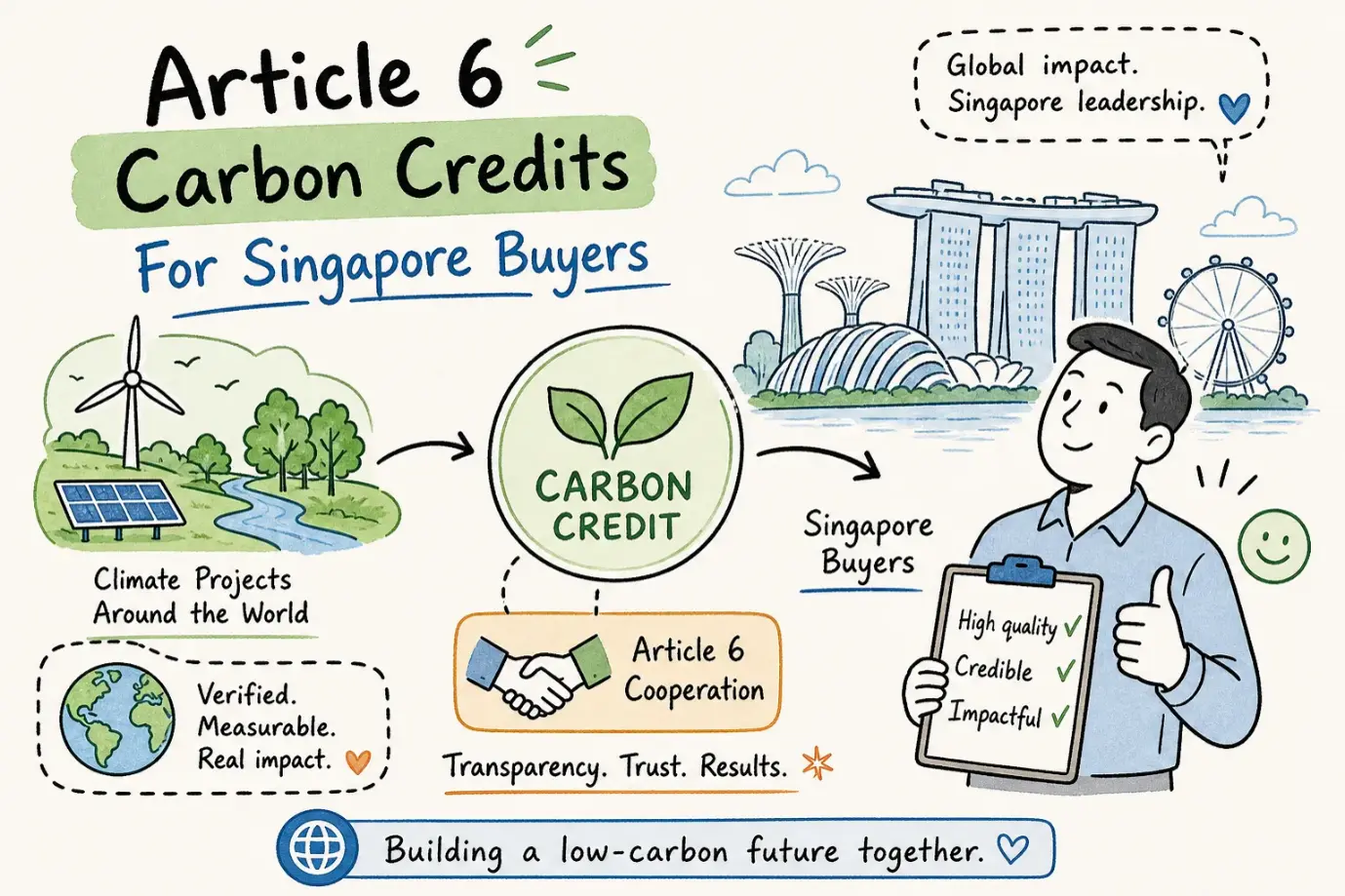
Article 6 carbon credits are fundamentally different from standard voluntary offsets, and...
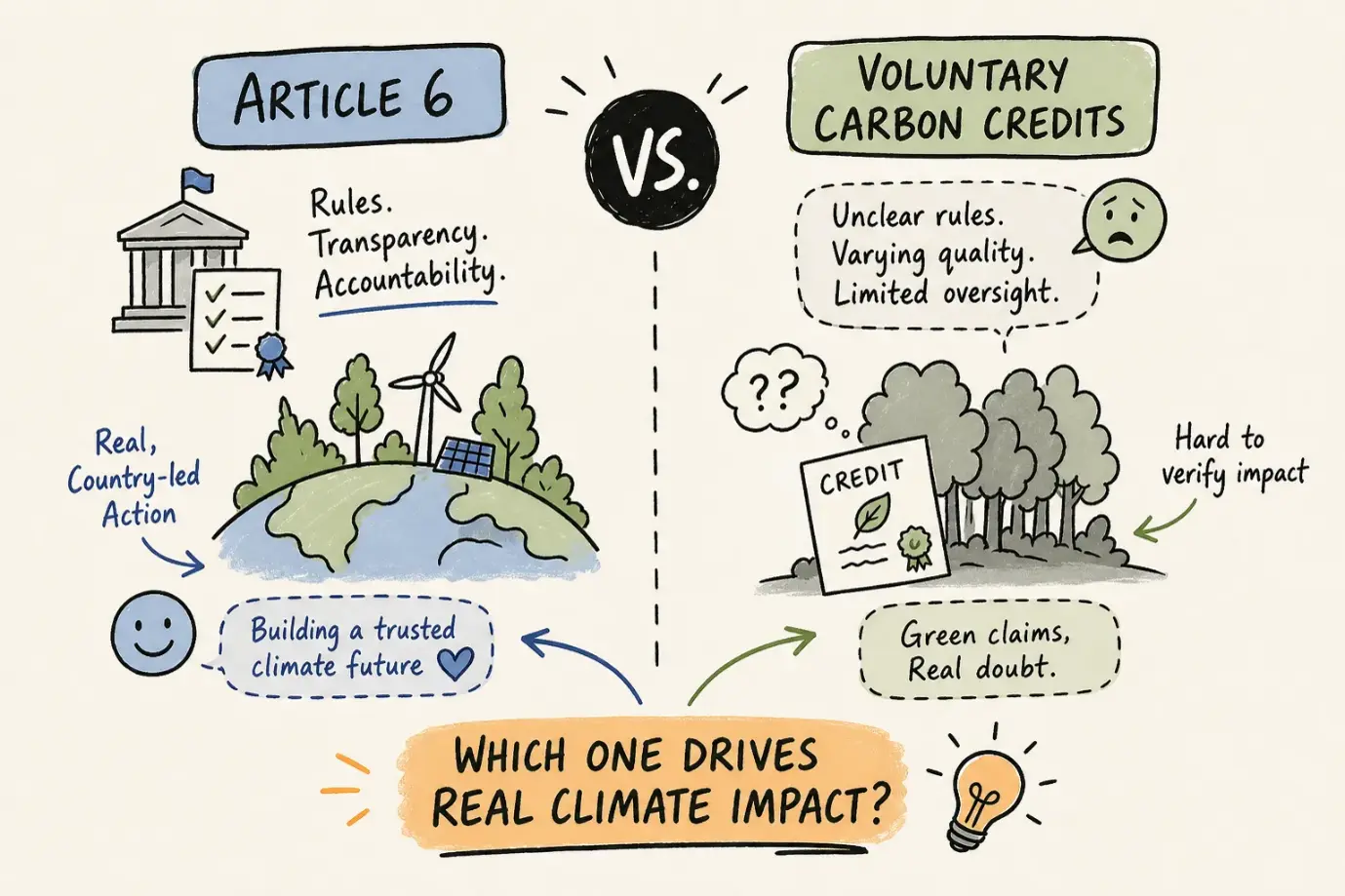
Understanding the difference between Article 6 and voluntary carbon market credits is...
Find quick answers about the Event Carbon Calculator, your emissions estimate, and what happens next.
There is no official threshold. The most cited reference is approximately 14.13 kg CO2 per attendee for venue-related emissions, with energy the dominant contributor. Note this excludes attendee travel, so a full-scope per-attendee figure will typically be higher. Treat it as a comparative benchmark for the venue category rather than a pass mark for the whole event.
Yes. SACEOS has published WA 4: Sustainable MICE — Guidelines for Carbon Emissions Management, a Singapore Standards workspace agreement covering measurement, reduction, calculation, verification and offset. Separately, the Singapore MICE Sustainability Certification (MSC) provides GSTC-Recognised organisational certification, and STB and SACEOS will develop a MICE Decarbonisation Framework by 2028.
Air-conditioning, lighting and audiovisual systems run continuously through operating hours regardless of attendee behaviour, making venue energy a structural and relatively predictable load. In Singapore’s climate, cooling demand is both unavoidable and substantial. This is why the MICE Venue Sustainability Playbook points to emissions per square foot of venue area as a comparable metric.
Yes — and then raised them. By 2025 the original roadmap targets were exceeded, with all purpose-built MICE venues and over 80% of SACEOS member companies certified. Roadmap 2.0, unveiled in July 2026, commits to a MICE Decarbonisation Framework by 2028 and net zero by 2050.
No. MSC certifies the organisation across domains including carbon, waste, energy, water, social responsibility, HR competency and procurement, valid for two years. It does not produce a per-event footprint figure or evidence that a specific event’s emissions were addressed. Those are separate exercises.
Article 6-aligned offsets are no longer just a conference talking point; they...
Article 6 carbon credits are fundamentally different from standard voluntary offsets, and...
Understanding the difference between Article 6 and voluntary carbon market credits is...
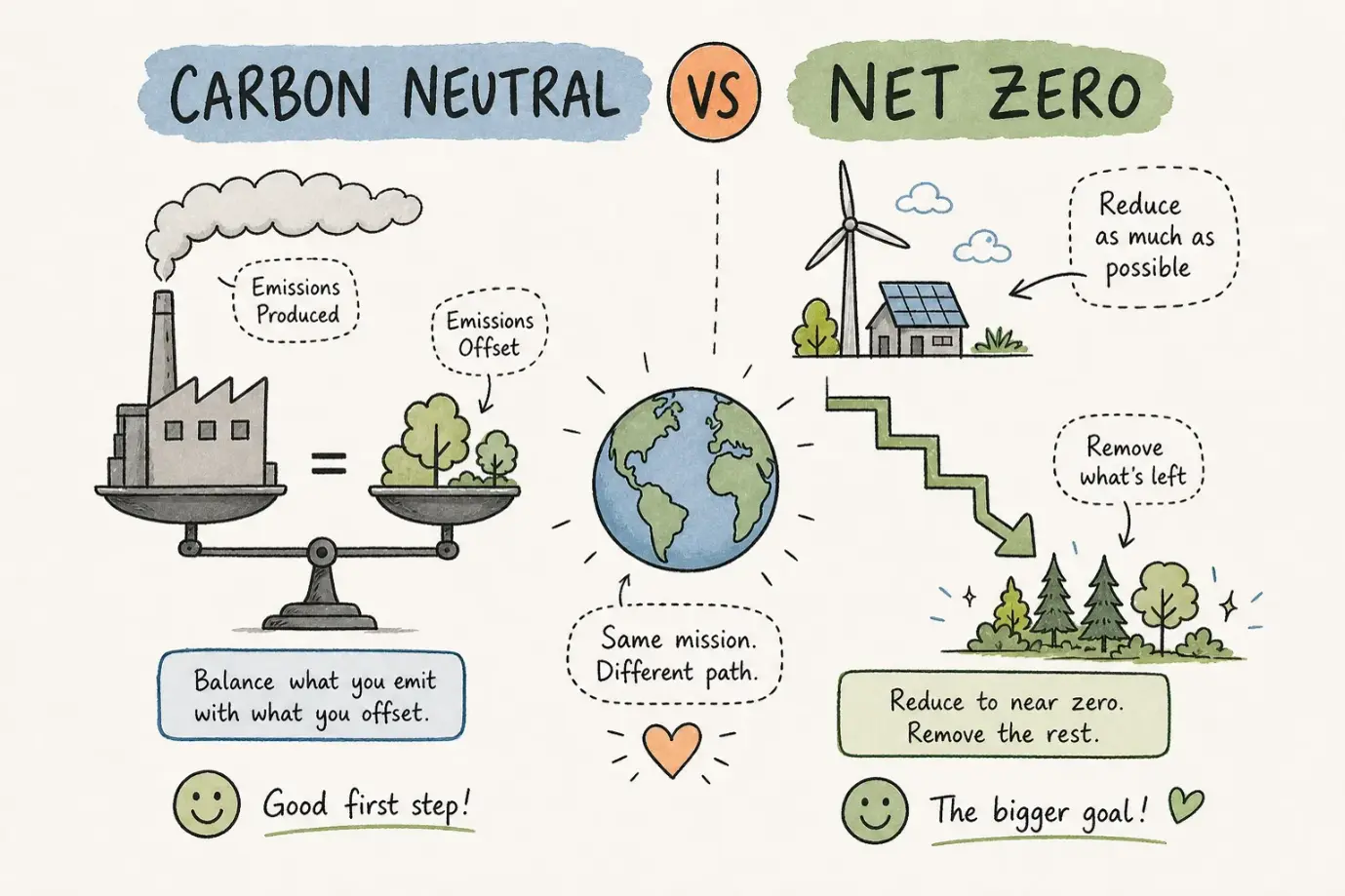
Carbon neutral vs net zero: two terms, both sound green, both are...
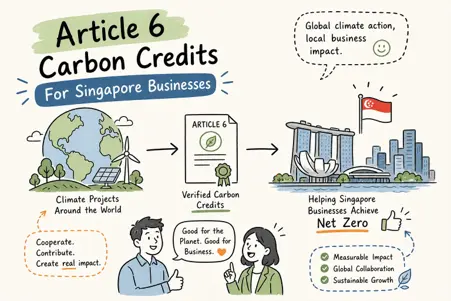
For Singapore businesses, Article 6 carbon credits explained properly can mean the...
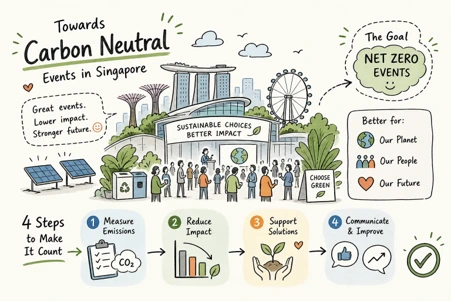
Carbon neutrality claims are increasingly visible in Singapore's events industry. Conference programmes...

Green Passport Carbon
Quick Links
More Information
 Optimized by Seraphinite Accelerator