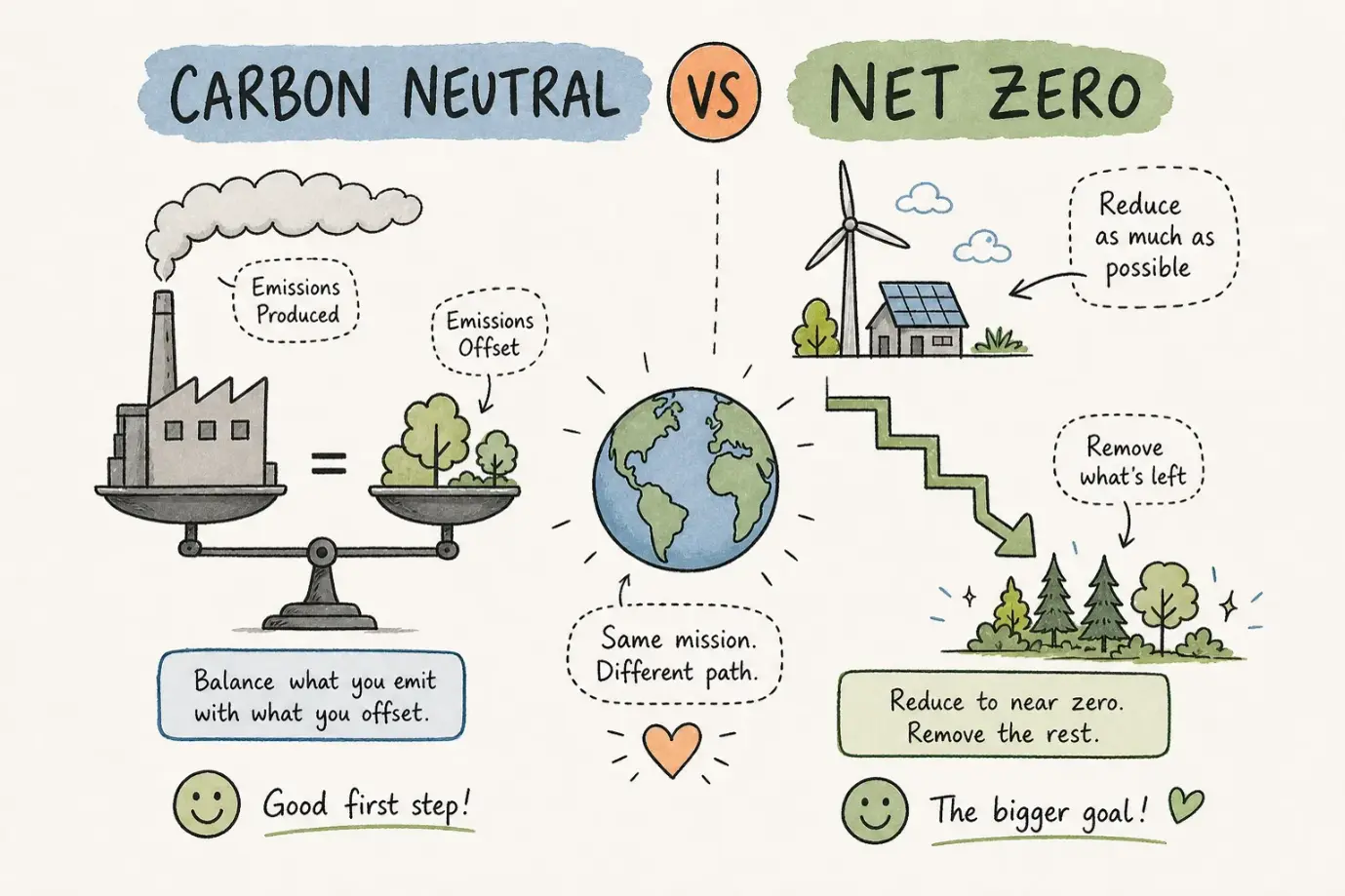
Carbon neutral vs net zero: what’s...
Carbon neutral vs net zero: two terms, both sound green, both are...

Green Passport Carbon , Singapore

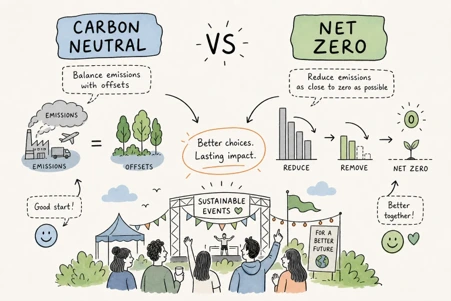
Picture this. A sustainability manager gets briefed before the annual conference planning cycle kicks off. The brief lands with one line: “Make this event net zero.” Everyone in the room nods. The sustainability manager smiles. And quietly, they know that what the brief is asking for and what they can actually deliver with credibility are two entirely different things.
Carbon neutral and net zero are not interchangeable. They carry different definitions, different requirements, and different standards, and this guide on the carbon neutral event vs net zero event key differences explained is designed to help event organisers in Singapore choose the right claim. Reaching for the wrong label is not just imprecise; it creates greenwashing exposure that can unravel client relationships and undermine the ESG disclosures your organisation worked hard to build. Singapore’s MICE sector is fielding these questions with increasing frequency, which is precisely why structured solutions that reference ISO 14068-1 principles, like Green Passport Carbon, have become relevant to event organisers who need a credible, documentable answer rather than a marketing phrase.
The goal here is not to overwhelm you with standards jargon. It is to help you make one good decision: which target fits your event, and how to back it up.
Carbon neutral means the measured greenhouse gas emissions from your event are reduced as far as practically possible, and the remaining emissions are compensated by retiring verified carbon credits. The net emissions associated with the event equal zero. It is an activity-level claim: it applies to a specific event, not to your company’s entire operations or emissions profile.
The standard that gives this claim credibility is ISO 14068-1:2023. It is the international standard for achieving and demonstrating carbon neutrality, and it applies to organisations and to products, including events. In September 2026, ISO replaced it with ISO 14068:2026, a minor revision that mainly changes the title and removes the part number. The standard requires a reduction-first approach: you reduce what you can, then offset the residual. Without a recognised standard anchoring the claim, “carbon neutral event” is just a marketing phrase, and ESG auditors are well aware of that distinction.
The practical appeal of this target is its scope. A single conference can make a carbon neutrality claim under ISO 14068-1, either as a self-declaration or with independent third-party verification, even if the hosting organisation has no company-wide net-zero commitment in place yet. That matters enormously when your client needs a credible sustainability credential for next quarter’s conference, not a five-year corporate transformation plan.
Net zero is not a stricter version of carbon neutral. It is a different category of commitment. Net zero means reducing emissions across the full value chain as far as science requires, then balancing the remaining small residual with permanent removals from the atmosphere. The distinction between “removal” and “offset” matters here: a broad offset can come from avoided emissions elsewhere in the world, whereas a removal physically extracts carbon from the atmosphere. These are not the same thing, and a net-zero event demands the latter for what cannot yet be eliminated.
The Science Based Targets initiative’s Corporate Net-Zero Standard is the most widely referenced framework for corporate net-zero claims, and Version 2.0 was published in June 2026. It requires companies to set science-based emissions reduction targets aligned with a 1.5°C pathway and validate them through SBTi’s process. Crucially, SBTi is a company-level framework. It does not certify individual events as net zero, and it was never designed to function as an event-specific standard.
Calling a single conference “net zero” is, in most cases, a category error. A conference does not have the emissions boundary, the multi-year reduction trajectory, or the removal mechanisms that a credible net-zero claim requires. The hosting company might be on a net-zero pathway, but the event is a different subject entirely. Conflating the two is one of the most common and consequential greenwashing risks in event sustainability communications.
To make this concrete, here is where the two claims diverge. A carbon-neutral event operates at the activity level, one conference, one footprint, one claim cycle. A net-zero commitment operates at the organisational level across multiple years, requiring science-based reduction targets, a validated emissions trajectory, and ultimately permanent carbon removals rather than offsets. The subject, the timeframe, the mechanism, and the applicable standard are all different. Mixing the terms in your communications signals to any informed reader, an ESG auditor, a procurement team, an industry association, that the claim is not grounded in a real standard.
For the vast majority of Singapore event organisers, the carbon neutral event vs net zero event distinction resolves simply: carbon neutral is what you can credibly achieve at the event level, right now. Net zero is a corporate destination reached over years of systematic reduction.
Before any claim is possible, you need to understand your emissions boundary. Under the GHG Protocol, Scope 1 covers direct fuel use on-site, generators or gas catering equipment, for instance. Scope 2 covers purchased electricity for the venue. Scope 3 covers everything else: attendee travel, accommodation, catering supply chains, materials, freight, and waste. For most events, Scope 3 represents the large majority of total emissions, often estimated at 70 to 90%. The most significant sustainability decisions happen before a single attendee walks through the door.
Attendee travel dominates the footprint. For conferences, it typically accounts for 55 to 75% of total event emissions; some research puts the figure closer to 80 to 95% when all travel modes and full journey distances are included. The implication is direct: venue accessibility, transport incentives, and accommodation proximity are not minor logistics details. They are the primary levers. Choosing a venue close to a major transit hub, encouraging rail over short-haul flights, and grouping accommodation near the event space will do more for your emissions profile than any amount of reusable lanyards.
Catering sits as the second major source in most events, particularly when beef- and dairy-heavy menus are involved. Venue energy follows behind that, but it is not negligible across multi-day events. The bottom line: you cannot credibly claim carbon neutral or net zero without first knowing your emissions boundary and measuring your footprint. Reaching for the label before doing the measurement work is where most event sustainability claims fall apart under scrutiny.
The hierarchy under ISO 14068-1 is explicit: reduce first, then offset the residual. Most independent verifiers expect clear evidence of reduction efforts before endorsing a carbon-neutral claim, and the standard’s requirements reflect this. So the practical sequence starts with transport, then catering, then energy and materials.
On transport, venue selection and travel incentives deliver the largest reductions. Rail over short-haul air, public transit links, and grouped shuttle services all register meaningfully in the footprint. On catering, shifting to lower-carbon menus, reducing beef and dairy options and prioritising local and seasonal produce, is measurable and often easier to implement than people expect. On energy, venues with strong energy management credentials help, and switching off AV systems during breaks adds up across a multi-day programme.
When selecting carbon credits for the residual, quality matters. High-quality credits come from projects verified under recognised standards such as Gold Standard or Verra/VCS. They need to demonstrate three things: additionality (the project would not exist without carbon credit revenue), permanence (the climate benefit will last), and independent third-party verification tracked through a public registry. For Singapore event organisers, Article 6-aligned credits can add a further layer of credibility. Singapore has been an active participant in bilateral Article 6 cooperation agreements, and credits structured under these arrangements carry corresponding adjustments that avoid double-counting between countries. However, Singapore’s October 2025 guidance on carbon credits states that corresponding adjustment requirements do not apply to corporate buyers meeting voluntary climate commitments, and that a corresponding adjustment does not by itself indicate the quality of a credit, which must be assessed separately. Buyers should still disclose whether their credits include one.
Vague claims without a referenced standard are the most common problem. Phrases like “eco-friendly event,” “sustainable conference,” or “green certified” mean nothing without a documented methodology and a named standard. Corporate procurement teams and ESG auditors increasingly ask which standard was applied and by whom it was verified. If you cannot answer that question with specifics, the claim is a liability rather than an asset.
Purchasing carbon offsets for events to fully cover an event’s emissions without making any reductions, then calling the result “net zero”, is the definition of greenwashing. Even under ISO 14068-1’s carbon neutral framework, the reduction-first hierarchy must be evidenced. Certifications that skip this step will not hold up to scrutiny, and they are increasingly the first thing third-party auditors check when reviewing ESG disclosures.
Using “carbon neutral” and “net zero” interchangeably in your communications is also a problem. The two terms have distinct definitions, distinct requirements, and distinct applicable standards. Mixing them signals to any informed reader that the claim is not grounded in a real standard, and that erodes trust quickly, particularly with clients who need to reference your event’s sustainability credentials in their own reporting.
For most events, a carbon-neutral event claim that follows ISO 14068-1 is the right first target. It is achievable within a single event cycle. It produces documentation that supports ESG reporting. It builds the measurement and documentation discipline that longer-term net-zero commitments will eventually require. Critically, it can be pursued without the hosting organisation having a company-wide net-zero commitment already in place.
Green Passport Carbon structures this process into three steps for Singapore event organisers: Calculate (covering travel, venue, accommodation, and catering emissions), Retire (retiring eligible carbon credits with documented retirement records), and Certify (issuing a branded Green Passport Carbon certificate with a unique ID and verification link). For event organisers in Singapore’s MICE sector who need a credible, documentable output rather than a drawn-out consulting engagement, this removes the complexity of sourcing separate tools and credit registries. The certificate supports client ESG reporting; it documents the carbon action taken and is not an ISO certification or an independent third-party verification, which can be commissioned separately if a claim requires it. The calculator itself is free and gives a Free Event Carbon Estimate; the Full Event Carbon Assessment, carbon-credit retirement and the Green Passport Carbon Event Certificate are provided as part of Green Passport Carbon’s quote-based service.
Net zero belongs on the corporate roadmap, not the individual event brief. If your organisation is setting science-based targets through SBTi and building a company-level net-zero commitment, individual events become one component of a wider emissions reduction plan. The path there runs through measuring, reducing, and certifying each event first, which is exactly what a carbon neutral certification programme builds towards over time.
The difference between a carbon-neutral event and a net-zero event is not a matter of degree. It is the difference between a credible, achievable, standards-backed claim and a long-term corporate transformation. For event organisers being asked to demonstrate sustainability credentials now, carbon neutral, following ISO 14068-1, is the right target: grounded, documentable, and defensible under scrutiny. Net zero is where the journey goes, not where it starts.
The practical sequence is straightforward: measure your event’s emissions across travel, venue, accommodation, and catering; reduce what you can through venue selection, transport incentives, and catering choices; retire credible, high-quality carbon credits for the residual; and document the outcome transparently, with independent verification against ISO 14068-1 where the claim requires it. That is exactly the process we have built at Green Passport Carbon for Singapore event organisers who need a result, not a research project. Get in touch with our team to get started.
Carbon neutral vs net zero: two terms, both sound green, both are...
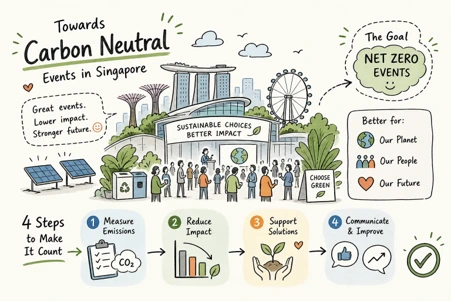
Carbon neutrality claims are increasingly visible in Singapore's events industry. Conference programmes...

Carbon offset solutions for hotel ballrooms and event spaces in Singapore are...
Find quick answers about the Event Carbon Calculator, your emissions estimate, and what happens next.
There is no official threshold. The most cited reference is approximately 14.13 kg CO2 per attendee for venue-related emissions, with energy the dominant contributor. Note this excludes attendee travel, so a full-scope per-attendee figure will typically be higher. Treat it as a comparative benchmark for the venue category rather than a pass mark for the whole event.
Yes. SACEOS has published WA 4: Sustainable MICE — Guidelines for Carbon Emissions Management, a Singapore Standards workspace agreement covering measurement, reduction, calculation, verification and offset. Separately, the Singapore MICE Sustainability Certification (MSC) provides GSTC-Recognised organisational certification, and STB and SACEOS will develop a MICE Decarbonisation Framework by 2028.
Air-conditioning, lighting and audiovisual systems run continuously through operating hours regardless of attendee behaviour, making venue energy a structural and relatively predictable load. In Singapore’s climate, cooling demand is both unavoidable and substantial. This is why the MICE Venue Sustainability Playbook points to emissions per square foot of venue area as a comparable metric.
Yes — and then raised them. By 2025 the original roadmap targets were exceeded, with all purpose-built MICE venues and over 80% of SACEOS member companies certified. Roadmap 2.0, unveiled in July 2026, commits to a MICE Decarbonisation Framework by 2028 and net zero by 2050.
No. MSC certifies the organisation across domains including carbon, waste, energy, water, social responsibility, HR competency and procurement, valid for two years. It does not produce a per-event footprint figure or evidence that a specific event’s emissions were addressed. Those are separate exercises.
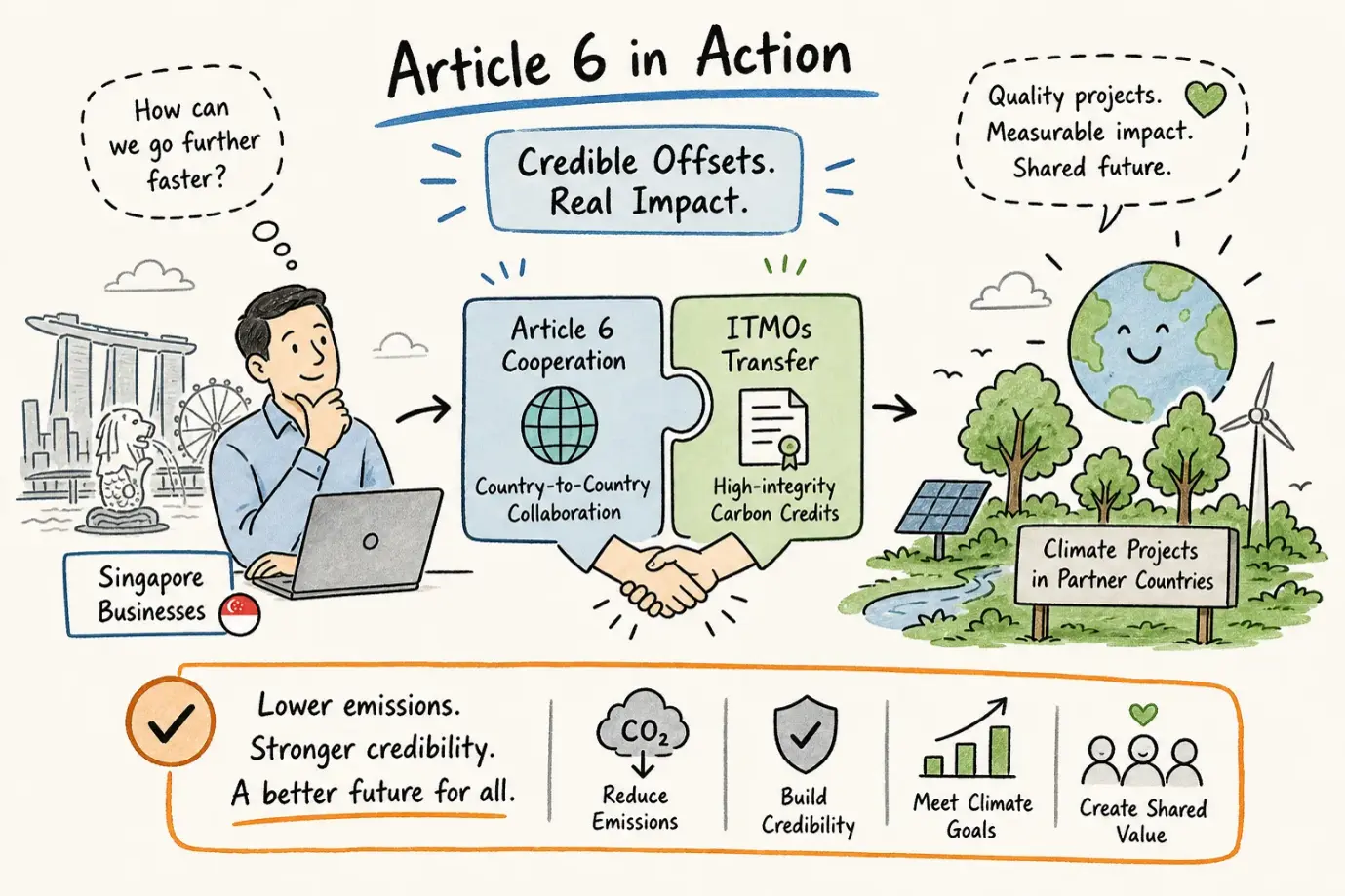
Article 6-aligned offsets are no longer just a conference talking point; they...
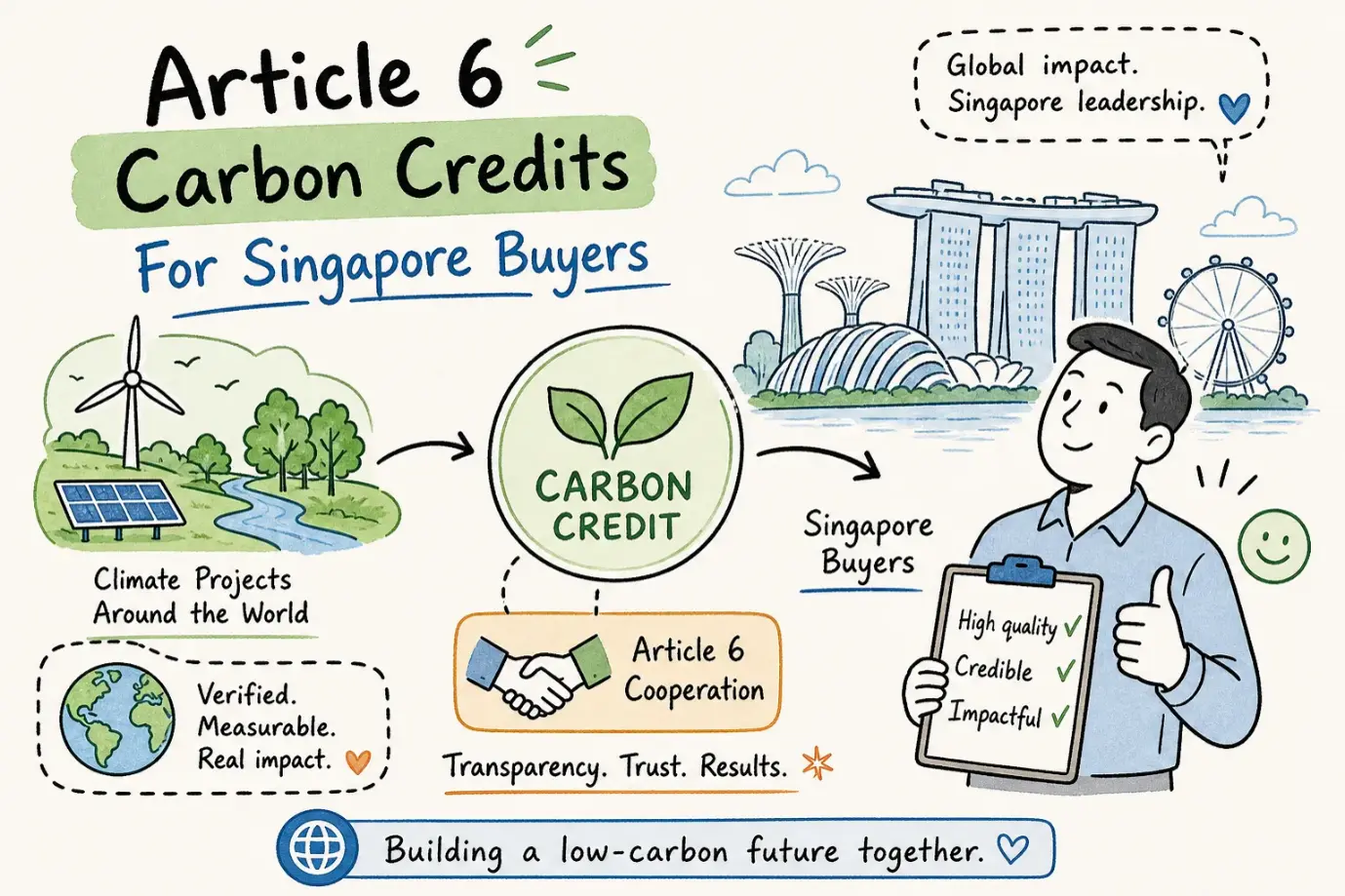
Article 6 carbon credits are fundamentally different from standard voluntary offsets, and...
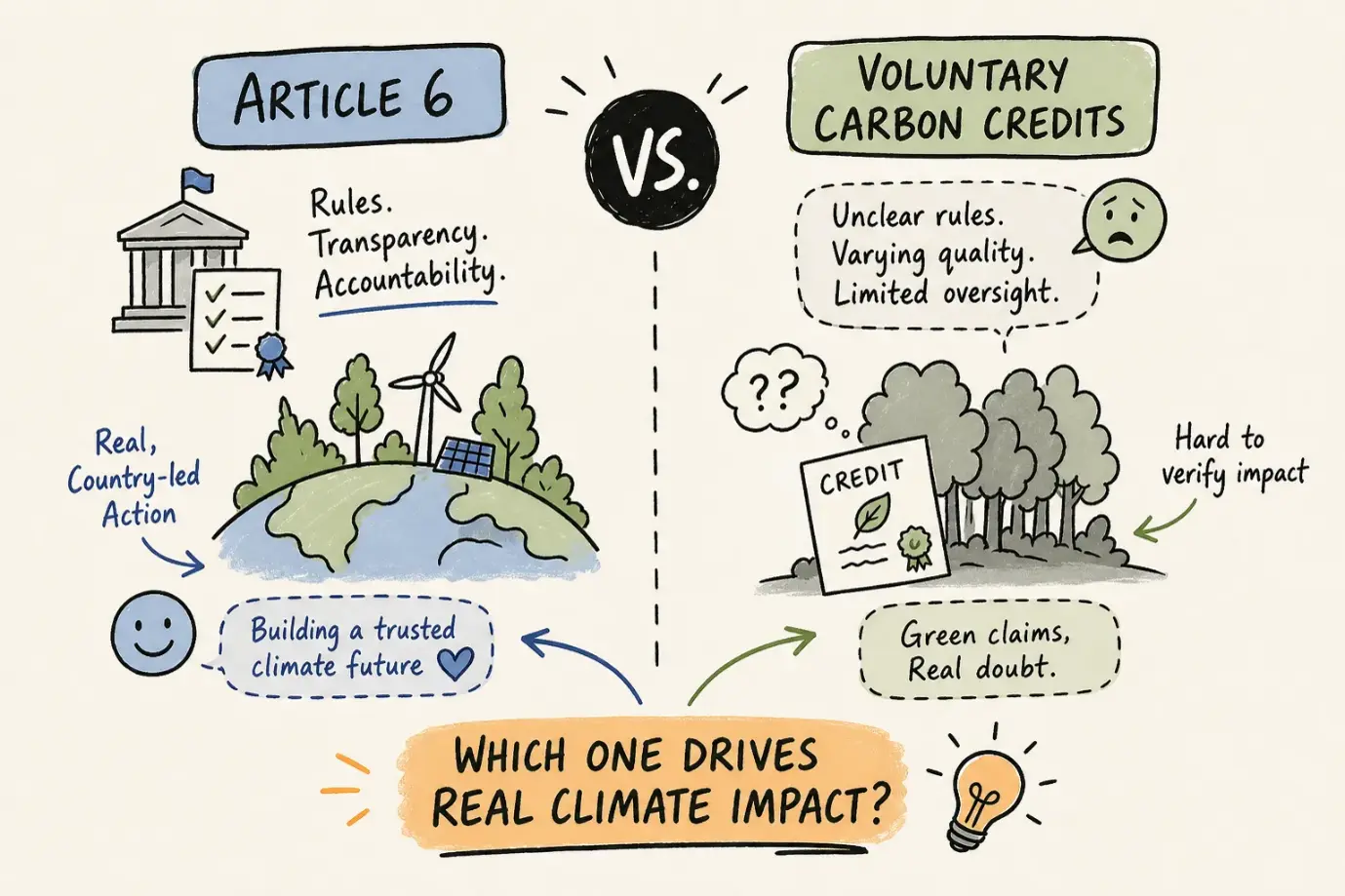
Understanding the difference between Article 6 and voluntary carbon market credits is...
Carbon neutral vs net zero: two terms, both sound green, both are...
For Singapore businesses, Article 6 carbon credits explained properly can mean the...
Carbon neutrality claims are increasingly visible in Singapore's events industry. Conference programmes...

Green Passport Carbon
Quick Links
More Information
 Optimized by Seraphinite Accelerator