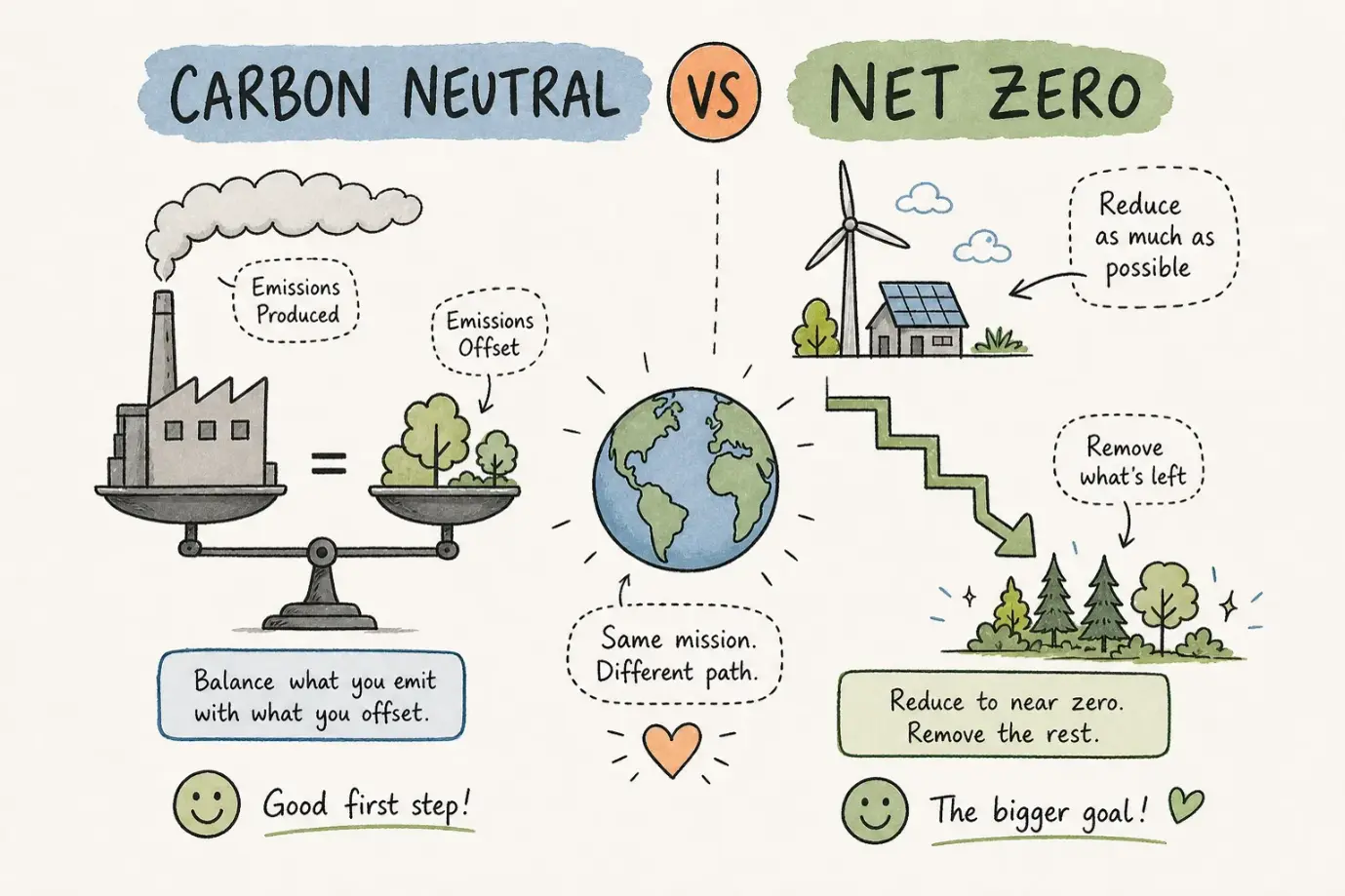
Carbon neutral vs net zero: what’s...
Carbon neutral vs net zero: two terms, both sound green, both are...

Green Passport Carbon , Singapore

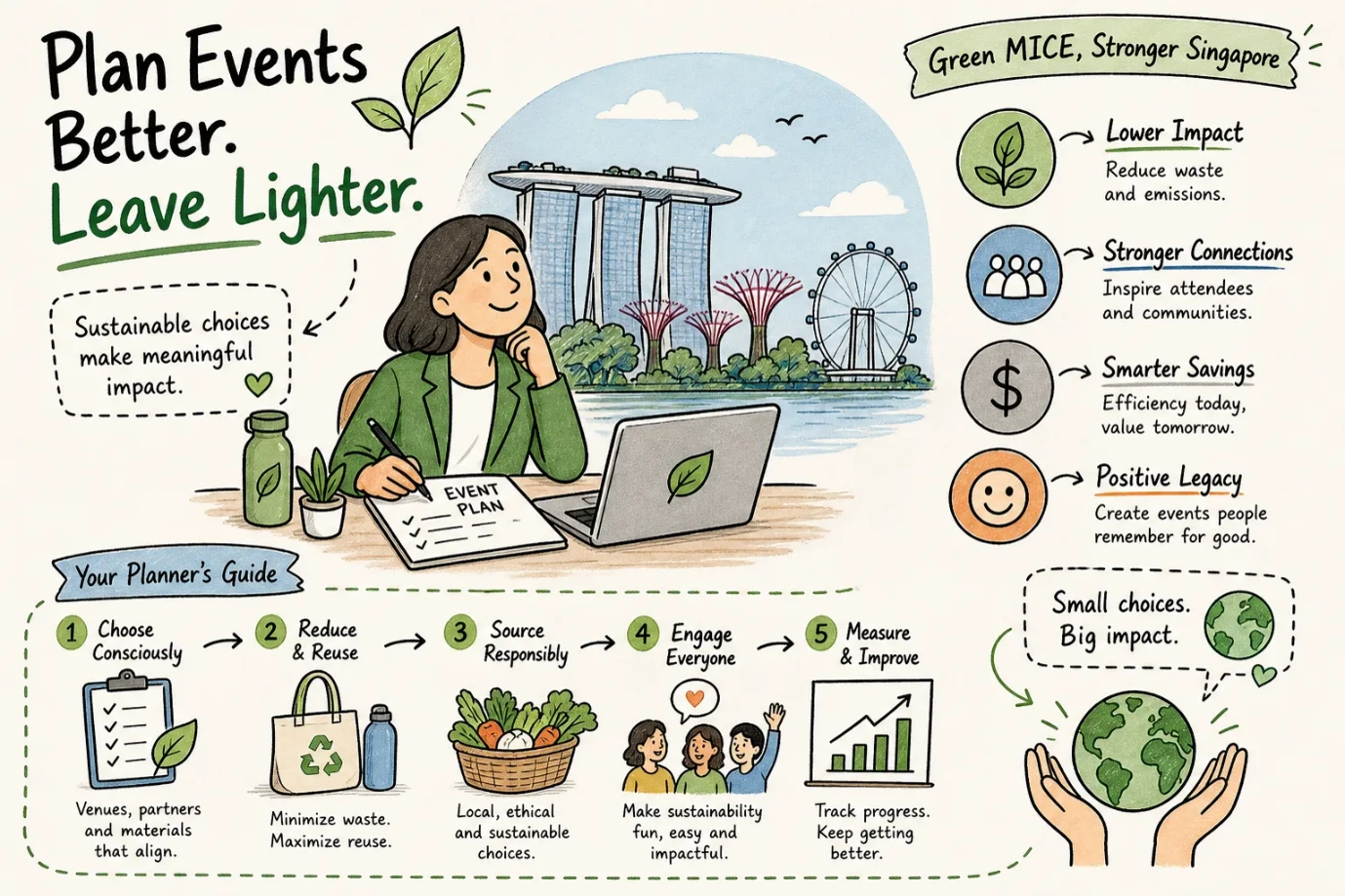
Green MICE Singapore is no longer an aspirational label, it is an operational baseline shaped by public industry commitments. The MICE Sustainability Roadmap, backed by the Singapore Tourism Board (STB) and the Singapore Green Plan 2030, set concrete targets: a set of MICE sustainability standards by 2023, with international recognition targeted by 2024; nationally or internationally recognised sustainability certification for all six purpose-built MICE venues and 80% of SACEOS members by 2025; and net-zero emissions by 2050. Industry feedback increasingly suggests these milestones are showing up as qualifying criteria in sustainability sections of event briefs from MNCs and government-linked organisations, which means the pressure lands directly on the event planner’s desk.
This guide covers the full operational path for green MICE events in Singapore: venue selection, certification options, carbon measurement, on-the-ground waste and F&B strategies, and the grants available to fund it all. Where carbon measurement is concerned, Green Passport Carbon is a Singapore-native solution built specifically for the MICE sector. It offers a structured end-to-end process covering calculation, retirement of eligible carbon credits and a branded Green Passport Carbon certificate, designed for event planners who need a documented, reportable outcome rather than just a number. You will see how it fits into the broader toolkit as you work through this guide.
The MICE Sustainability Roadmap is an industry roadmap rather than legislation, but it is a public commitment with deadlines already passed. Waste and carbon tracking was targeted from 2023. Certification targets for venues and SACEOS members were set for 2025, and organisers should check current certification status rather than assume every target was met. These are the numbers your clients and sponsors have read, and they are increasingly appearing as qualifying criteria in sustainability sections of event briefs, not optional appendices.
The roadmap sets three targets. First, develop a recognised set of MICE sustainability standards, with international recognition targeted by 2024. Second, achieve broad certification across all purpose-built MICE venues and 80% of SACEOS members by 2025. Third, track waste and carbon emissions consistently from 2023, reduce waste in line with the Singapore Green Plan, and reach net-zero by 2050. For event planners, the practical implication is clear: industry feedback and anecdotal evidence from procurement teams suggest these milestones are increasingly being used as qualifying criteria when evaluating event partners, particularly at MNCs and government-linked corporations.
STB’s implementation framework translates the roadmap into four operational areas: raising sustainability standards, building measurement capability, scaling circular economy practices, and enabling industry capability through training and grants. The framing is explicit, treat sustainability as a core operating principle, not a bolt-on to an existing planning process. The encouraging element is that STB has built specific grant and co-funding mechanisms, covered in the final section of this guide, to help organisers meet these expectations without carrying the entire cost burden themselves. The Business Improvement Fund (BIF), for instance, can co-fund qualifying sustainability certification and consultancy costs, with support levels that differ for SMEs and non-SMEs.
Venue selection is typically the first and most visible sustainability decision in the planning process. Choosing a certified venue does not complete your sustainability obligations, but it establishes a credible baseline and signals to clients and sponsors that the infrastructure underpinning the event meets a recognised standard.
The BCA Green Mark scheme runs from Certified through Gold, GoldPLUS, Platinum, and Platinum Super Low Energy. The tiers are differentiated by energy performance benchmarks relative to a 2005 baseline: Platinum requires approximately 55% improvement over that baseline, while Platinum Super Low Energy requires at least 60%, per BCA published guidance. These are not cosmetic distinctions. A venue rated Platinum Super Low Energy has materially higher energy performance requirements and third-party verification than one rated Certified, and that difference is relevant when a client’s ESG team reviews your venue selection rationale.
Singapore’s purpose-built MICE venues span a range of certification levels, based on venue disclosures at the time of writing; confirm current certificates directly with each venue before citing them in a proposal. At the highest tier, Singapore EXPO and MAX Atria hold both BCA Green Mark Platinum Super Low Energy 2025 and Singapore MSC Platinum, making them the strongest certified options currently available. Marina Bay Sands and Sands Expo hold BCA Green Mark Platinum alongside ISO 20121 and LEED Platinum certification. Suntec Singapore holds BCA Green Mark Gold, and Raffles City Convention Centre holds BCA Green Mark GoldPLUS on a provisional basis.
Hotel venues extend the options at different price and capacity points. PARKROYAL COLLECTION Marina Bay holds Green Mark Gold and ISO 14001, while Fairmont Singapore and Swissôtel The Stamford hold Green Mark Certified status. Venue certification directly supports your sustainability narrative, but it does not replace event-level carbon measurement and reporting, the two work together.
Certification converts your sustainability practices into a communicable, auditable credential. For most Singapore MICE players pursuing green event planning in Singapore, two pathways are worth understanding: the Singapore MICE Sustainability Certification (MSC) and ISO 20121.
The MSC is an organisational-level certification administered by SACEOS and conducted by an appointed certification body. The process runs in six stages:
Organisations must comply with at least 80% of the clauses for their sector and should check the framework’s competency requirements, which can be supported by staff completing a recognised MICE sustainability course, such as the SACEOS Certified Event Sustainability programme. Certification is valid for two years. Without a grant application, the process typically takes 4 to 5 weeks, or 10 to 20 weeks with one.
ISO 20121 is an internationally recognised sustainable events management system standard, operating at the organisational level rather than the individual event level. Venues such as Marina Bay Sands already hold it, and for organisers pitching international clients or entering bids where global recognition carries weight, alignment with ISO 20121 can strengthen the case. That said, it is more resource-intensive than the MSC pathway. For most Singapore-based organisers operating primarily in the local MICE market, the MSC delivers the right level of recognition at a proportionate effort and cost.
STB’s published baseline for Singapore’s six purpose-built MICE venues is 14.13 kg CO₂ of venue-related emissions per attendee, with 94% attributed to energy. It excludes attendee travel, accommodation and most supply-chain emissions. That number gives you a useful reference point, but the more important question is how you measure your specific event’s footprint and what you do with the result once you have it.
Four tools are worth knowing for eco-friendly events in Singapore. The SGFIN MICE Carbon Calculator is built specifically for Singapore MICE events, is free and web-based, and covers transport, accommodation, and on-site activities, the right scope for most event briefs. ESGpedia’s Events Carbon Footprint Calculator supports Scope 1, 2, and 3 outputs and integrates with broader corporate ESG reporting, making it a better fit for in-house sustainability teams compiling annual reports. Climeet is GHG Protocol and Bilan Carbone compliant and is already deployed in Singapore. Singapore EXPO operates its own ESGpedia-powered carbon reporting for events held at the venue.
The right choice depends on your output requirement: a standalone event report, a venue-linked calculation, or a figure that feeds directly into a corporate ESG disclosure.
Many calculators stop at producing a number. Green Passport Carbon is designed to take that number through to a documented, reportable outcome via a three-step process: Calculate (an indicative estimate covering flights, accommodation, electricity, food and beverages, and materials); Retire (retirement of eligible carbon credits with documented retirement records); and Certify (a branded Green Passport Carbon certificate with a unique ID and verification link). The certificate documents the carbon action taken; it is not an ISO certification or an independent third-party verification. ISO 14068-1, revised in September 2026 as ISO 14068:2026, is the internationally recognised carbon neutrality standard, and organisations that want an independently verified claim against it can commission that separately. As a vendor service, Green Passport Carbon presents this as a purpose-built, end-to-end offering for the MICE sector, if you need a solution that takes you from measurement to a credible certificate, speak with the Green Passport Carbon team to discuss your event’s requirements. The calculator itself is free and gives a Free Event Carbon Estimate; the Full Event Carbon Assessment, carbon-credit retirement and the Green Passport Carbon Event Certificate are provided as part of Green Passport Carbon’s quote-based service.
Article 6 of the Paris Agreement governs the international transfer of mitigation outcomes between countries. Singapore has signed Implementation Agreements with countries including Bhutan, Ghana, Thailand, Vietnam, and the Philippines, among others. Credits authorised under these agreements carry corresponding adjustments that prevent double-counting, the risk that the same emissions reduction is claimed by both the host country and the organisation purchasing the credit. For event carbon claims that will appear in an ESG report or be reviewed by a sustainability auditor, this distinction can matter. However, Singapore’s October 2025 guidance on carbon credits states that corresponding adjustment requirements do not apply to corporate buyers meeting voluntary climate commitments, and that a corresponding adjustment does not by itself indicate the quality of a credit, which must be assessed separately. Buyers should still disclose whether their credits include one.
Certification and carbon measurement are structural. The numbers behind those credentials come from operational decisions made during planning and execution, the metrics attendees and auditors will see are shaped before the event begins.
Singapore’s event case study data provides a useful benchmark. Sentosa GrillFest’s food-waste segregation pilot recovered 697 kg of food waste from general waste bins, approximately 7% of total event waste, and produced 60 kg of compost for local landscaping. Singapore EXPO reported an 8% improvement in emissions intensity in 2023, with a 21% reduction versus pre-COVID levels. Practical measures that produce these outcomes include on-site food waste segregation, digitised event materials, reusable booth structures, reduced disposable carpeting, and renewable electricity procurement. These are not complex interventions; they are procurement and logistics decisions made at the planning stage, though the ease of implementation will vary depending on event scale and supplier readiness.
Transport and accommodation typically represent the largest share of event emissions for attendees, which means design decisions made before the event begins matter more than what happens on the day. Venue proximity to public transport, virtual participation options for international attendees, and accommodation block agreements with Green Mark certified hotels all reduce the carbon footprint before any offsetting is applied. Marina Bay Sands has reported a 33% reduction in carbon footprint since 2012, reflecting what sustained low-carbon design can deliver at the venue level; the same discipline applied at the event design level produces proportionate results.
Understanding what to do is the first step. Knowing which funding mechanisms will support the cost is what moves a sustainability intention into an active project plan.
The STB Business Improvement Fund (BIF) supports qualifying sustainability investments, including certification costs, consultancy fees, equipment, training, and materials. Funding support levels differ for SMEs and non-SMEs based on annual turnover and employment size. One critical planning point: projects must not have commenced before the grant application date, so BIF funding must be factored into the planning timeline from the outset. Applying through the BIF extends the MSC certification timeline to 10 to 20 weeks, compared to 4 to 5 weeks without a grant application, build this into your event calendar accordingly. The TIP-iT initiative provides training support for capability-building, which is particularly relevant for meeting the MSC requirement that at least one employee complete a recognised MICE sustainability course.
SACEOS is the primary industry body coordinating the MSC framework, training accreditation, and standards development for sustainable venues in Singapore’s MICE sector. The SACEOS member network provides peer benchmarking and practical implementation guidance, which is particularly useful for organisations going through the MSC process for the first time. The MSC framework also attained GSTC-Recognized Standard status in November 2024, aligned with the GSTC MICE Criteria, extending its relevance for organisations with international partners or clients who apply global sustainability benchmarks.
The path is clear and the sequence matters. Start with a BCA Green Mark certified venue to establish your green MICE event’s sustainability baseline. Choose the right certification pathway: the MSC for most Singapore MICE players, ISO 20121 if international recognition is a priority. Measure your event carbon footprint using a tool calibrated for Singapore conditions, then address unavoidable emissions through high-quality carbon credits, disclose their corresponding-adjustment status, and document the outcome clearly for your ESG reporting. Apply waste and F&B strategies to reduce the footprint before it is measured. Use STB and SACEOS support to fund and validate the process.
Green MICE Singapore is no longer a differentiator, it is a baseline expectation that clients, sponsors, and procurement teams are already applying. Green Passport Carbon is designed to make the carbon measurement, credit retirement and documentation step straightforward and credible, specifically for event planners who need a documented outcome for ESG reporting rather than just a number from a calculator. The regulatory framework is set, the tools are available, and the funding support is in place. Reach out to the Green Passport Carbon team to start with your next event’s carbon footprint.
Carbon neutral vs net zero: two terms, both sound green, both are...
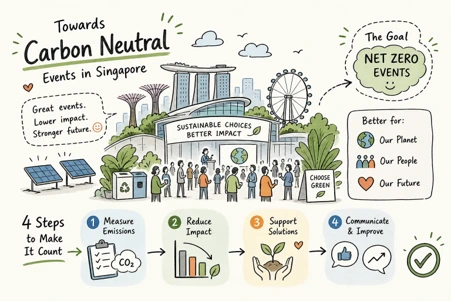
Carbon neutrality claims are increasingly visible in Singapore's events industry. Conference programmes...

Carbon offset solutions for hotel ballrooms and event spaces in Singapore are...
Find quick answers about the Event Carbon Calculator, your emissions estimate, and what happens next.
There is no official threshold. The most cited reference is approximately 14.13 kg CO2 per attendee for venue-related emissions, with energy the dominant contributor. Note this excludes attendee travel, so a full-scope per-attendee figure will typically be higher. Treat it as a comparative benchmark for the venue category rather than a pass mark for the whole event.
Yes. SACEOS has published WA 4: Sustainable MICE — Guidelines for Carbon Emissions Management, a Singapore Standards workspace agreement covering measurement, reduction, calculation, verification and offset. Separately, the Singapore MICE Sustainability Certification (MSC) provides GSTC-Recognised organisational certification, and STB and SACEOS will develop a MICE Decarbonisation Framework by 2028.
Air-conditioning, lighting and audiovisual systems run continuously through operating hours regardless of attendee behaviour, making venue energy a structural and relatively predictable load. In Singapore’s climate, cooling demand is both unavoidable and substantial. This is why the MICE Venue Sustainability Playbook points to emissions per square foot of venue area as a comparable metric.
Yes — and then raised them. By 2025 the original roadmap targets were exceeded, with all purpose-built MICE venues and over 80% of SACEOS member companies certified. Roadmap 2.0, unveiled in July 2026, commits to a MICE Decarbonisation Framework by 2028 and net zero by 2050.
No. MSC certifies the organisation across domains including carbon, waste, energy, water, social responsibility, HR competency and procurement, valid for two years. It does not produce a per-event footprint figure or evidence that a specific event’s emissions were addressed. Those are separate exercises.
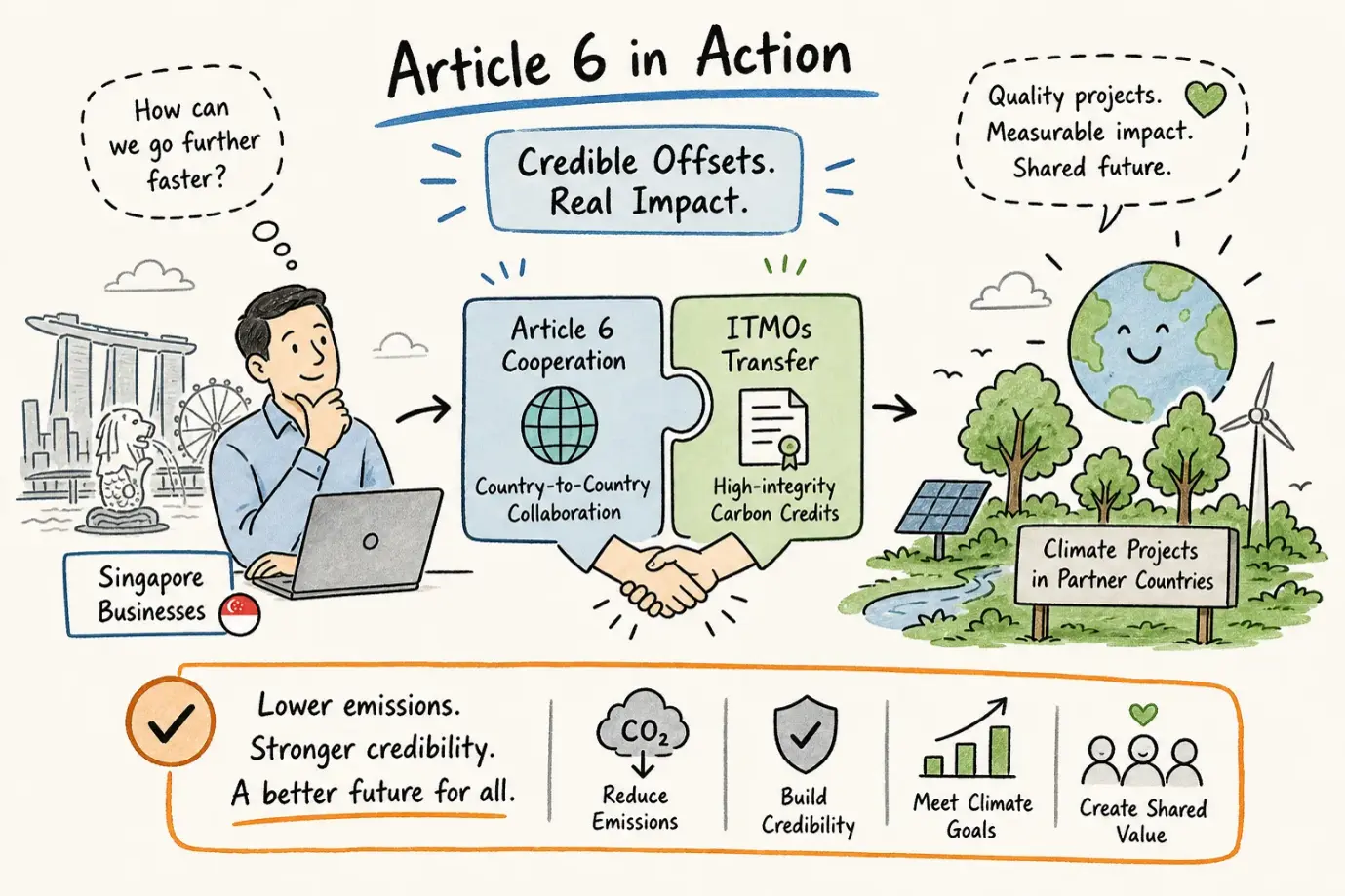
Article 6-aligned offsets are no longer just a conference talking point; they...
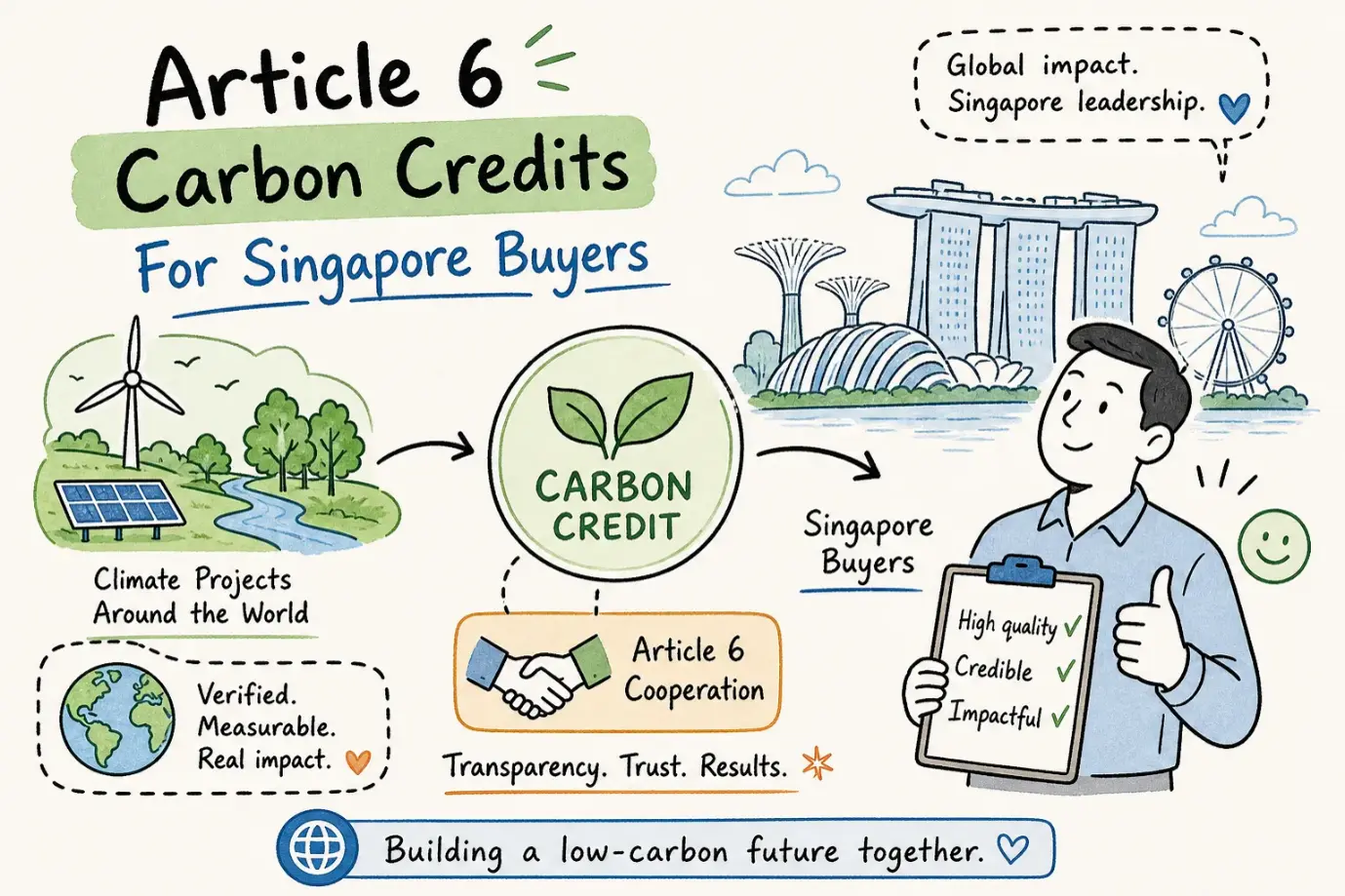
Article 6 carbon credits are fundamentally different from standard voluntary offsets, and...
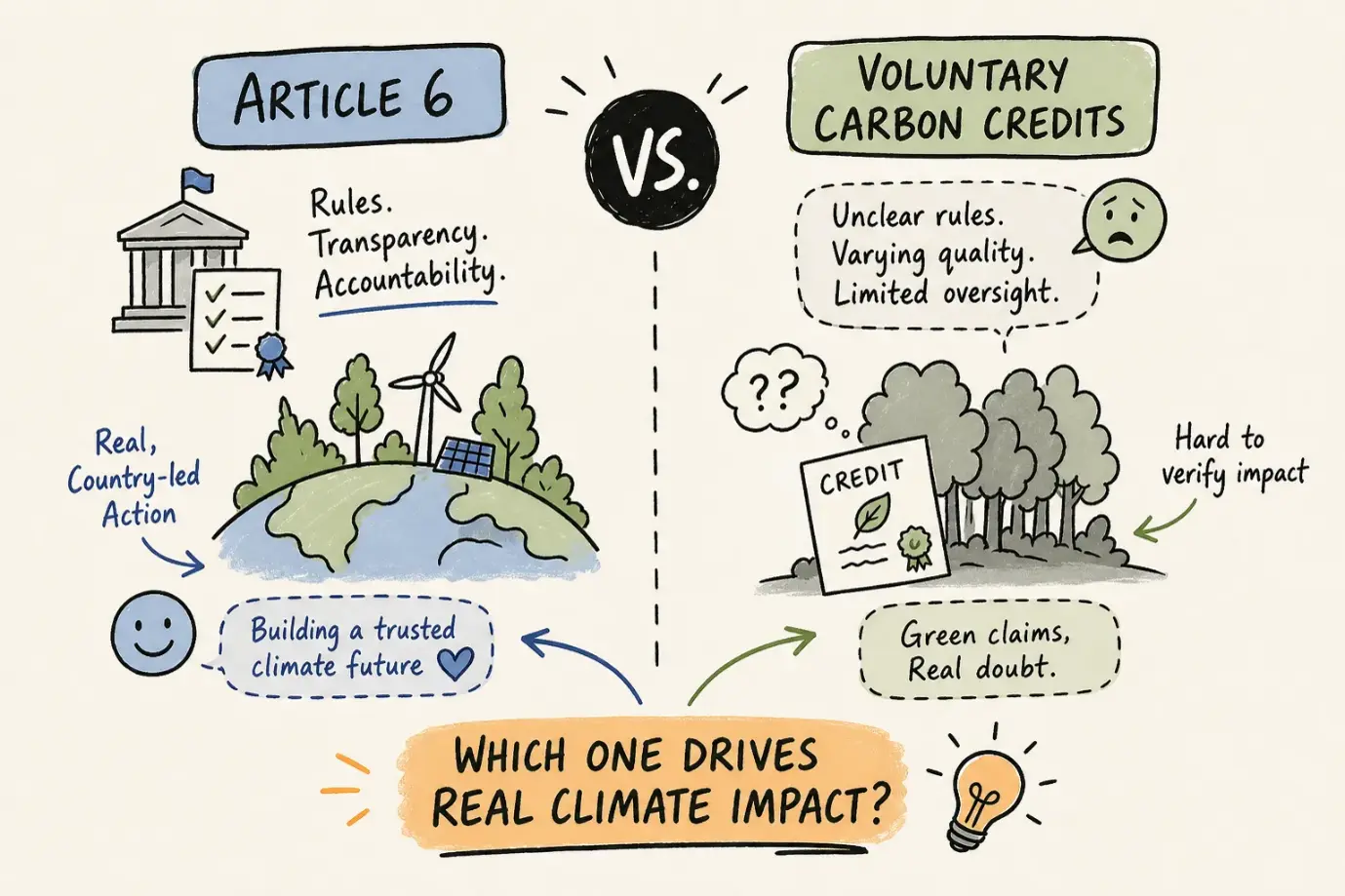
Understanding the difference between Article 6 and voluntary carbon market credits is...
Carbon neutral vs net zero: two terms, both sound green, both are...
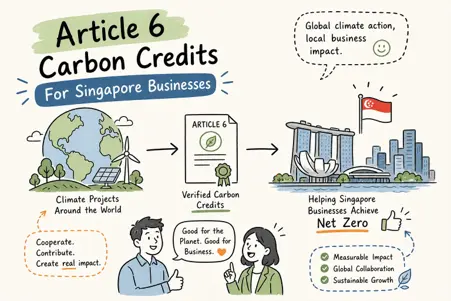
For Singapore businesses, Article 6 carbon credits explained properly can mean the...
Carbon neutrality claims are increasingly visible in Singapore's events industry. Conference programmes...

Green Passport Carbon
Quick Links
More Information
 Optimized by Seraphinite Accelerator