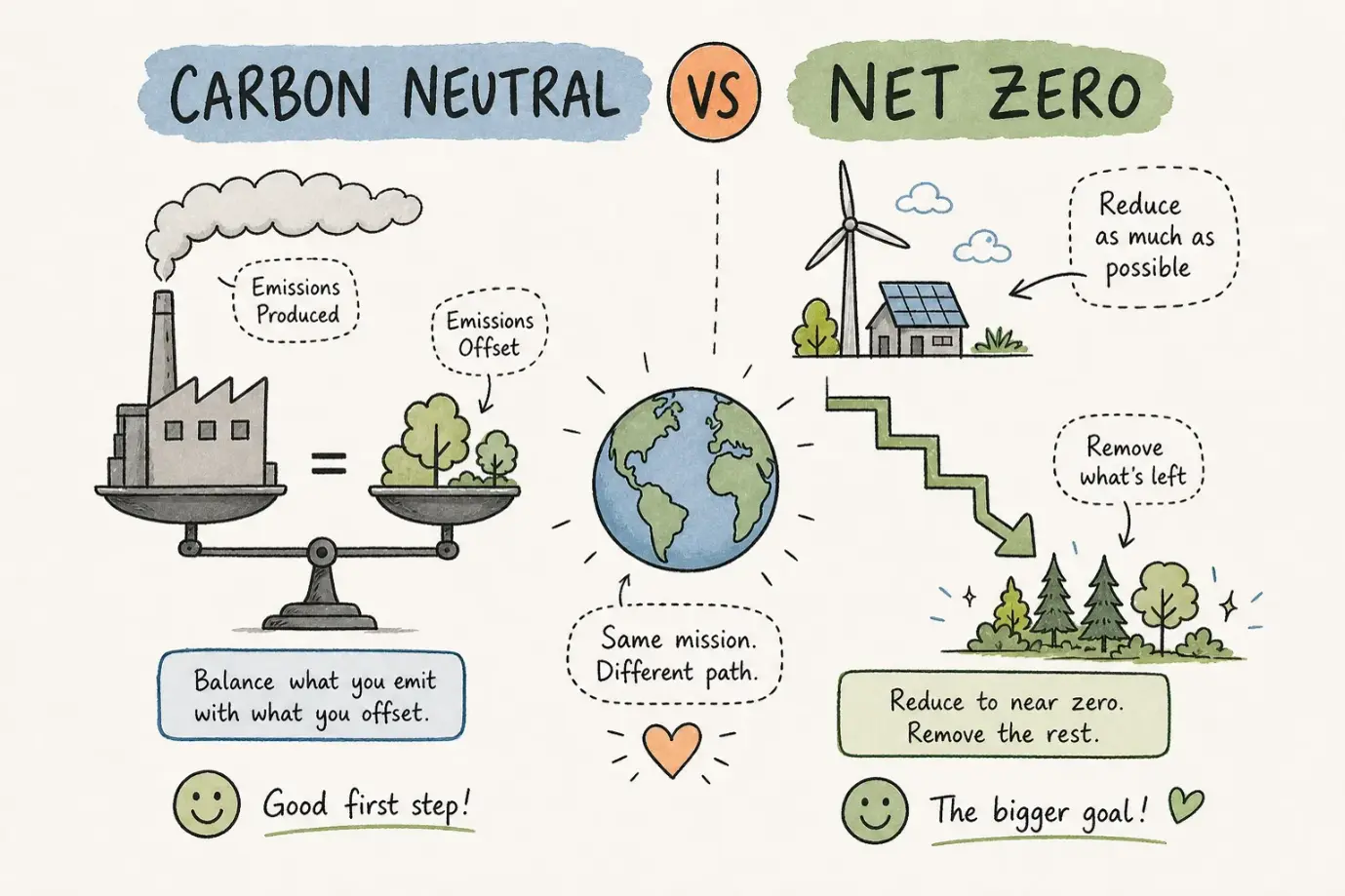
Carbon neutral vs net zero: what’s...
Carbon neutral vs net zero: two terms, both sound green, both are...

Green Passport Carbon , Singapore

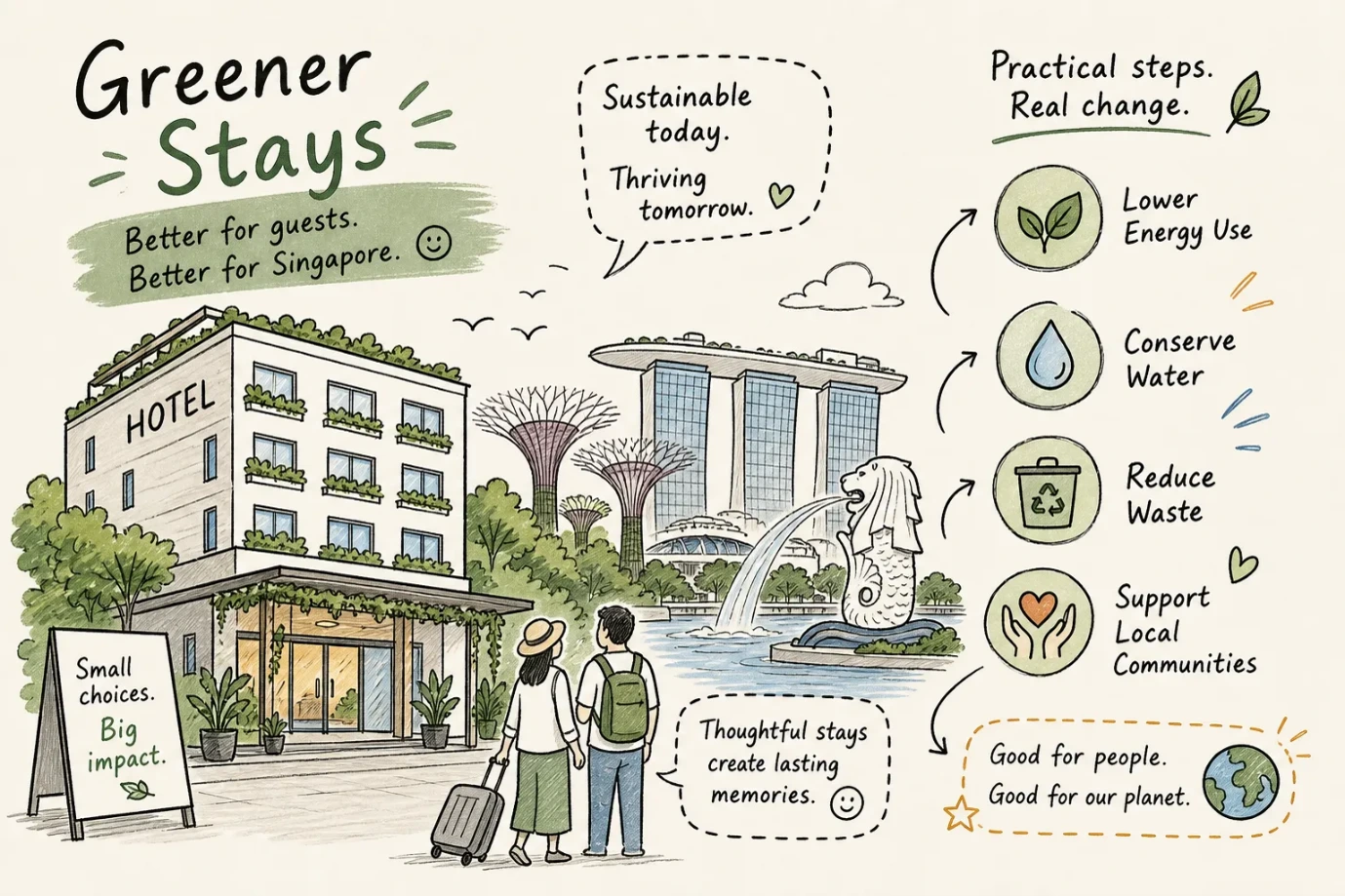
Hotel sustainability in Singapore has moved faster than most regional markets expected. By 2025, over 70% of hotel room stock, about 47,900 rooms across more than 120 hotels, had achieved internationally recognised sustainability certification, surpassing the sector’s own 60% target ahead of schedule, a result attributed to STB and SHA’s joint roadmap and strong industry uptake. The Singapore Green Plan 2030 is no longer a future commitment; it is an active framework that informs procurement decisions, investor expectations, and the questions your corporate clients raise before signing a booking contract.
For many certified hotels, the foundational work is well underway: energy retrofits completed, water-saving systems installed, waste management processes documented. The certificate is on the wall. But a new question is surfacing in hotel sales conversations across Singapore’s MICE sector, “Can you provide a carbon certificate for our event?” That single question reveals a gap that most hotels haven’t closed yet. It is becoming part of what complete hotel sustainability in Singapore looks like in 2026, and forward-looking venues are beginning to address it through structured venue partnership models.
This guide covers both the operational fundamentals and that emerging frontier: the grants available now, the certifications that carry real weight in Singapore’s market, the case study numbers worth knowing, and the practical steps to move forward regardless of where your programme currently sits.
The Singapore Tourism Board and the Singapore Hotel Association built their joint roadmap around four operational pillars: energy conservation, water conservation, waste management and circular economy, and sustainable sourcing and procurement. These are not aspirational categories. They are the specific areas against which hotels are measured under the roadmap, and they formed the basis for the emissions tracking requirement that started in 2022, with reporting completed in 2023. The 2030 target is a measurable reduction in emissions; the 2050 horizon is net-zero.
Surpassing the 60% certification target is a meaningful signal that the sector took the roadmap seriously. It also raises the floor. Hotels that haven’t certified yet are operating in a market where competitors, clients, and the STB have all normalised a higher standard. Certified hotels face a different question from uncertified ones: not whether to act, but what to do next.
Certification validates the operational work, but it doesn’t automatically translate into competitive advantage in Singapore’s MICE market. In conversations with Singapore’s MICE venues, corporate procurement teams are increasingly arriving at briefings with Scope 3 ESG reporting requirements that ask specifically about event emissions: travel, accommodation, venue energy, and catering. A hotel’s GSTC or Green Mark certification answers questions about the building and its operations. It doesn’t automatically answer questions about what happened during the conference in your ballroom last Tuesday. That gap is where the next differentiation layer sits.
STB administers two hotel-facing grant schemes from which most sustainability projects will draw funding. The Hotel Rejuvenation Fund supports renovation and refurbishment projects incorporating sustainability features, with support of up to 70% of qualifying costs, depending on enterprise size; project approvals are required by 31 March 2027, so check the current terms with STB. It is the right instrument when a hotel is undertaking a major physical upgrade and wants to embed sustainability-focused elements within that scope. The Business Improvement Fund is broader: it covers technology adoption, process redesign, and operational sustainability initiatives, and was expanded to explicitly include sustainability from April 2022.
The practical split is straightforward. Use HRF when the project is a capital-intensive rejuvenation with a sustainability component. Use BIF when the project is technology-led or process-driven without a major physical renovation attached. Both schemes run through STB’s standard process: an executive summary submission, an STB review, then a formal application. STB processes completed applications in up to 90 days.
The Energy Efficiency Grant, extended to 31 March 2027, is the most targeted instrument for equipment-level retrofits: chiller replacements, LED lighting systems, heat pumps, and other energy-efficient plant. It is an Enterprise Singapore scheme rather than an STB one, and its current eligible sectors are construction, data centres, food services, manufacturing, maritime and retail, so hotels may qualify only for eligible food-service operations for now. The Government announced in April 2026 that the Base tier will be opened to all sectors, with details due later in 2026, so check Enterprise Singapore for the latest position. The Enterprise Financing Scheme, Green, extended to 31 March 2031, is financing rather than a grant, which matters for hotels with larger transition programmes that outpace available grant funding.
These schemes can stack. A hotel undertaking a major refurbishment might use HRF for the broader project, EEG for specific energy-efficient equipment within that project where eligible, and EFS, Green to finance the remainder of the transition cost. Discussing this kind of structured funding approach with STB’s hospitality team early, before applications are submitted, is time well spent.
GSTC has become the de facto hotel sustainability certification in Singapore because the national roadmap uses GSTC-accredited certification bodies as its benchmark. STB explicitly describes GSTC as the global standard for sustainability in travel and tourism, and the 60%-plus certification milestone was measured against GSTC. The standard covers four core areas: effective sustainability planning, reduced negative environmental impacts, protection of cultural heritage, and maximised social and economic benefits for the local community. Certification involves self-assessment, documentation review, and an on-site audit by an accredited certification body.
For a mid-size Singapore hotel starting from a reasonable base of sustainability management, the process typically takes 6 to 12 months from self-assessment to certificate issuance. Hotels with strong documentation and systems already in place have achieved it in closer to three to six months. The audit itself is usually one day on-site; the timeline is driven by the preparation and gap-closure work preceding it.
Leading Singapore hotels pair GSTC with ISO 14001 and BCA Green Mark for good reason: the three certifications serve different audiences rather than overlapping ones. GSTC signals to tourism clients and the STB. ISO 14001, a systematic Environmental Management System standard, signals to corporate procurement teams and ESG auditors specifically looking for formalised environmental governance. BCA Green Mark signals to building regulators and institutional investors who evaluate the property as an asset. For hotels competing in both the tourism and corporate MICE markets, the strongest credibility position brings all three together.
BCA Green Mark assessment fees for hotels in Singapore vary by building type, size (for hotels, the number of rooms) and whether the application is a recertification, so check BCA’s current published fee schedule for your property. Certification periods are typically three years, with recertification forming part of an ongoing programme rather than a one-time exercise.
The published case study numbers from Singapore hotels are worth knowing because they show what consistent investment produces over time, not exceptional results from one-off projects. Pan Pacific Singapore reduced energy consumption from 55.95 kWh per guest night in early 2023 to 42.89 kWh in the same period of 2024, a 23% year-on-year reduction. Marina Bay Sands has reported a 65% decrease in electricity consumption across its sustainability journey. Grand Hyatt Singapore moved to 100% renewable electricity. PARKROYAL COLLECTION Marina Bay generated over 90,000 kWh of renewable energy from rooftop solar in ten months, saving close to SGD 33,500 per year.
These outcomes are consistent with what documented case studies show: sustained investment in energy-efficient retrofits and renewable energy produces measurable gains. The Marina Bay Sands energy efficiency programme had a payback period of less than two years. Ibis Novena Hotel modelled a 33% energy reduction through retrofit alone. The financial case for energy investment is clear enough that the sustainability argument rarely needs to carry the conversation on its own.
The hotels achieving the strongest sustainability profiles in Singapore treat green initiatives as visible, guest-facing programmes. Hilton Singapore Orchard installed sensor-based room controls and an in-house glass water bottling system that eliminates plastic bottles entirely. Fairmont Singapore and Swissotel The Stamford operate a rooftop urban aquaponics farm supplying restaurants in both properties. JW Marriott Singapore South Beach built a microclimatic canopy that harvests rainwater and generates solar energy while functioning as a naturally ventilated guest shelter.
What these initiatives share is deliberate visibility. The best hotel green initiatives in Singapore treat guest-facing storytelling as part of the programme design, not an afterthought. A guest who sees the aquaponics farm or the glass water bottling station leaves with a direct experience of the hotel’s commitment, not just a claim. That experience is also what corporate clients can point to when communicating their event’s sustainability credentials internally.
A hotel holding GSTC certification, ISO 14001, and BCA Green Mark has a strong sustainability story. But when a corporate client books a conference or gala dinner, that certification portfolio doesn’t automatically cover the carbon footprint of the event itself. Event emissions, delegate travel, catering, accommodation, and the venue’s energy use during the event, are increasingly appearing as a procurement requirement for MNCs managing their Scope 3 ESG reporting. The hotel’s operational certification addresses the building. The event’s carbon footprint is a separate question, and many hotels in Singapore can’t yet answer it.
That gap is consequential. Corporate clients arriving at a venue briefing with ESG requirements are not necessarily looking for a perfect answer, they are looking for a credible one. A hotel that can offer a carbon certificate for the event, produced through a documented methodology with verifiable credit retirement, is more likely to close the booking than one that cannot. Hotels unable to provide that answer risk sending the client elsewhere or leaving them to manage the reporting themselves.
Venue partnership models are built specifically for this situation. Rather than developing in-house carbon expertise or sourcing carbon credits independently, hotels can work with a specialist provider to cover the full process: calculating all relevant event emission sources (delegate travel, venue energy, accommodation, and catering), retiring carbon credits through a documented and verifiable process, and issuing a carbon neutrality certificate the hotel can offer as part of a green event package. Methodology and credit retirement should follow internationally recognised standards, such as ISO 14068-1 (revised in September 2026 as ISO 14068:2026) for carbon neutrality claims, and the provider should be able to supply full documentation on request.
Green Passport Carbon is one example of this approach, designed specifically for Singapore’s MICE and events sector and working with venues as well as organisers. Green Passport Carbon’s Calculate, Retire, Certify process covers an indicative emissions estimate for key event sources, the retirement of eligible carbon credits with documented retirement records, and a branded Green Passport Carbon certificate with a unique certificate ID and verification link. The certificate documents the carbon action taken; it is not an ISO certification or an independent third-party verification. For a hotel already holding GSTC certification, adding this layer means the sustainability story is complete. Operational credentials are validated by certification. Event-level carbon action is documented. The client receives a green event record with a verification link that sits cleanly in their Scope 3 ESG reporting. In Singapore’s MICE market, that remains a genuine competitive gap to close. The calculator itself is free and gives a Free Event Carbon Estimate; the Full Event Carbon Assessment, carbon-credit retirement and the Green Passport Carbon Event Certificate are provided as part of Green Passport Carbon’s quote-based service.
If your hotel hasn’t started a formal sustainability programme, the most useful first step is a self-assessment against GSTC criteria. That exercise identifies where the gaps are and which STB grant, HRF or BIF, matches your most pressing upgrade project. Don’t wait until the full programme is designed before contacting STB’s hospitality team. The grant application process takes time, and starting the conversation early means funding can support the work sooner.
If your hotel is already GSTC certified, the priority is pairing that certification with ISO 14001 and ensuring energy and water outcomes are tracked, reported, and improving consistently. The next layer is the events carbon piece: assess whether your current green event package can produce a documented carbon certificate, and if not, identify the partnership or process that closes that gap.
Singapore’s MICE sector is one of Asia’s largest and most active. The corporate clients moving through it are arriving with ESG requirements that hotels haven’t needed to address in previous years. Hotels that build a complete green events offering, combining existing sustainability certifications with event-level carbon certification through a partnership model, are positioned to win business that less-prepared competitors will lose. The operational work matters. So does the ability to hand a client a certificate they can include in their ESG report.
Hotel sustainability in Singapore in 2026 operates across three layers: the operational foundations covering energy, water, and waste reduction; the certification framework that validates them through GSTC, ISO 14001, and BCA Green Mark; and the emerging events-carbon layer that leading hotels are beginning to address through structured carbon certification programmes. Government funding is available across all three layers, the standards are internationally recognised, and the case studies demonstrate that the returns, in both cost savings and market positioning, are real.
Assess where your hotel sits across all three layers, then identify one concrete next step: an STB grant application to fund an upgrade, a GSTC self-assessment to begin certification, a BCA Green Mark gap review, or a conversation about what a green event package with carbon certification looks like for your venue. If the events carbon piece is where you want to start, the Green Passport Carbon team can walk you through how its Calculate, Retire, Certify process could work for your specific property.
The hotels leading Singapore’s sustainability conversation built their programmes one decision at a time, from wherever they happened to be starting. The next decision is yours to make.
Carbon neutral vs net zero: two terms, both sound green, both are...
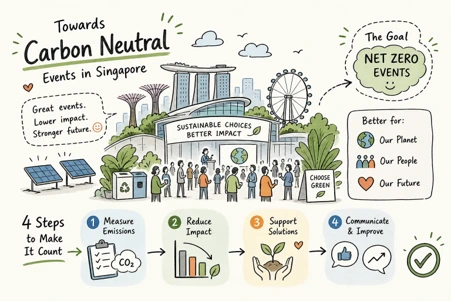
Carbon neutrality claims are increasingly visible in Singapore's events industry. Conference programmes...
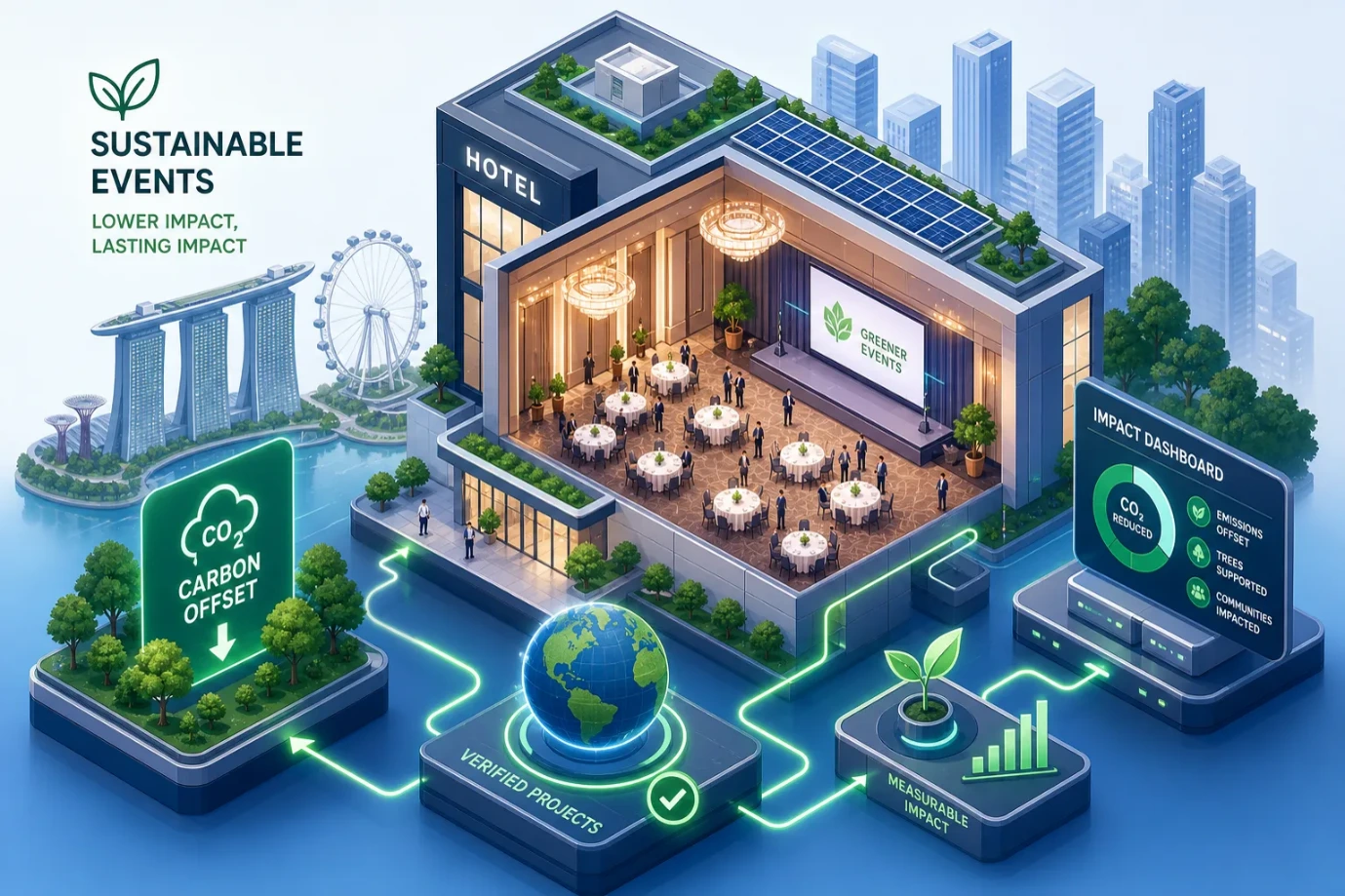
Carbon offset solutions for hotel ballrooms and event spaces in Singapore are...
Find quick answers about the Event Carbon Calculator, your emissions estimate, and what happens next.
There is no official threshold. The most cited reference is approximately 14.13 kg CO2 per attendee for venue-related emissions, with energy the dominant contributor. Note this excludes attendee travel, so a full-scope per-attendee figure will typically be higher. Treat it as a comparative benchmark for the venue category rather than a pass mark for the whole event.
Yes. SACEOS has published WA 4: Sustainable MICE — Guidelines for Carbon Emissions Management, a Singapore Standards workspace agreement covering measurement, reduction, calculation, verification and offset. Separately, the Singapore MICE Sustainability Certification (MSC) provides GSTC-Recognised organisational certification, and STB and SACEOS will develop a MICE Decarbonisation Framework by 2028.
Air-conditioning, lighting and audiovisual systems run continuously through operating hours regardless of attendee behaviour, making venue energy a structural and relatively predictable load. In Singapore’s climate, cooling demand is both unavoidable and substantial. This is why the MICE Venue Sustainability Playbook points to emissions per square foot of venue area as a comparable metric.
Yes — and then raised them. By 2025 the original roadmap targets were exceeded, with all purpose-built MICE venues and over 80% of SACEOS member companies certified. Roadmap 2.0, unveiled in July 2026, commits to a MICE Decarbonisation Framework by 2028 and net zero by 2050.
No. MSC certifies the organisation across domains including carbon, waste, energy, water, social responsibility, HR competency and procurement, valid for two years. It does not produce a per-event footprint figure or evidence that a specific event’s emissions were addressed. Those are separate exercises.
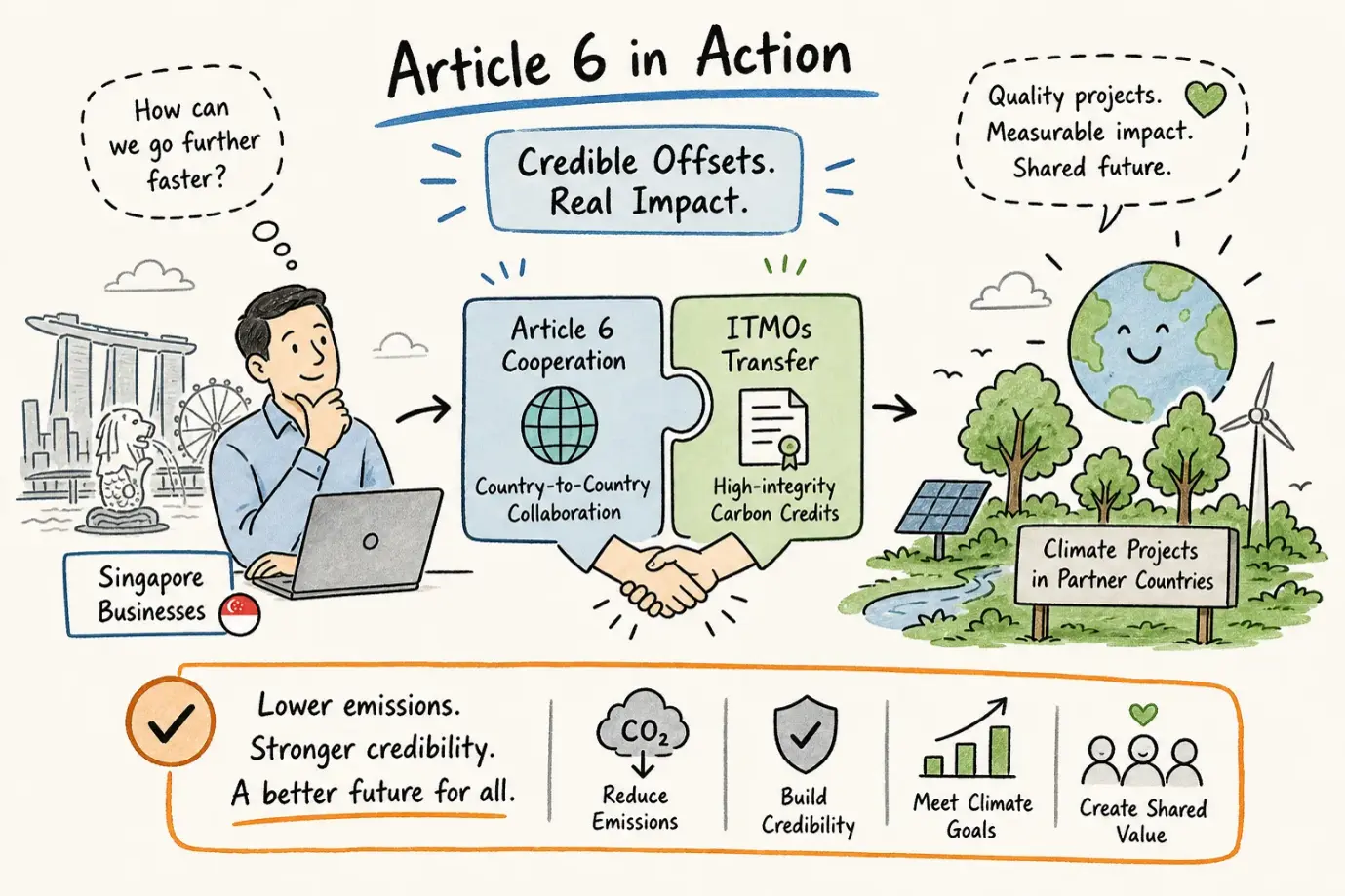
Article 6-aligned offsets are no longer just a conference talking point; they...
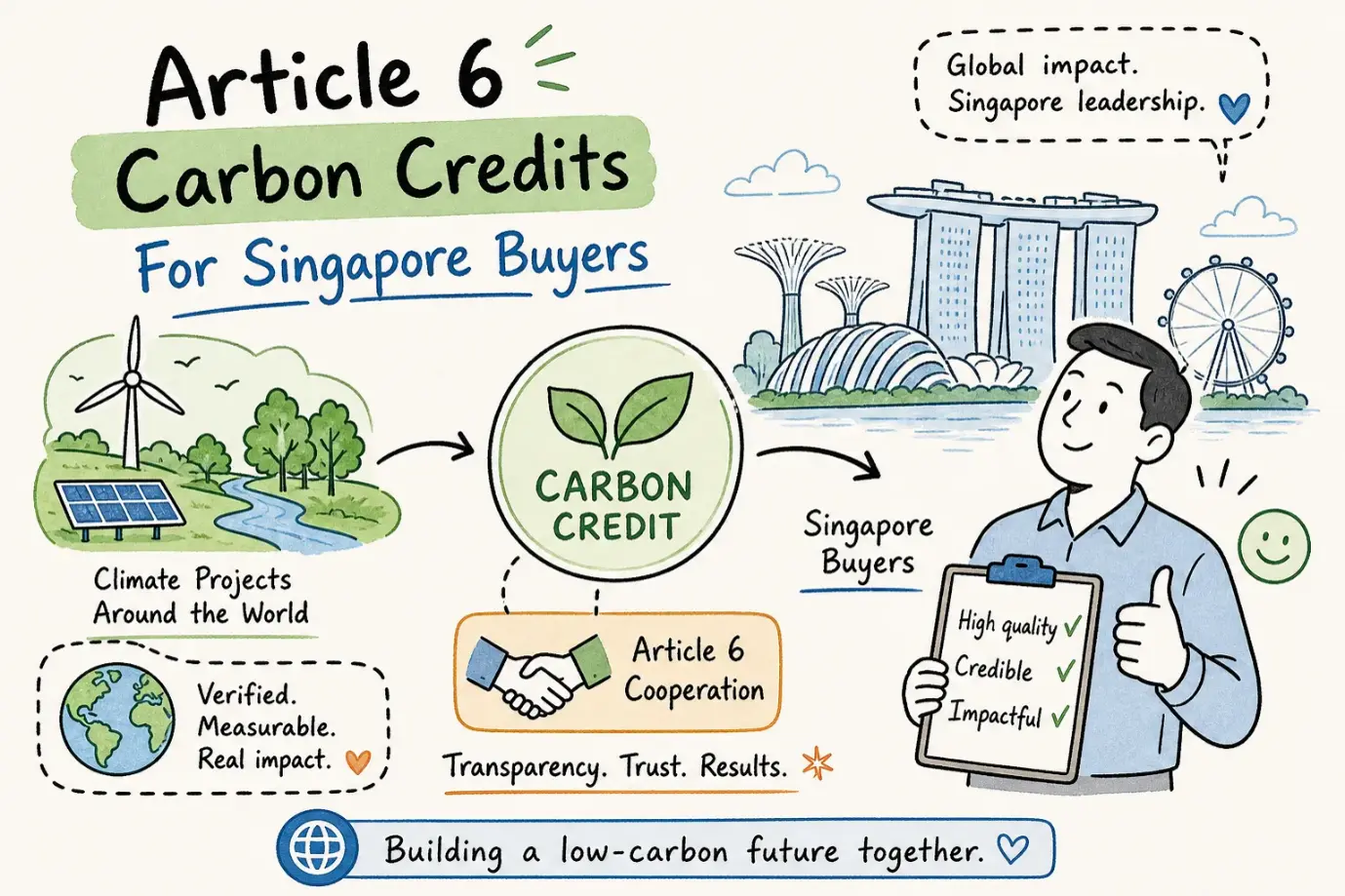
Article 6 carbon credits are fundamentally different from standard voluntary offsets, and...
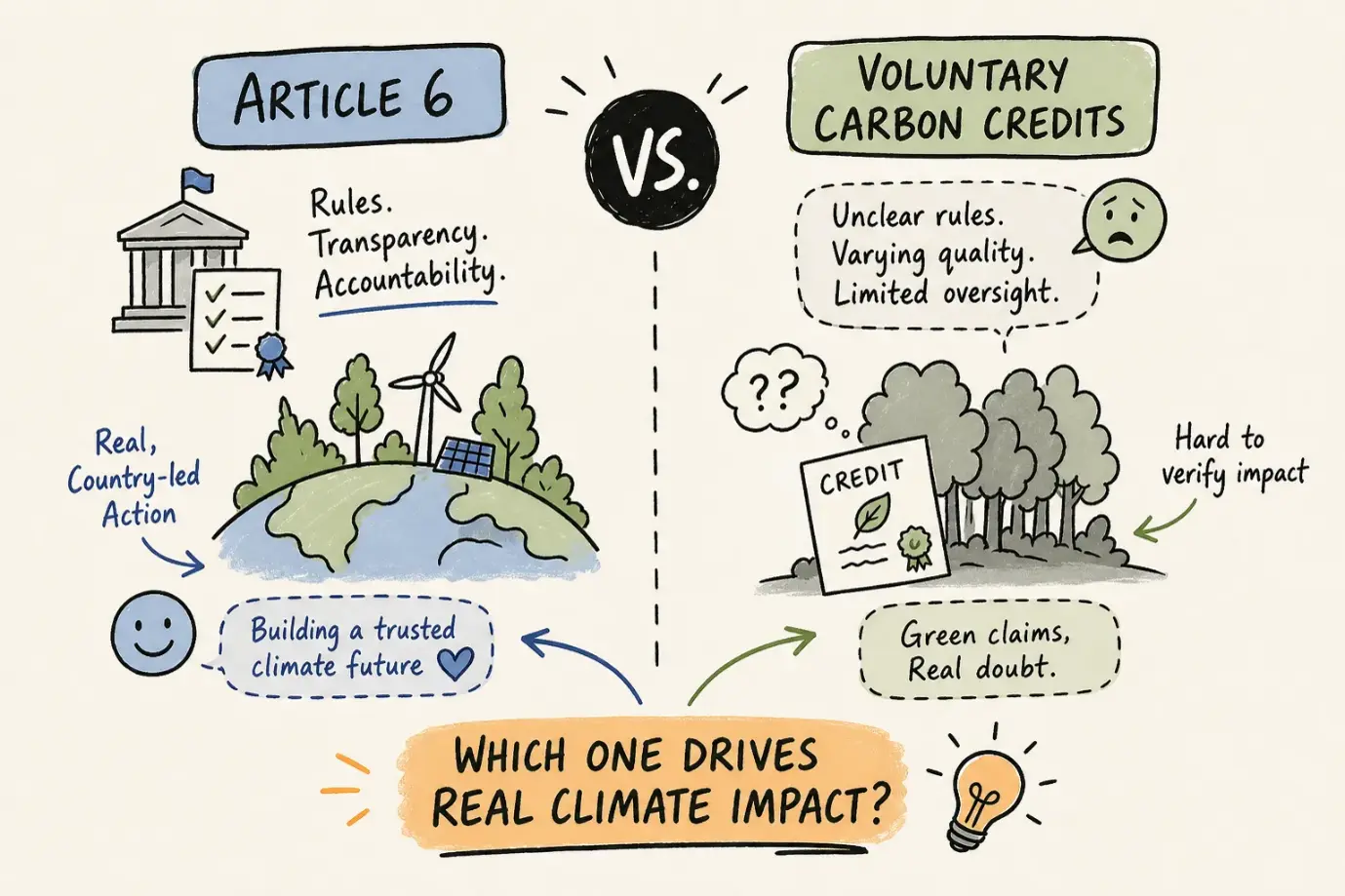
Understanding the difference between Article 6 and voluntary carbon market credits is...
Carbon neutral vs net zero: two terms, both sound green, both are...
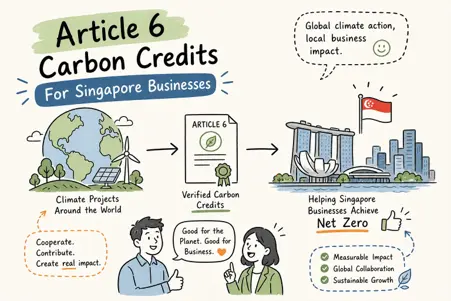
For Singapore businesses, Article 6 carbon credits explained properly can mean the...
Carbon neutrality claims are increasingly visible in Singapore's events industry. Conference programmes...

Green Passport Carbon
Quick Links
More Information
 Optimized by Seraphinite Accelerator