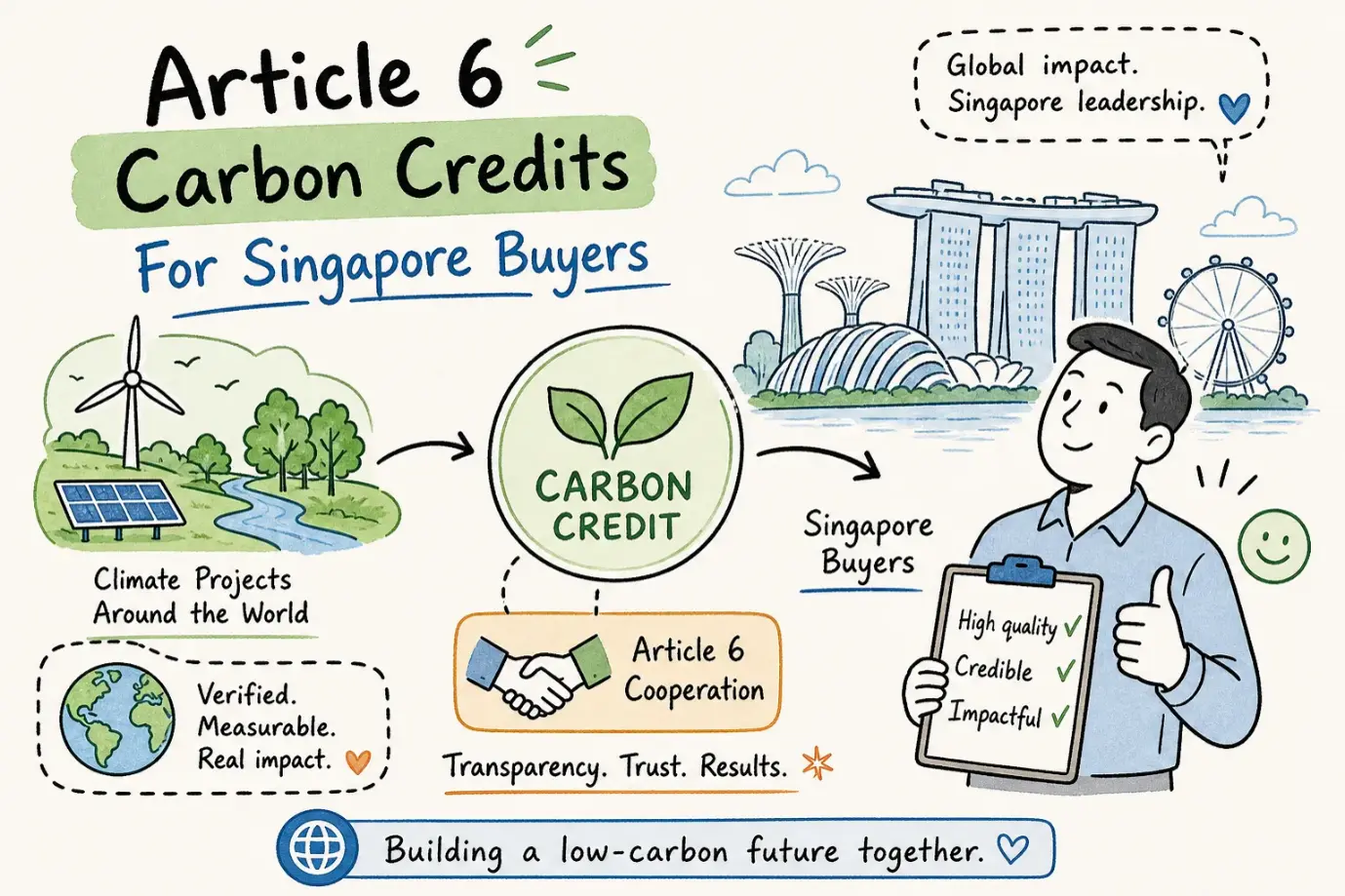
Article 6 Carbon Credits Explained for...
Article 6 carbon credits are fundamentally different from standard voluntary offsets, and...

Green Passport Carbon , Singapore

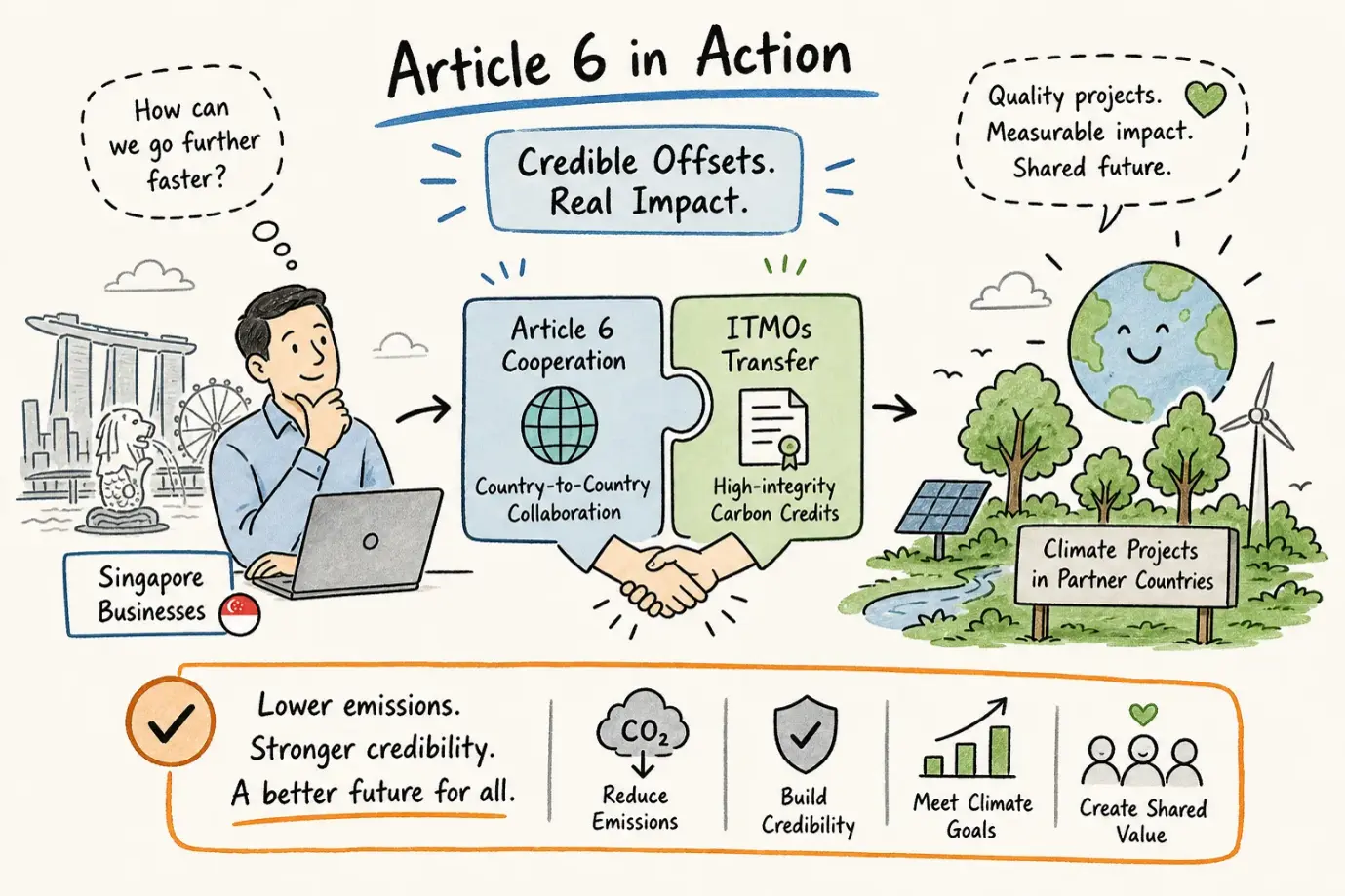
Article 6-aligned offsets are no longer just a conference talking point; they increasingly appear in audit queries, investor questionnaires, and procurement checklists. The gap between a credible offset and a questionable one is no longer theoretical; it is the difference between a carbon claim that holds up under scrutiny and one that quietly unravels when anyone looks closely. For Singapore event organisers and corporate ESG teams, this distinction now carries real consequences.
Article 6-aligned offsets are credits that carry host-country authorisation for international use, paired with an accounting mechanism that prevents the same emission reduction from being claimed by two different parties at once. Understanding this distinction is no longer optional. Regulators, sponsors, and international clients are all asking the same question: how do we know this offset actually counts? At Green Passport Carbon, we help event organisers retire eligible carbon credits against event footprints, and the explanation below is the clearest account we can give of how this framework actually works.
The phrase “Article 6-aligned” does not appear as a defined term in the Paris Agreement text itself. In market practice, it describes offsets that satisfy two specific conditions: the host country has authorised the credit for international use, and an accounting mechanism has been applied so the same tonne cannot be counted by both the host country and the corporate buyer. Meeting one condition without the other does not clear the bar.
Two separate pathways exist within Article 6. Article 6.2 is the country-to-country cooperative framework. Under this pathway, countries transfer Internationally Transferred Mitigation Outcomes (ITMOs) bilaterally, with each government accounting for the transfer in its own national records. Article 6.4 is the UN-supervised crediting mechanism, sometimes described as the successor to the Clean Development Mechanism. It issues standardised Article 6.4 Emission Reduction units (A6.4 ERs) from approved projects under supervisory body rules. Both pathways require explicit host-country authorisation to qualify as genuinely Article 6-aligned offsets. That authorisation step is what separates these credits from standard voluntary offsets.
This matters because a credit issued under Verra, Gold Standard, or another voluntary standard is not automatically Article 6-aligned. Authorisation is a separate, formal act that the host government must take. Without it, the credit remains a standard voluntary offset, and both the host country and the corporate buyer could, in principle, be claiming the same reduction in their respective accounts. That double-counting problem is precisely what Article 6 was designed to solve.
The accounting logic behind corresponding adjustments is straightforward. When a host country authorises an ITMO for international use, it adds that amount back to its own emissions account as a debit. The acquiring country subtracts the same amount from its account. The result is one claim, one tonne, one account. No double-counting.
For companies, this mechanism can add an extra layer of defensibility. When you retire one of these credits with a documented corresponding adjustment, you are retiring a reduction that the host country has formally released, it is not sitting on two balance sheets at once. Without this mechanism, a corporate ESG claim built on standard voluntary offsets can be challenged on the grounds that the host country is simultaneously counting the same reduction toward its own Nationally Determined Contribution. Singapore’s October 2025 guidance on carbon credits states that corresponding adjustment requirements do not apply to corporate buyers meeting voluntary climate commitments, and that a corresponding adjustment does not by itself indicate the quality of a credit, which must be assessed separately. Buyers should still disclose whether their credits include one.
Sustainability reports, CDP submissions, and Singapore’s SGX and ACRA climate reporting requirements are all under increasing scrutiny. For voluntary claims, an offset without a corresponding adjustment is not automatically a weakness under Singapore’s guidance, but its status should be disclosed clearly. An Article 6-aligned offset with documented authorisation and a traceable adjustment is structurally different from a standard voluntary offset in ways that matter to anyone reading your ESG report with a critical eye.
Singapore introduced its International Carbon Credits (ICC) Framework on 1 January 2024. Under this framework, taxable facilities covered by the carbon tax can use eligible international credits to offset up to 5% of their taxable emissions. The credits must meet Singapore’s specific eligibility criteria: not double counted, additional, real, quantified and verified, permanent, no net harm, and no leakage. They must also come from approved host countries and programmes listed on the National Environment Agency’s (NEA) published eligibility list.
As of October 2026, Singapore has signed or substantively concluded 12 bilateral Article 6.2 Implementation Agreements, covering Ghana, Bhutan, Peru, Rwanda, Thailand, Papua New Guinea, Vietnam, the Philippines, Mongolia, Chile, Paraguay and Lao PDR. Approved programmes under these agreements include recognised standards such as Gold Standard, Verra’s Verified Carbon Standard, and the American Carbon Registry (ACR), but only for credits specifically authorised under Singapore’s bilateral framework, and the Eligibility List differs by host country. The registry label matters: a credit must carry documented Article 6 authorisation on its registry record to qualify.
The 5% ceiling applies to compliance surrender. The process for taxable facilities is clear: confirm the credit is on NEA’s Eligibility List, submit a Notice of ICC Use to NEA, procure the credits from an authorised registry, and surrender them against the carbon tax liability. A credit that lacks host-country authorisation will not qualify regardless of how strong the underlying project is, Singapore’s eligibility framework is explicitly tied to Article 6 authorisation rules, not just project quality.
Corporates making voluntary carbon neutrality claims, not just taxable facilities, face the same credibility standard from their own stakeholders. The 5% rule applies only to compliance surrender. For voluntary claims, Singapore’s October 2025 guidance on carbon credits states that corresponding adjustment requirements do not apply to corporate buyers meeting voluntary climate commitments, and that a corresponding adjustment does not by itself indicate the quality of a credit, which must be assessed separately. Buyers should still disclose whether their credits include one. In Singapore’s MICE sector, some international clients and sponsors may still prefer credits with corresponding adjustments, so it is worth confirming their expectations early.
Early Article 6.2 transactions have already drawn criticism. Some credits were issued while emissions in the host country were rising, which directly undermines additionality, the basic test that a reduction would not have happened without the crediting incentive. Legacy CDM problems, rainforest credit controversies, and weak baseline discipline have all resurfaced in early Article 6 activity. The risk is real, and due diligence is not optional.
These are the checks that actually matter before accepting any Article 6-aligned offset:
Host-country authorisation documented and traceable to the relevant UNFCCC registry
Corresponding adjustment confirmed in writing, not merely promised
Conservative baseline methodology with independent third-party verification
Credible additionality analysis that goes beyond regulatory screening alone
Verification by an accredited body with no conflict of interest with the project developer
Public registry record showing issuance, transfer, and retirement in a single traceable chain
Verra, Gold Standard, ACR, and the Climate Action Reserve (CAR) all have registry infrastructure capable of tagging credits as Article 6-authorised, but only when the host government has taken that formal step. A credit without that specific flag on its registry record has not cleared the bar. For Singapore buyers, the additional check is whether the credit appears on NEA’s approved programme list under the relevant bilateral implementation agreement.
Many credits from high-quality projects in eligible countries still lack authorisation because the host government has not formally applied for or granted it. Project quality and Article 6 authorisation are two separate assessments, and the corresponding adjustment must be confirmed in the documentation, not assumed from the project’s reputation or standard certification alone.
For event organisers and corporate ESG teams in Singapore, the practical question is straightforward: who does this due diligence for you? Green Passport Carbon’s three-step process, Calculate, Retire, Certify, is designed to bring these steps together. It estimates the event footprint, arranges the retirement of eligible carbon credits with documented retirement records, and issues a branded Green Passport Carbon certificate. Where a client specifically needs Article 6-authorised credits with a corresponding adjustment, that status should be confirmed and documented for the specific credits before retirement. The calculator itself is free and gives a Free Event Carbon Estimate; the Full Event Carbon Assessment, carbon-credit retirement and the Green Passport Carbon Event Certificate are provided as part of Green Passport Carbon’s quote-based service.
The calculation estimates the main event sources, including travel, venue operations, accommodation and catering, using documented emission factors and assumptions informed by recognised carbon-accounting principles. Eligible credits are then retired against that event’s calculated footprint, with the retirement tied to the event record and documentation that can support ESG reporting.
The Green Passport Carbon certificate issued at the end of this process records the event, the calculated footprint and the carbon credits retired, with a unique certificate ID and a public verification link that confirms the certificate’s status. It is not an ISO certification or an independent third-party verification of the footprint. A corporate sponsor or attendee can see what was done and which credits were used, and should still ask for registry details and corresponding-adjustment status where a claim depends on them. Contact our team to run through what this looks like for your next event.
Article 6-aligned offsets are not just a compliance term. They represent a concrete accounting standard, one that prevents double-counting, supports defensible ESG claims, and aligns with Singapore’s own regulatory direction. For event organisers and sustainability teams who need to stand behind their carbon neutrality claims, the corresponding adjustment is what separates a credible offset record from one that will not survive close inspection.
The path forward requires discipline rather than complexity. Verify host-country authorisation. Confirm the corresponding adjustment is documented. Check the registry record. Work with a provider who handles the sourcing, retirement, and documentation as a single end-to-end process rather than leaving you to assemble it from separate sources. That is exactly what Green Passport Carbon is built to do, and it is why understanding the distinction between Article 6-aligned offsets and standard voluntary credits matters before your next event carbon claim goes into a sustainability report.
Article 6 carbon credits are fundamentally different from standard voluntary offsets, and...
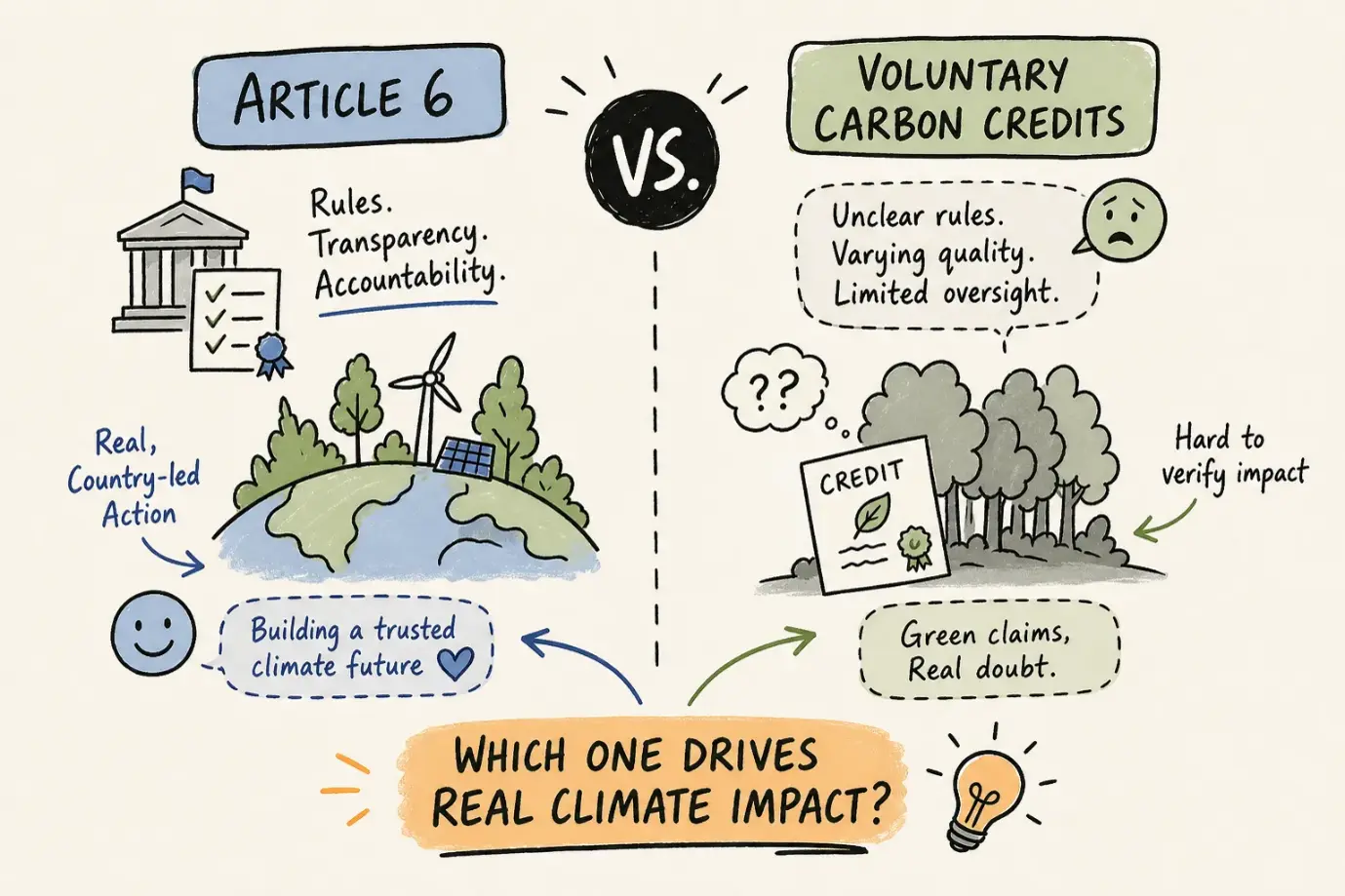
Understanding the difference between Article 6 and voluntary carbon market credits is...
For Singapore businesses, Article 6 carbon credits explained properly can mean the...
Find quick answers about the Event Carbon Calculator, your emissions estimate, and what happens next.
There is no official threshold. The most cited reference is approximately 14.13 kg CO2 per attendee for venue-related emissions, with energy the dominant contributor. Note this excludes attendee travel, so a full-scope per-attendee figure will typically be higher. Treat it as a comparative benchmark for the venue category rather than a pass mark for the whole event.
Yes. SACEOS has published WA 4: Sustainable MICE — Guidelines for Carbon Emissions Management, a Singapore Standards workspace agreement covering measurement, reduction, calculation, verification and offset. Separately, the Singapore MICE Sustainability Certification (MSC) provides GSTC-Recognised organisational certification, and STB and SACEOS will develop a MICE Decarbonisation Framework by 2028.
Air-conditioning, lighting and audiovisual systems run continuously through operating hours regardless of attendee behaviour, making venue energy a structural and relatively predictable load. In Singapore’s climate, cooling demand is both unavoidable and substantial. This is why the MICE Venue Sustainability Playbook points to emissions per square foot of venue area as a comparable metric.
Yes — and then raised them. By 2025 the original roadmap targets were exceeded, with all purpose-built MICE venues and over 80% of SACEOS member companies certified. Roadmap 2.0, unveiled in July 2026, commits to a MICE Decarbonisation Framework by 2028 and net zero by 2050.
No. MSC certifies the organisation across domains including carbon, waste, energy, water, social responsibility, HR competency and procurement, valid for two years. It does not produce a per-event footprint figure or evidence that a specific event’s emissions were addressed. Those are separate exercises.
Article 6-aligned offsets are no longer just a conference talking point; they...
Article 6 carbon credits are fundamentally different from standard voluntary offsets, and...
Understanding the difference between Article 6 and voluntary carbon market credits is...
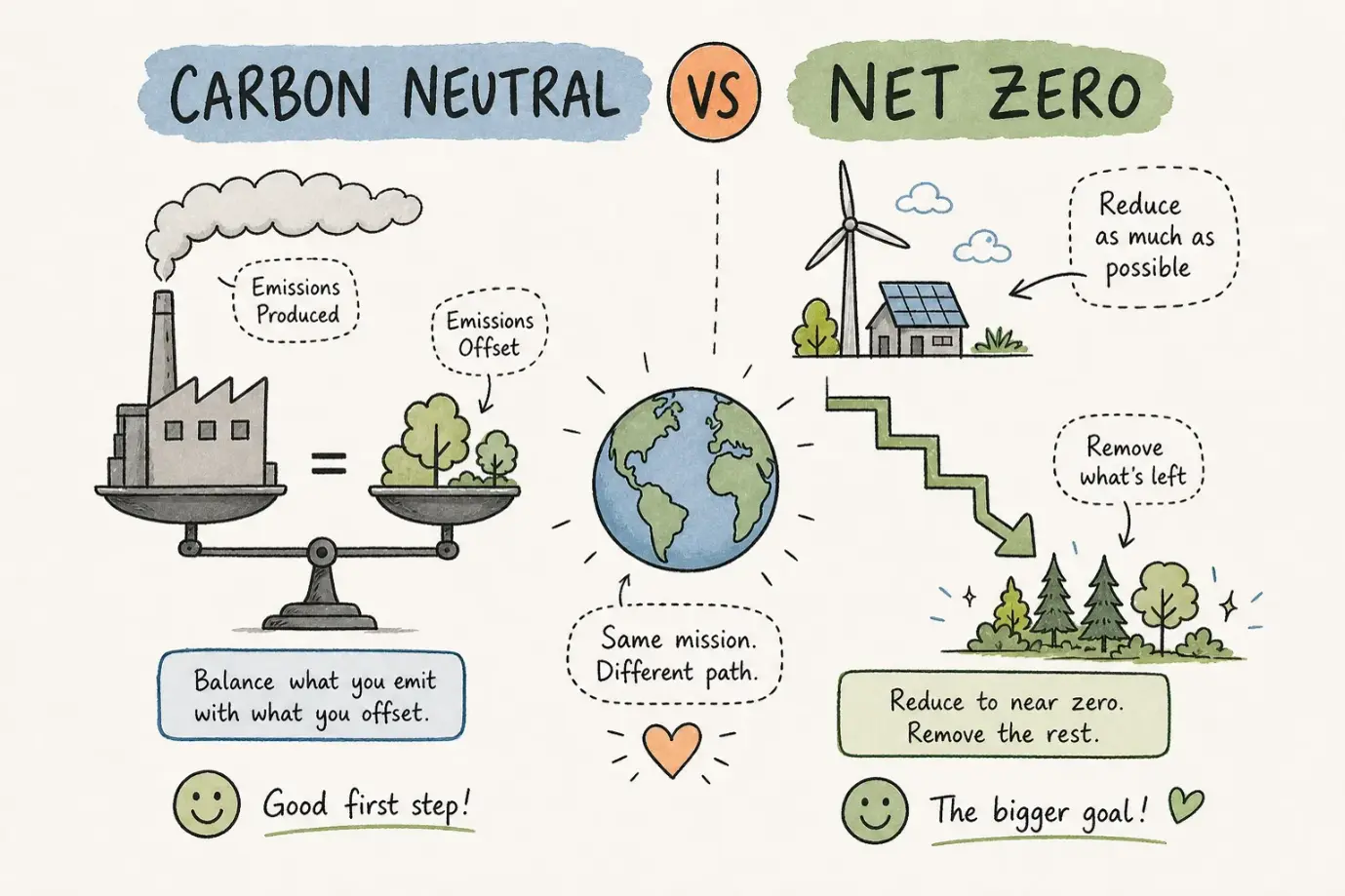
Carbon neutral vs net zero: two terms, both sound green, both are...
For Singapore businesses, Article 6 carbon credits explained properly can mean the...
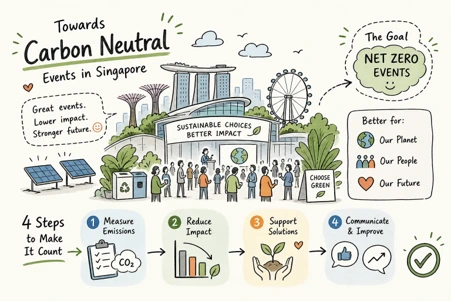
Carbon neutrality claims are increasingly visible in Singapore's events industry. Conference programmes...

Green Passport Carbon
Quick Links
More Information
 Optimized by Seraphinite Accelerator