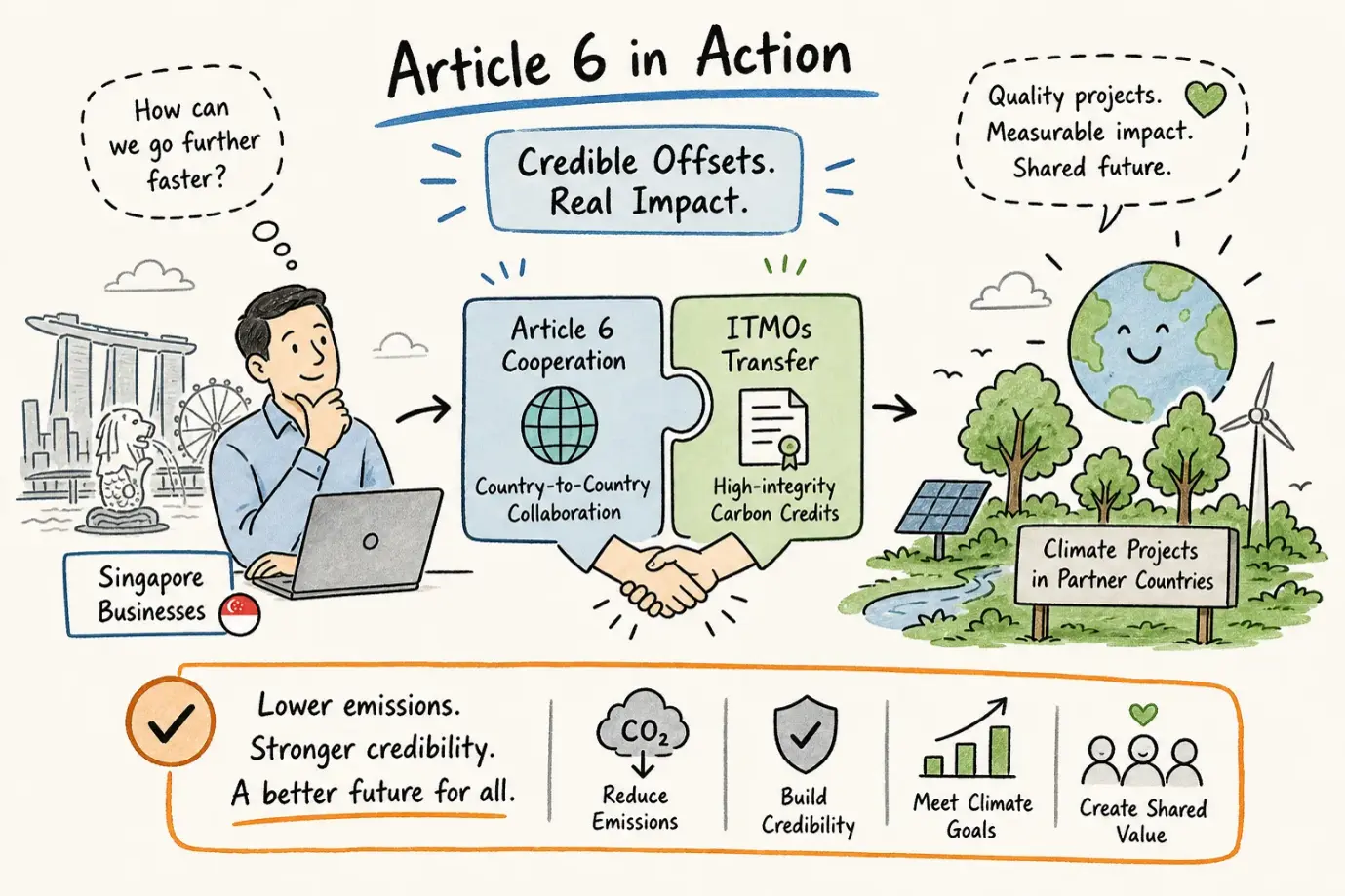
Article 6-aligned offsets explained for Singapore...
Article 6-aligned offsets are no longer just a conference talking point; they...

Green Passport Carbon , Singapore

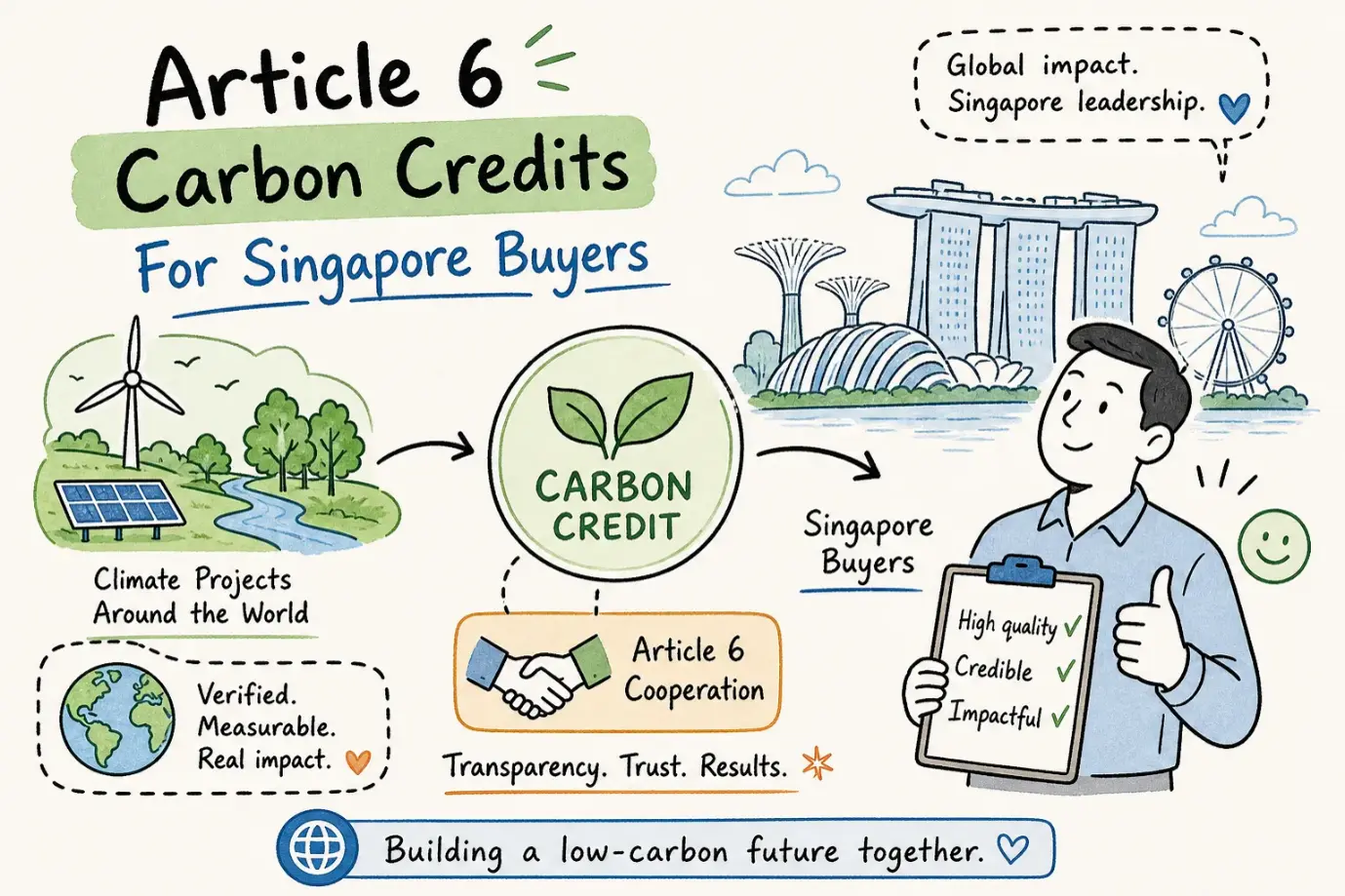
Article 6 carbon credits are fundamentally different from standard voluntary offsets, and many buyers do not realise that until someone asks the right questions. Many organisations purchasing carbon credits do not verify what type of credit they actually hold. They assume a credit is a credit. It isn’t. Credits issued under Article 6 of the Paris Agreement add a layer of government authorisation and national accounting on top of normal project rules, designed to prevent the same reduction being counted by two countries. That distinction is worth understanding before any organisation uses credits in a carbon neutrality claim.
This piece explains what Article 6 carbon credits actually are, how the two mechanisms differ, what the first wave of issued credits revealed about real-world integrity, and what any Singapore buyer needs to evaluate before using these credits in a formal sustainability claim. Singapore-based providers like Green Passport Carbon help event organisers estimate emissions and retire eligible carbon credits, so knowing what to check matters. By the end of this article, you will understand which questions to ask.
Standard voluntary carbon market credits are generated and sold independently of national climate accounting. A company buys a credit issued by a registry. The emission reduction it represents gets claimed by that company. Meanwhile, the host country where the underlying project sits can still count that same tonne toward its own nationally determined contribution (NDC). Critics describe this as double claiming: the same reduction appears in the buyer’s claim and in the host country’s national accounts. Singapore’s guidance treats voluntary corporate claims as accounted separately from national targets, but buyers should still understand and disclose this point.
Article 6 of the Paris Agreement was designed to fix this. Where a credit is authorised under Article 6 for international use, it must be accompanied by a corresponding adjustment. When the host country transfers an Article 6 credit authorised for international purposes, it formally subtracts that tonne from its own national accounting. This prevents the same tonne being counted towards two countries’ targets. For a voluntary carbon neutrality claim, it can add assurance, but it is not a requirement. Singapore’s October 2025 guidance on carbon credits states that corresponding adjustment requirements do not apply to corporate buyers meeting voluntary climate commitments, and that a corresponding adjustment does not by itself indicate the quality of a credit, which must be assessed separately. Buyers should still disclose whether their credits include one.
Article 6 contains two separate crediting mechanisms. Understanding the difference matters if you are evaluating which type of credit you are actually holding, particularly as Article 6 operationalisation progresses and more credits enter circulation with varying levels of host-country authorisation and accounting treatment.
Article 6.2 governs country-to-country cooperative approaches. Under this mechanism, two or more governments establish a bilateral or multilateral arrangement. The mitigation outcome transferred between them is called an Internationally Transferred Mitigation Outcome, or ITMO. There is no single global registry issuing these units. The framework is decentralised, with each bilateral agreement defining its own project authorisation process, reporting requirements, and corresponding adjustment obligations. Singapore’s approach to Article 6 is primarily through this mechanism. As of October 2026, Singapore has signed or substantively concluded Implementation Agreements with 12 partner countries: Papua New Guinea, Ghana, Bhutan, Chile, Peru, Rwanda, Paraguay, Thailand, Vietnam, Mongolia, the Philippines and Lao PDR, which signed in September 2026.
Article 6.4 creates a centralised UN-supervised mechanism. A Supervisory Body sets methodologies and validates projects globally. The units it issues are called A6.4ERs. Once a host country authorises an A6.4ER for international use, it becomes an ITMO and must follow Article 6.2 accounting rules, including the corresponding adjustment obligation. The centralised structure theoretically provides more uniform standards. In practice, as early analysis of the first project transitioning into the mechanism suggested, strong rules on paper do not automatically translate into high-integrity outcomes if the underlying methodologies are flawed.
In April 2025, before any credits had been issued, Carbon Market Watch analysed the project expected to generate the first Article 6.4 credits and the findings were stark. The project was expected to generate approximately 26 times more credits than peer-reviewed science suggests the actual emission reductions justify. Only about one in 26 credits would likely represent a real tonne of reduced emissions. When the UN Supervisory Body approved the first issuance from this Myanmar cookstove project in February 2026, it reported that updated, more conservative calculations had reduced the credited volume by roughly 40% compared with the CDM approach. Civil society groups have continued to question the project’s integrity.
The methodology in question was CDM’s AMS-II.G, a cookstove methodology. The assumptions underlying it, including stove usage rates, participant dropout patterns, and fuel consumption figures, were cited as outdated and unrealistic. At the time of that analysis, AMS-II.G had not been approved by the Integrity Council for the Voluntary Carbon Market. The Methodological Expert Panel under the Article 6.4 Supervisory Body had the methodology listed as under revision, not approved for current use under the new mechanism.
The structural implication here is important. This was not a rogue project slipping through. It was a design-flaw issue: even under a centralised UN mechanism, if the methodology that gets approved is flawed, the credits that flow from it will be inflated. The authorisation paperwork can look entirely correct while the underlying credit represents a fraction of the emission reduction claimed. For any buyer, this means that Article 6 authorisation is a necessary condition for credit integrity, but not a sufficient one. The methodology still needs to stand up independently.
Singapore has built one of the more structured national frameworks for implementing Article 6. Under the International Carbon Credit (ICC) framework, as set out in Singapore’s carbon tax legislation and accompanying policy guidance, taxable facilities are permitted to use eligible international carbon credits to offset up to 5% of their taxable emissions. To qualify, credits must come from projects authorised through Singapore’s bilateral Implementation Agreements, and they must carry a corresponding adjustment from the host country. Credits must also satisfy seven environmental-integrity principles enumerated in the ICC framework: no double counting, additional, real, quantified and verified, permanent, no net harm, and no leakage.
Under Singapore’s bilateral arrangements, credits are subject to a 2% cancellation at first issuance, contributing to overall mitigation of global emissions (OMGE), a requirement that ensures a portion of every transferred unit delivers a net atmospheric benefit rather than simply transferring an existing reduction between parties. Project developers also make a monetary contribution equivalent to a 5% share of proceeds towards adaptation in the host country or the UNFCCC Adaptation Fund. These are safeguards baked into the bilateral structure, not optional add-ons.
In September 2025, Singapore announced that it will contract 2.175 million tonnes of high-quality nature-based carbon credits, valued at about S$76 million, from four projects in Ghana, Peru and Paraguay, with delivery between 2026 and 2030 to help meet its 2030 national target. This signals that Singapore is moving from framework-building into active credit supply development. The eligible credit pool is growing and the standards are clearly defined, although the Government reported in November 2025 that no credits had yet been purchased under the International Carbon Credit framework.
The mechanics of Article 6 are complex enough that it is easy to rely on a seller’s representation rather than verify independently. That is a risk; here is what actually needs checking.
Host-country authorisation with corresponding adjustment. The host government must have formally authorised the credit for international use and must be excluding that tonne from its own NDC accounting. This distinction matters: an A6.4ER that has been issued but not yet authorised for international use does not yet carry a corresponding adjustment. Without confirmed authorisation, the credit is not a genuine Article 6 unit regardless of what the seller claims or how the marketing describes it.
Methodology integrity. Look at the specific methodology used to calculate the emission reductions. Has it been reviewed by a credible, independent body? Is it listed as approved by the ICVCM or an equivalent integrity standard? If it relies on a transitioning CDM methodology, check its current approval status. Not all CDM methodologies carried into Article 6 have been validated for current use. AMS-II.G is the most visible example of this problem, but it is not the only one.
Additionality evidence. The project must demonstrate that the emission reductions would not have occurred without the carbon finance. Projects based on activities that are already legally required or commercially viable on their own do not meet this threshold. Additionality is not a formality. It is the core of what makes a credit worth anything.
Beyond these, confirm the credit is registered and tracked in a transparent registry with a clear retirement record. Verify the credit has not been used for any other claim by any other party. Check whether the project’s baseline assumptions reflect current conditions rather than outdated reference scenarios that inflate the apparent size of the reduction.
Event carbon footprints, covering travel, venue energy, accommodation, and catering, are typically scope 3 emissions. They fall outside Singapore’s carbon tax framework, and event organisers are not taxable facilities. But corporate clients, sponsors, and ESG reporting frameworks increasingly require that event-related emissions be offset credibly. The type of credit used determines whether those claims will survive scrutiny. A corresponding adjustment can strengthen a claim in some contexts, but it does not by itself make a credit high quality. For a claim that needs to hold up in an ESG report or client review, organisers should be able to show methodology quality, registry retirement records and whether a corresponding adjustment applies.
Green Passport Carbon is purpose-built for Singapore’s MICE sector. Its Calculate, Retire, Certify process covers an indicative emissions estimate for key event sources, the retirement of eligible carbon credits with documented retirement records, and a branded Green Passport Carbon certificate prepared with reference to the principles of ISO 14068-1 (now revised as ISO 14068:2026). The certificate documents the carbon action taken; it is not an ISO certification or an independent third-party verification. Where a client specifically needs Article 6-authorised credits with a corresponding adjustment, that status should be confirmed and documented for the specific credits before retirement. The calculator itself is free and gives a Free Event Carbon Estimate; the Full Event Carbon Assessment, carbon-credit retirement and the Green Passport Carbon Event Certificate are provided as part of Green Passport Carbon’s quote-based service.
If you are organising events in Singapore and need a credible, documented approach to carbon neutrality, get in touch with the Green Passport Carbon team to understand how this works in practice.
Article 6 carbon credits represent a meaningful step forward in credit quality. The corresponding adjustment requirement helps prevent the same reduction being counted by two countries. But the mechanism alone does not guarantee integrity. The April 2025 Carbon Market Watch findings suggested that authorisation paperwork and a flawed methodology can coexist. Buyers who do not look past the label are exposed.
For Singapore event organisers, the simplest path to credible carbon action is working with a provider that documents the calculation, the credits selected and the retirement records clearly, and is transparent about what its certificate does and does not cover. Organisers should still ask for the project, registry, vintage and corresponding-adjustment status of any credits retired on their behalf.
Organisations that understand what distinguishes Article 6 carbon credits from standard voluntary offsets make better decisions and better claims. Those that do not are exposed, often at the moment when scrutiny matters most.
Article 6-aligned offsets are no longer just a conference talking point; they...
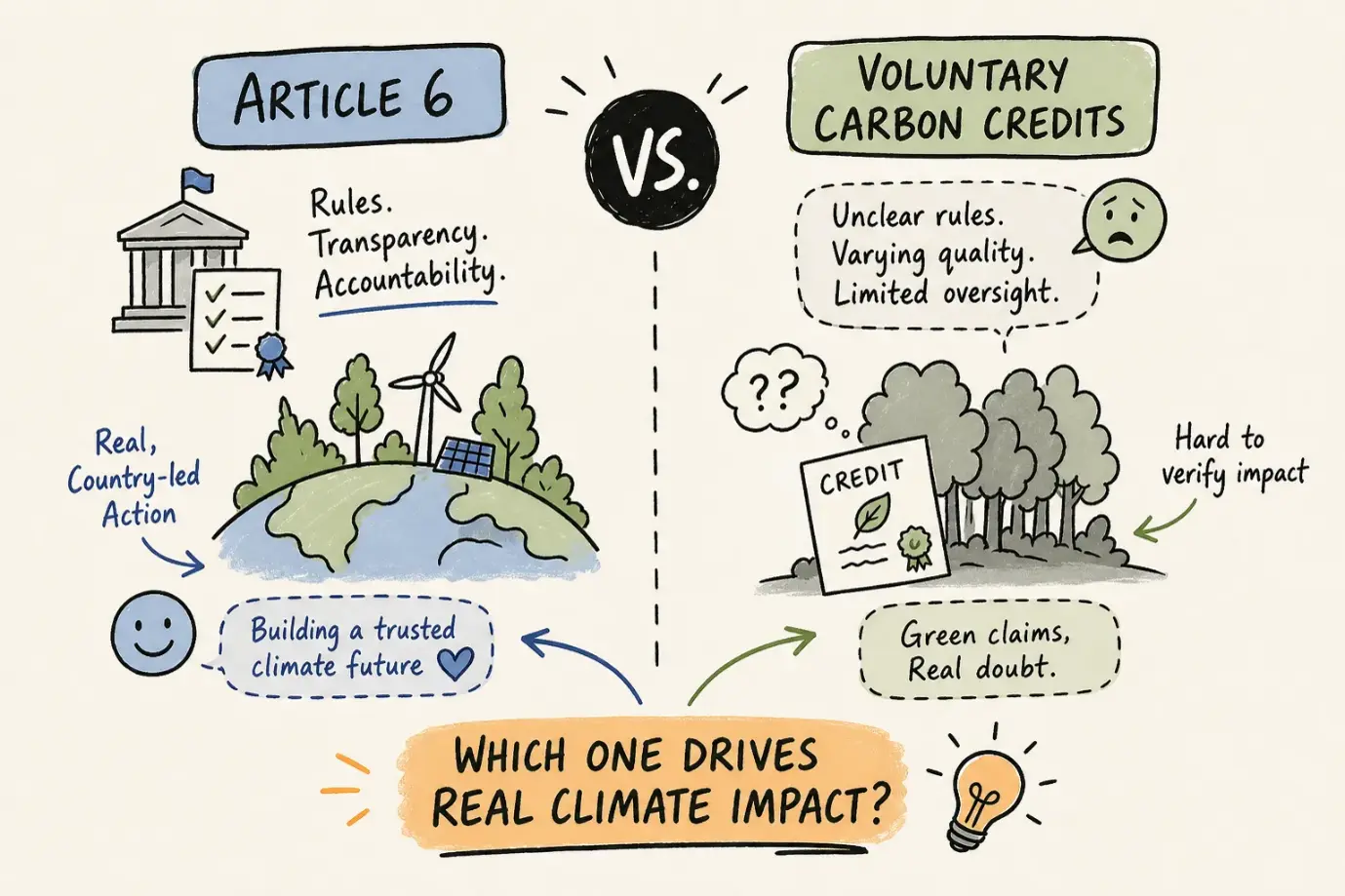
Understanding the difference between Article 6 and voluntary carbon market credits is...
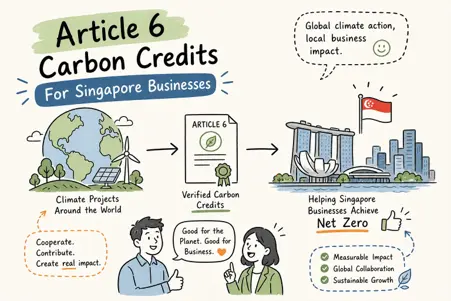
For Singapore businesses, Article 6 carbon credits explained properly can mean the...
Find quick answers about the Event Carbon Calculator, your emissions estimate, and what happens next.
There is no official threshold. The most cited reference is approximately 14.13 kg CO2 per attendee for venue-related emissions, with energy the dominant contributor. Note this excludes attendee travel, so a full-scope per-attendee figure will typically be higher. Treat it as a comparative benchmark for the venue category rather than a pass mark for the whole event.
Yes. SACEOS has published WA 4: Sustainable MICE — Guidelines for Carbon Emissions Management, a Singapore Standards workspace agreement covering measurement, reduction, calculation, verification and offset. Separately, the Singapore MICE Sustainability Certification (MSC) provides GSTC-Recognised organisational certification, and STB and SACEOS will develop a MICE Decarbonisation Framework by 2028.
Air-conditioning, lighting and audiovisual systems run continuously through operating hours regardless of attendee behaviour, making venue energy a structural and relatively predictable load. In Singapore’s climate, cooling demand is both unavoidable and substantial. This is why the MICE Venue Sustainability Playbook points to emissions per square foot of venue area as a comparable metric.
Yes — and then raised them. By 2025 the original roadmap targets were exceeded, with all purpose-built MICE venues and over 80% of SACEOS member companies certified. Roadmap 2.0, unveiled in July 2026, commits to a MICE Decarbonisation Framework by 2028 and net zero by 2050.
No. MSC certifies the organisation across domains including carbon, waste, energy, water, social responsibility, HR competency and procurement, valid for two years. It does not produce a per-event footprint figure or evidence that a specific event’s emissions were addressed. Those are separate exercises.
Article 6-aligned offsets are no longer just a conference talking point; they...
Article 6 carbon credits are fundamentally different from standard voluntary offsets, and...
Understanding the difference between Article 6 and voluntary carbon market credits is...
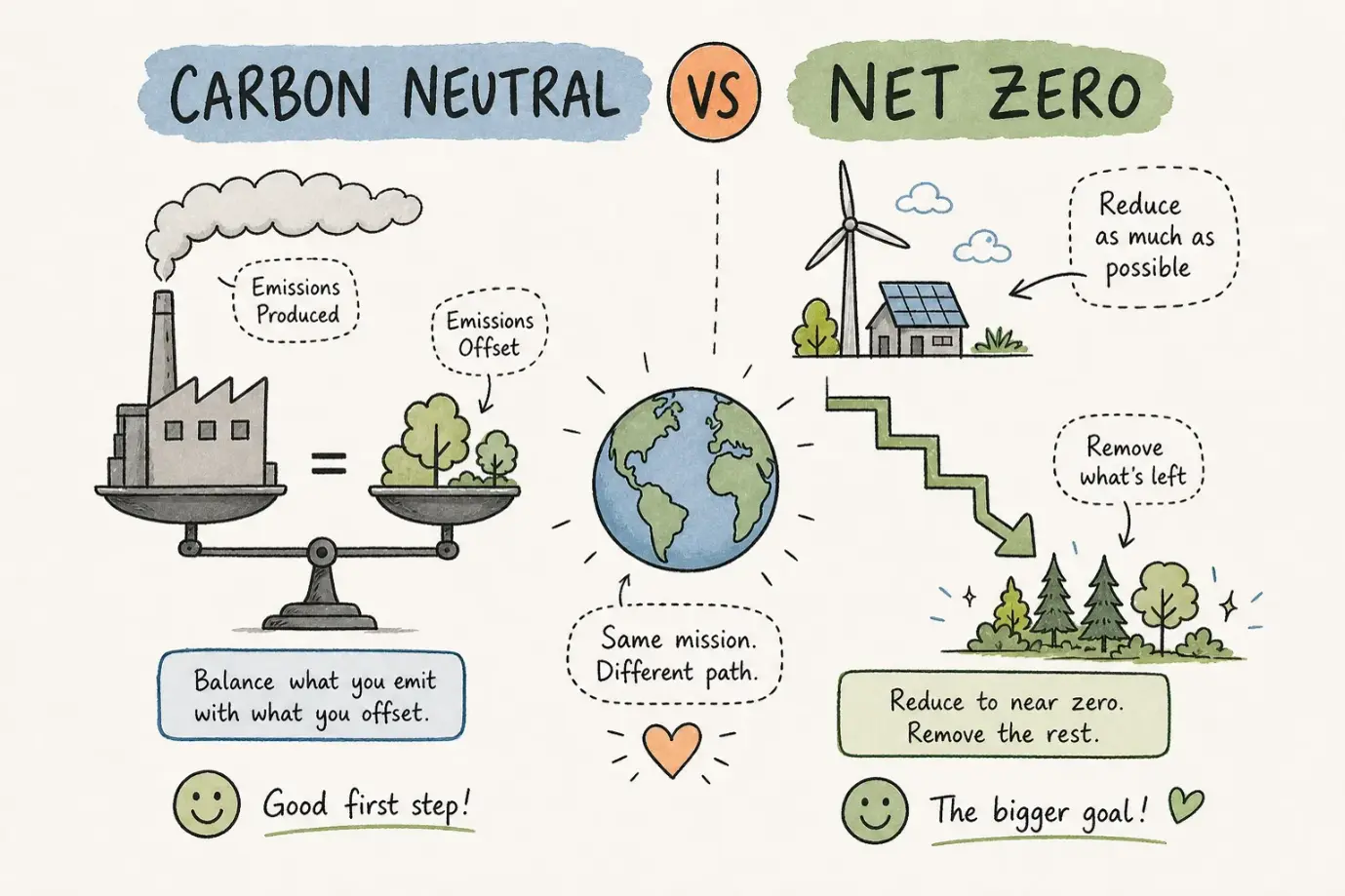
Carbon neutral vs net zero: two terms, both sound green, both are...
For Singapore businesses, Article 6 carbon credits explained properly can mean the...
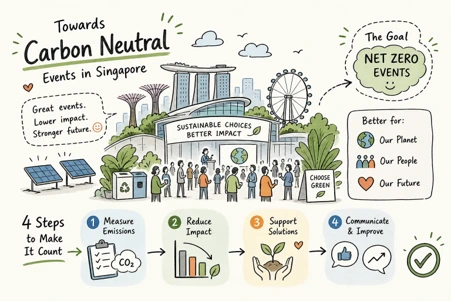
Carbon neutrality claims are increasingly visible in Singapore's events industry. Conference programmes...

Green Passport Carbon
Quick Links
More Information
 Optimized by Seraphinite Accelerator