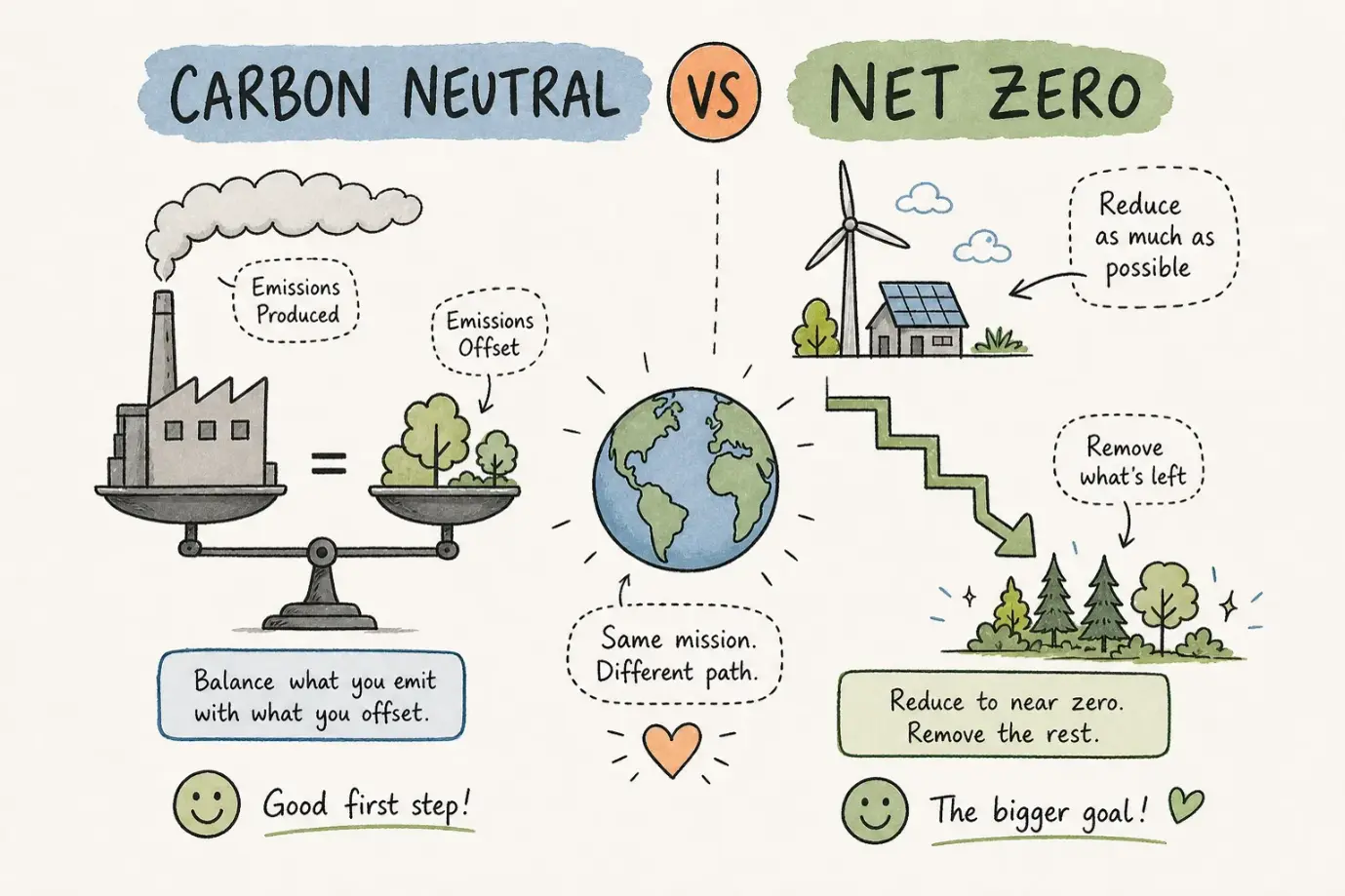
Carbon neutral vs net zero: what’s...
Carbon neutral vs net zero: two terms, both sound green, both are...

Green Passport Carbon , Singapore


Clients are asking. Sponsors are asking. And in Singapore’s MICE sector, procurement teams are increasingly making it a formal requirement. Planning an eco conference in Singapore has moved well beyond a line in the sustainability report, it now shows up in RFPs, venue briefs, and attendee expectations from companies managing their Scope 3 emissions.
The challenge is that many organisers focus on the operational layer: reusable lanyards, plant-based snacks, digital programmes. These choices matter, but they do not automatically produce something you can hand to a procurement team or include in an ESG disclosure. There is a gap between looking sustainable and being able to prove it, and that gap costs organisers credibility when it counts most.
This article walks through every practical layer of planning a genuinely eco-friendly conference in Singapore, from venue selection to carbon certification. Third-party carbon-certification providers exist precisely to bridge that gap between good operations and credible, reportable outcomes. Each decision below connects to the next, building toward a documented outcome rather than a collection of good intentions.
Not all venue sustainability claims carry equal weight. The most credible markers in Singapore’s MICE context are BCA Green Mark (the national building sustainability rating), ISO 14001 environmental management certification, and the Singapore MICE Sustainability Certification (MSC), which is GSTC-recognised and has been attained by venues such as Singapore EXPO at its Platinum tier. Ask whether the certification covers energy, water, and waste, or just one dimension. A Platinum Green Mark rating is substantively different from a standard one, so always request the most recent certificate rather than accepting marketing language.
Marina Bay Sands holds BCA Green Mark Platinum, one of the highest ratings in Singapore’s built environment. The scheme assesses energy and water efficiency, indoor environmental quality, and environmental protection across operations. Suntec Singapore and Resorts World Sentosa have each published sustainability programmes, though their certification details should be verified directly with the venue rather than assumed from promotional materials. The key is asking for disaggregated data, not a brochure.
Before committing to a venue, get specific answers to these: Does the venue have a dedicated sustainability coordinator? Can it provide energy consumption data specific to your event footprint, not just building-wide averages?
It is equally important to ask: Will it accommodate your caterer’s packaging preferences and waste segregation requirements? Does it measure and report waste generated per event, and will it share that data with you? These answers tell you whether your venue choice genuinely supports your sustainability goals or simply provides a green backdrop.
Catering is typically one of the highest-impact decisions after venue and travel. Plant-forward menus can substantially reduce food-related emissions compared to meat-heavy equivalents, lifecycle studies consistently show the gap is significant. You do not need a fully vegan spread; shifting proteins toward plant-based and locally sourced options makes a measurable difference and is increasingly well-received by Singapore conference audiences. Design the menu with plant-based dishes as the default, then add animal-protein options selectively rather than the other way around.
Source from Singapore-based caterers who can demonstrate food provenance, minimise cold-chain transport, and work within SFA food safety frameworks. Shorter supply chains reduce both carbon emissions and food-waste risk because you are not managing perishables across long distances. Caterers already familiar with the Singapore Tourism Board and SACEOS Sustainability Guidelines for MICE or SGBC supplier guidelines are a practical starting point, since they will understand your reporting requirements without needing extensive briefing.
Singapore guidance is clear that buffets generate roughly twice as much food waste as plated or pre-ordered meals, so where the event format allows, pre-ordered portions are the better choice. For buffet-style service, use smaller trays replenished in batches rather than large displays that sit out and go to waste. Commit to reusable crockery for plated meals and compostable serviceware for buffet stations, and brief your caterer on your sustainability targets before finalising the menu, not after.
Surplus food should be directed to donation partners rather than disposed of, this reduces both landfill impact and the emissions associated with food decomposition.
Green conference communications work best when they are specific. “Our catering is 80 per cent plant-forward and served on reusable crockery” lands better than “We are committed to sustainability.” Include a pre-event email section that explains exactly how your carbon footprint will be measured and what action you are taking on it. This builds credibility before attendees arrive and primes them to engage with your sustainability initiatives on the day.
Visible signage at waste stations with clear bin labelling, MRT and bus route cards at registration, and a brief sustainability note in the MC’s opening remarks all shift attendee behaviour without friction. Digital delegate guides instead of printed programmes reduce paper waste significantly, and QR codes make them easy to distribute at check-in. These small signals reinforce that your sustainability commitments are operational, not just aspirational, and they give attendees a role to play.
Share a short sustainability report with attendees shortly after the event, within a few weeks is a reasonable target. Include headline figures: waste diverted, meals served, carbon footprint, and offset action taken. Attendees who see the numbers are far more likely to share them, recommend the event to colleagues, and return the following year. This report also feeds directly into your ESG reporting cycle, doing double duty as both stakeholder communication and internal documentation.
The Singapore Tourism Board’s sustainable business events guidance, including the Sustainability Guidelines for MICE developed with SACEOS and the MICE Sustainability Roadmap, gives organisers practical direction on areas such as energy and carbon, waste, procurement and community impact. It is guidance rather than a mandatory certification, but it is a widely used reference among Singapore MICE buyers and venue partners. Aligning your planning to these pillars gives you a structured checklist and improves your responses to sustainability-focused RFPs. STB’s current guidance also references the Singapore MICE Sustainability Certification framework, GSTC-recognised and held by a growing number of venues and suppliers, making it a natural fit for the sustainability events calendar Singapore 2026 and beyond.
The Building and Construction Authority administers the Green Mark scheme, which applies to buildings and venues rather than individual events, while the Singapore Green Building Council certifies green building products and services. Understanding your venue’s Green Mark rating tells you the baseline energy and water efficiency of the space you are working within. Some SGBC members also offer event-specific guidance and supplier directories that are useful for sustainable procurement, particularly if you are building a supply chain from scratch for a new event series.
A certificate is not just a communication asset. It signals to sponsors, clients, and regulators that your sustainability claims have been reviewed against a recognised standard, not self-declared. As climate reporting requirements tighten under SGX and ACRA rules and Singapore’s Green Plan 2030 targets, conference organisers who have already built a certification habit hold a tangible advantage when a client or auditor asks for evidence. The time to build that habit is before you need to prove it.
Offsetting is the step you take after you have minimised what you can, not a substitute for doing so. A credible offset process starts with a rigorous emissions calculation covering travel, venue energy, accommodation, catering, and waste. That figure is then retired against verified carbon credits from projects that meet internationally recognised standards. The result is a documented, transparent record of your net carbon position, exactly the kind of evidence that ESG auditors and procurement teams are trained to look for.
Singapore is an active participant in Article 6 of the Paris Agreement, the international carbon credit cooperation framework. Article 6-aligned credits require host-country authorisation and a corresponding adjustment, which means the emission reduction cannot be counted twice by both the buyer and the originating country. For Singapore-based event organisers, these credits connect directly with Singapore’s own carbon market commitments. However, Singapore’s October 2025 guidance on carbon credits states that corresponding adjustment requirements do not apply to corporate buyers meeting voluntary climate commitments, and that a corresponding adjustment does not by itself indicate the quality of a credit, which must be assessed separately. Buyers should still disclose whether their credits include one. Credit quality, documented retirement and clear disclosure are what matter when your carbon neutrality claim is scrutinised by a client or external auditor.
ISO 14068-1 is the international standard for achieving and demonstrating carbon neutrality. It defines a methodology for measuring, reducing, and offsetting a subject’s carbon footprint in a way that is auditable and defensible. For event organisers, the standard applies the same logic to the event boundary: define the scope, calculate the footprint, reduce what you can, offset the residual, and document everything. ISO revised the standard in September 2026 as ISO 14068:2026, a minor revision that mainly changes the title and removes the part number. A carbon neutrality claim built on ISO 14068-1 is materially different from a self-declared badge, and that difference is exactly what a sponsor, client, or ESG reviewer will probe when they receive your certificate.
Green Passport Carbon structures its event carbon solution around three steps. First, the carbon footprint of your event is estimated using an event-specific calculator that covers flights, accommodation, electricity, food and beverages, and materials, and the estimate is then reviewed in a Full Event Carbon Assessment. Second, eligible carbon credits are retired against the reviewed emissions figure, with documented retirement records. Third, a branded Green Passport Carbon certificate with a unique certificate ID and verification link is issued for use in client communications, sponsor reports, and your annual ESG disclosure. The certificate documents the carbon action taken; it is not an ISO certification or an independent third-party verification. Details of the methodology and credit retirement documentation are available directly from Green Passport Carbon. The calculator itself is free and gives a Free Event Carbon Estimate; the Full Event Carbon Assessment, carbon-credit retirement and the Green Passport Carbon Event Certificate are provided as part of Green Passport Carbon’s quote-based service.
The certificate is the output that makes your operational green choices count. It provides a documented record that your event’s carbon emissions were estimated using a recognised methodology and that eligible carbon credits were retired against them, with a unique certificate ID and verification link. Where a client needs independent assurance against an international standard, third-party verification can be added. That is the evidence layer that procurement teams, sponsors, and ESG auditors look for, and it is the piece that most operational green checklists cannot provide on their own. Without it, your sustainability efforts are real but harder to evidence.
The process suits Singapore’s MICE sector, professional conference organisers, corporate event teams, hotel and venue partners, and in-house ESG managers, who need a single end-to-end solution rather than three separate vendors for calculation, credits, and certification. If you are responsible for a conference that will appear in an ESG report, or if a client or sponsor is asking for documented carbon action, Green Passport Carbon offers a path to a credible, reportable outcome without added complexity.
Planning an eco conference in Singapore does not require perfection across every dimension. It requires intentional choices: a venue with real credentials, a catering plan that reflects your values, clear attendee communication, and a carbon certification process that connects all of those choices to a documented outcome.
The certification piece is what separates a conference that is genuinely sustainable from one that simply looks like it. Operational green choices build the foundation, but the certificate is what makes that foundation visible and credible to the people who matter: your clients, your sponsors, and your ESG reviewers. That same documented outcome is what distinguishes a serious sustainability conferences Singapore entry from a box-ticking exercise.
If you are planning an eco conference in Singapore and need that credibility layer, get in touch with the team at Green Passport Carbon. It begins with your event’s footprint calculation, and that part is straightforward.
Carbon neutral vs net zero: two terms, both sound green, both are...
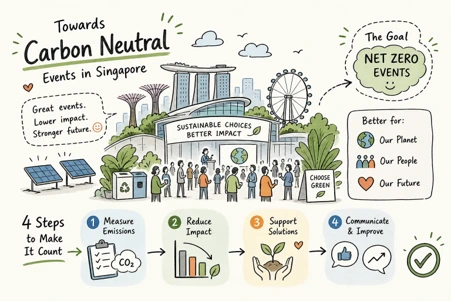
Carbon neutrality claims are increasingly visible in Singapore's events industry. Conference programmes...

Carbon offset solutions for hotel ballrooms and event spaces in Singapore are...
Find quick answers about the Event Carbon Calculator, your emissions estimate, and what happens next.
There is no official threshold. The most cited reference is approximately 14.13 kg CO2 per attendee for venue-related emissions, with energy the dominant contributor. Note this excludes attendee travel, so a full-scope per-attendee figure will typically be higher. Treat it as a comparative benchmark for the venue category rather than a pass mark for the whole event.
Yes. SACEOS has published WA 4: Sustainable MICE — Guidelines for Carbon Emissions Management, a Singapore Standards workspace agreement covering measurement, reduction, calculation, verification and offset. Separately, the Singapore MICE Sustainability Certification (MSC) provides GSTC-Recognised organisational certification, and STB and SACEOS will develop a MICE Decarbonisation Framework by 2028.
Air-conditioning, lighting and audiovisual systems run continuously through operating hours regardless of attendee behaviour, making venue energy a structural and relatively predictable load. In Singapore’s climate, cooling demand is both unavoidable and substantial. This is why the MICE Venue Sustainability Playbook points to emissions per square foot of venue area as a comparable metric.
Yes — and then raised them. By 2025 the original roadmap targets were exceeded, with all purpose-built MICE venues and over 80% of SACEOS member companies certified. Roadmap 2.0, unveiled in July 2026, commits to a MICE Decarbonisation Framework by 2028 and net zero by 2050.
No. MSC certifies the organisation across domains including carbon, waste, energy, water, social responsibility, HR competency and procurement, valid for two years. It does not produce a per-event footprint figure or evidence that a specific event’s emissions were addressed. Those are separate exercises.
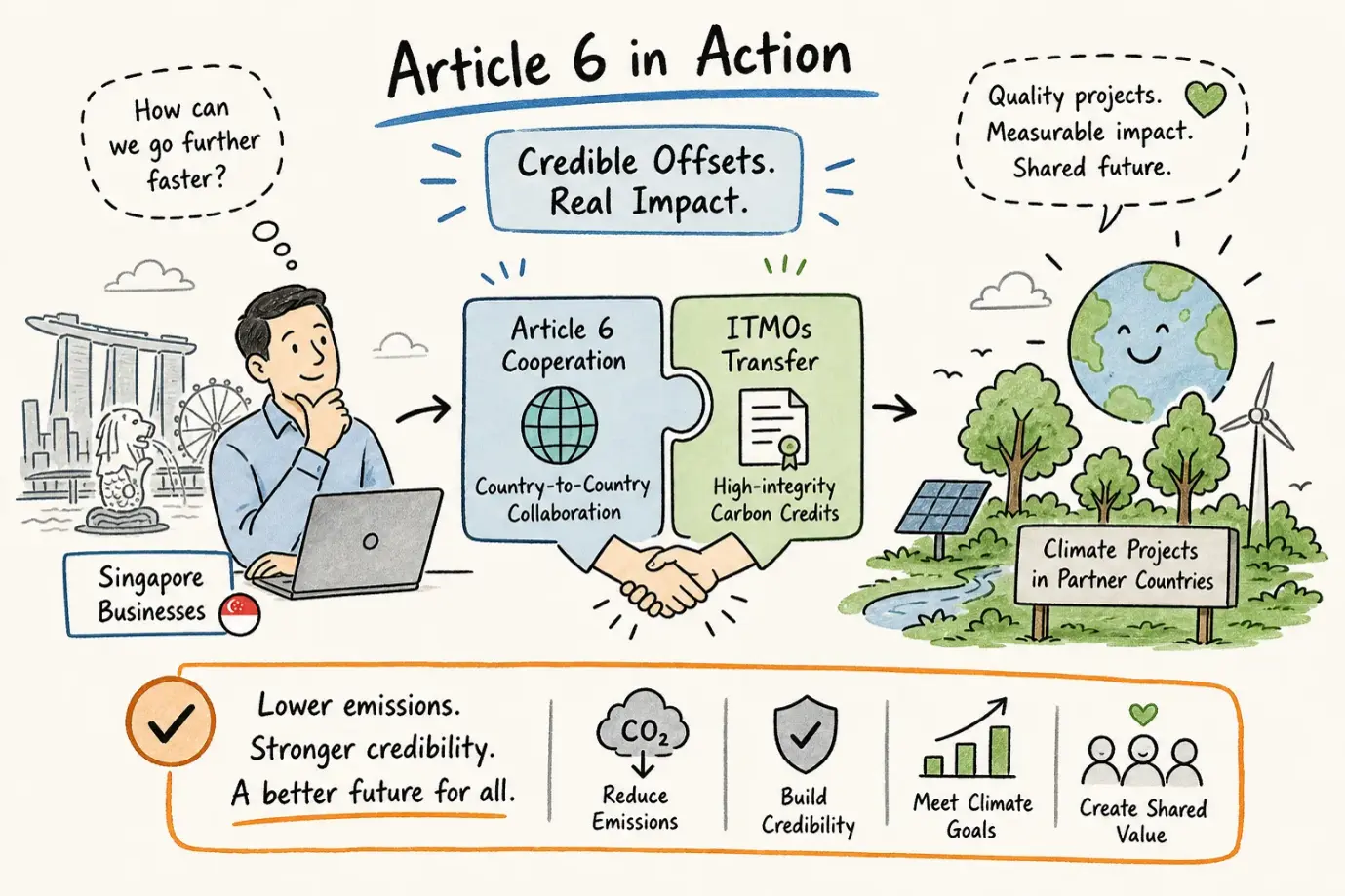
Article 6-aligned offsets are no longer just a conference talking point; they...
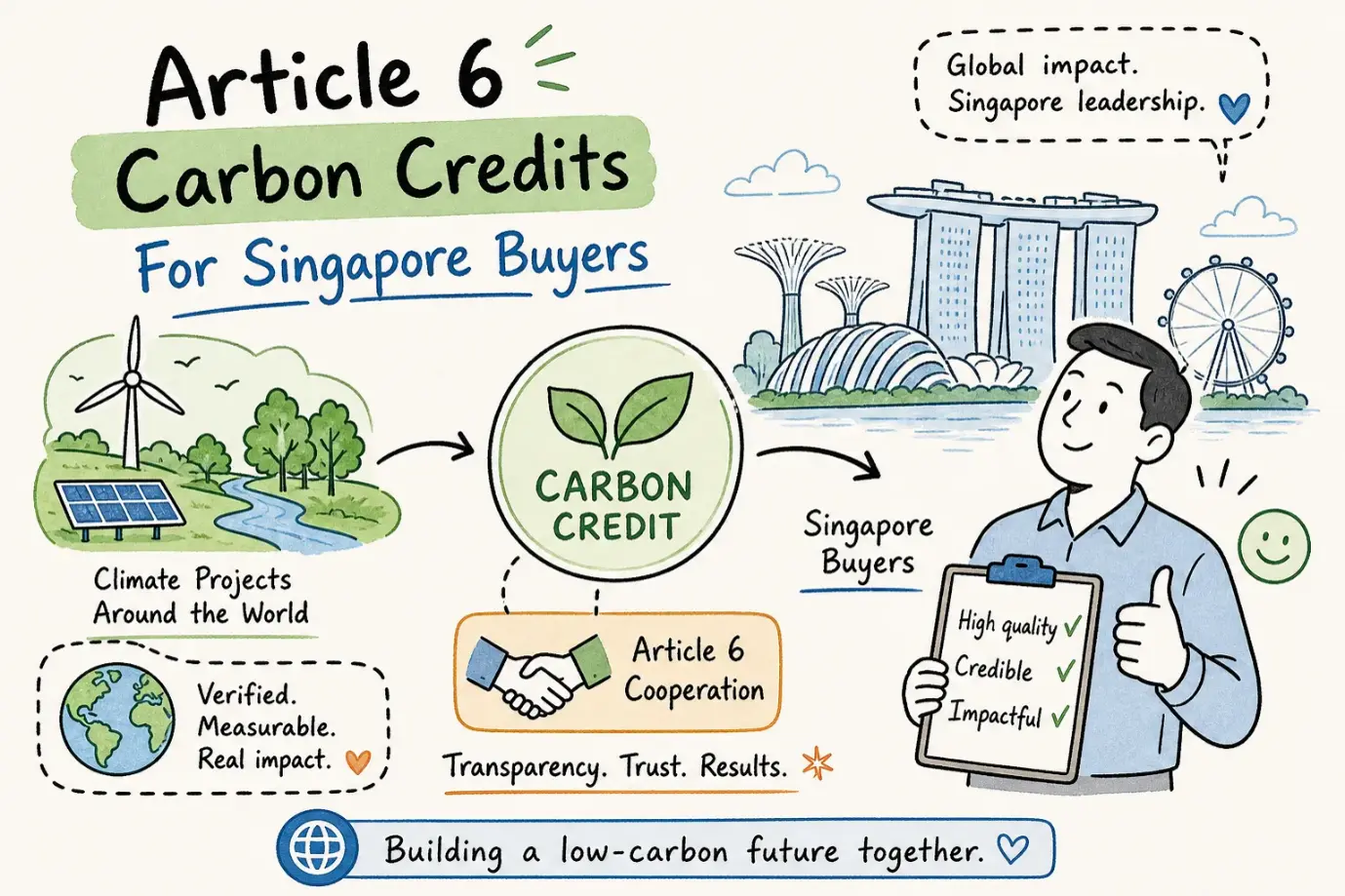
Article 6 carbon credits are fundamentally different from standard voluntary offsets, and...
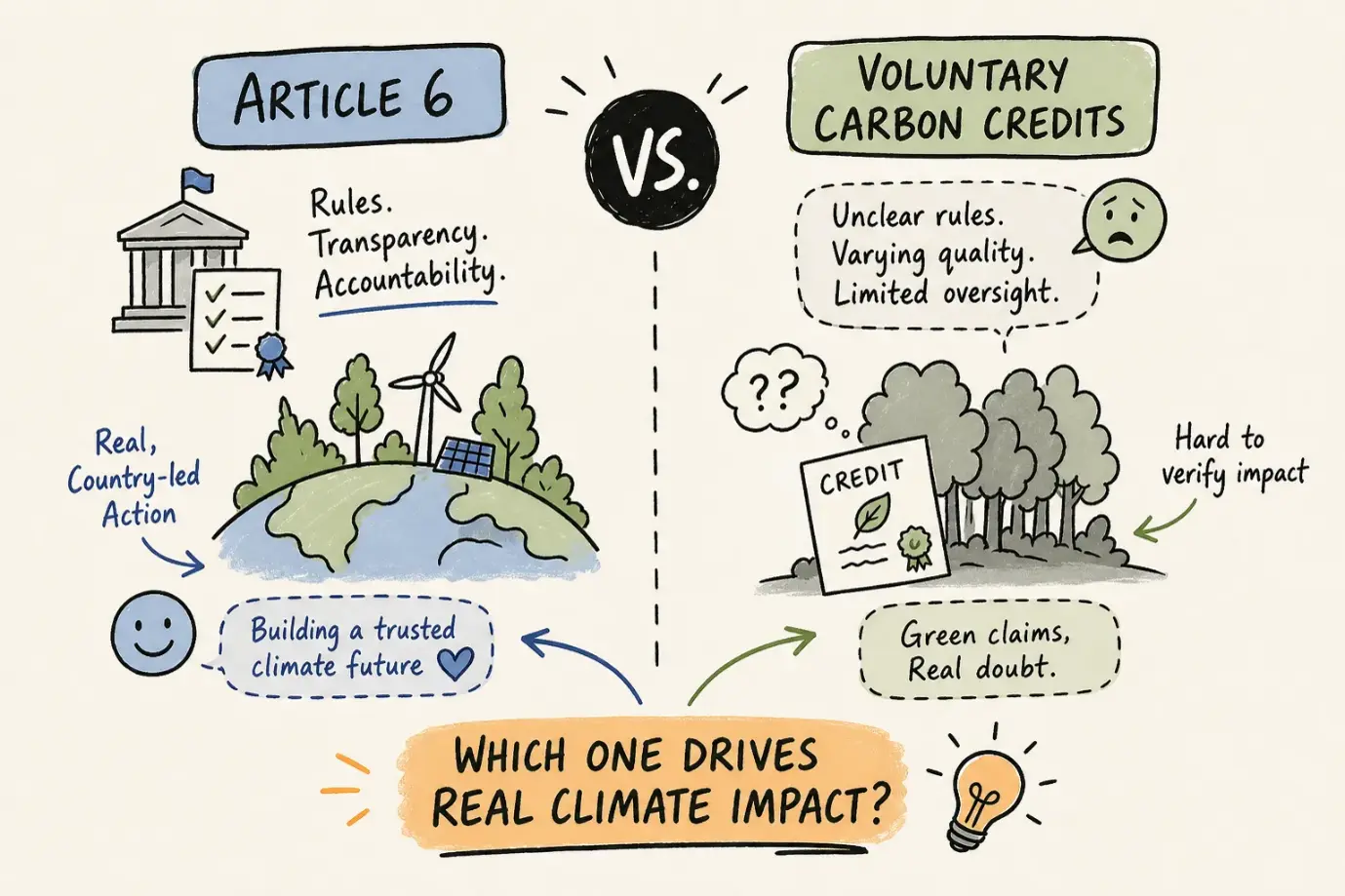
Understanding the difference between Article 6 and voluntary carbon market credits is...
Carbon neutral vs net zero: two terms, both sound green, both are...
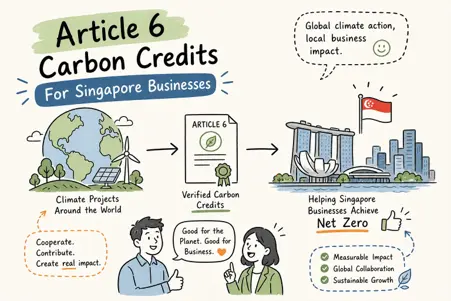
For Singapore businesses, Article 6 carbon credits explained properly can mean the...
Carbon neutrality claims are increasingly visible in Singapore's events industry. Conference programmes...

Green Passport Carbon
Quick Links
More Information
 Optimized by Seraphinite Accelerator