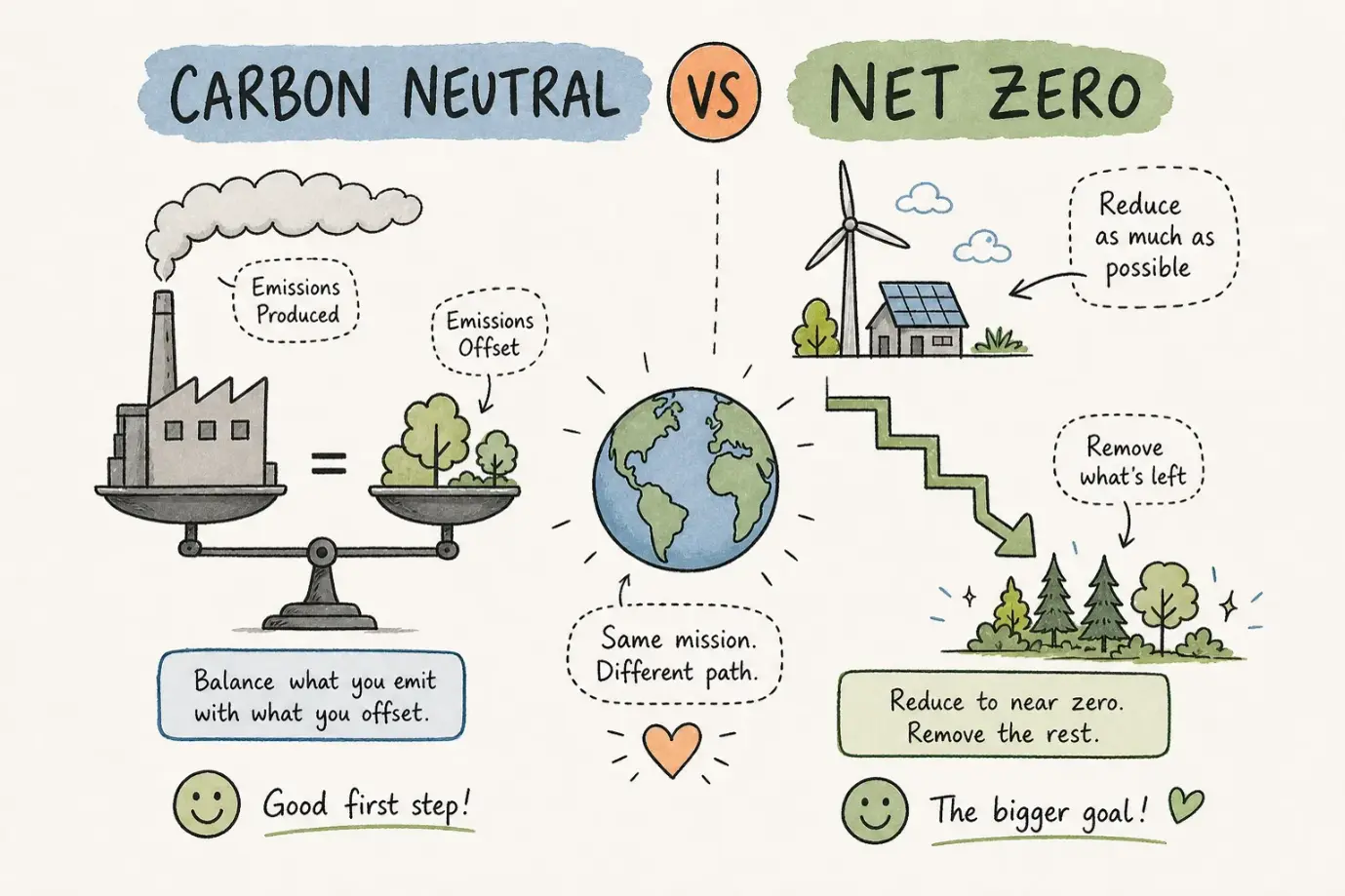
Carbon neutral vs net zero: what’s...
Carbon neutral vs net zero: two terms, both sound green, both are...

Green Passport Carbon , Singapore

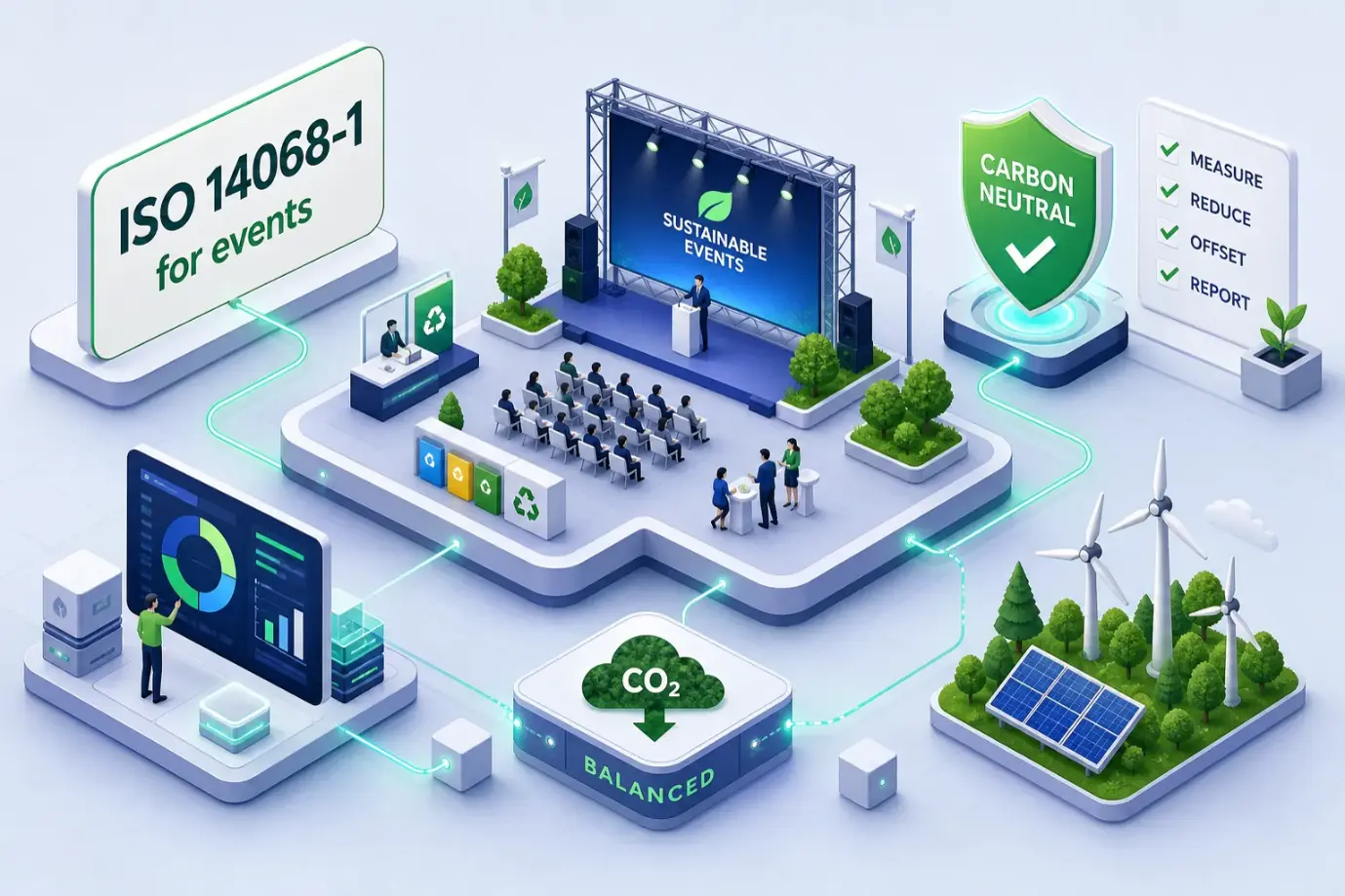
Clients want proof. Sponsors want documentation. Attendees want to know the event they attended actually did something real about its carbon footprint. The pressure on event organisers to move beyond sustainability promises has never been more concrete, and a marketing claim with no evidence behind it is not just unconvincing. It is increasingly a liability.
ISO 14068-1 for events is the international standard that changes this picture. Published in 2023 and revised in September 2026 as ISO 14068:2026, a minor revision that mainly changes the title and removes the part number, it sets the requirements for achieving and demonstrating carbon neutrality across a range of subjects, events explicitly included. For organisers who want a defensible, well-evidenced path to a carbon-neutral claim, it is the framework that matters most right now. This article walks you through what the standard actually requires, how it differs from older approaches, and what a compliant process looks like from boundary-setting through to certification.
If you are based in Singapore and want expert guidance without building the methodology yourself, Green Passport Carbon applies methodology informed by ISO 14068-1 principles for the events sector, although its certificate is not itself an ISO certification. But first, here is what you need to understand about the standard itself.
ISO 14068-1 is an international standard that establishes specific requirements for achieving and demonstrating carbon neutrality. It is not a general guidance document you can interpret loosely. It sets out what must be done before an organisation can legitimately state that an activity, product, service, or event is carbon neutral. The word “requirements” is deliberate: it means compliance is not optional if you want the claim to hold up under scrutiny.
The standard applies to a broad range of subjects, including organisations, products, services, buildings, and events. That breadth is intentional. Whether you are measuring the carbon footprint of a manufactured product or a three-day conference, the same structured framework applies: quantify emissions, reduce what you can, offset the residuals, then substantiate the claim, ideally through verification. In practice, for an event organiser, this means you need a documented process for each of those steps, not a spreadsheet and a good-faith estimate.
Annex B.2.2 of ISO 14068-1 addresses events directly. It treats an event as a type of product or service to be quantified using ISO 14067 or a compatible methodology. This means a single conference, an industry exhibition, a corporate annual dinner, or a recurring roadshow series can each be a valid subject of a carbon-neutrality claim under the standard. That formal standing matters: it gives organisers a legitimate basis to make the claim, but it also creates clear obligations that cannot be sidestepped.
PAS 2060 was the British Standard that preceded ISO 14068-1 and became the most widely used framework for carbon-neutral certifications in the events industry. It brought structure to what had been an essentially unregulated space, and many organisations used it in good faith. The limitation was that, as a national standard, it lacked the rigour of the ISO framework and left considerable room for interpretation, particularly around boundary-setting and offset quality. That flexibility, in practice, made greenwashing easier to disguise. BSI withdrew PAS 2060 at the end of 2025.
PAS 2060 also allowed first-time carbon-neutrality claims to rest primarily on offsets, without requiring demonstrable reductions first. Organisations could, in principle, buy enough credits to balance a footprint without making any genuine operational changes. ISO 14068-1 closes that gap.
The most significant shift is the reduction-first hierarchy. Under ISO 14068-1, reductions must be demonstrated before residual emissions are addressed through carbon credits. Offsetting is explicitly positioned as the last step, not the primary strategy. The standard also sets out how a claim can be substantiated, from self-declaration to independent third-party verification, with ISO 14064-3 referenced for verification. Third-party verification is not mandatory, but it provides the strongest assurance, and a self-declared claim carries considerably less weight with external stakeholders. For event organisers who hold PAS 2060-based certificates, this represents a material change in what a robust claim actually requires.
Annex B.2.2 sets out four lifecycle phases that must form the boundary of an event claim: planning, preparation, event delivery, and post-event activities. Each phase captures different emission sources. Planning covers the decisions that generate emissions before anything physical happens, venue selection, catering choices, and travel logistics planning. Preparation covers procurement, materials production, and physical set-up of the event space. Event delivery covers the main period of activity, including venue energy consumption, attendee and speaker travel, accommodation, and catering. Post-event covers waste, materials disposal, and any demobilisation or transport activities that follow.
Organisers who measure only the event day itself will produce a boundary that is too narrow to satisfy a verifier. The standard is clear that the full lifecycle must be accounted for, and any material omissions will result in findings during verification.
ISO 14068-1 distinguishes between one-off and recurring events because the management approach differs between the two. A single annual conference is a discrete, time-bound subject with a clear start and end. A recurring event series, such as a roadshow or a quarterly leadership summit, may need to be defined as individual events or as an aggregate programme, depending on how the claim is communicated. For recurring events, the standard requires a carbon-neutrality management plan that addresses how emissions will be reduced across future iterations, assessed against a reference event. Getting this definition right at the outset prevents rework and ensures the declared unit is consistent with how the claim is eventually communicated to stakeholders.
The key emission sources for a typical MICE event are attendee and speaker travel (usually the single largest contributor), accommodation, venue energy consumption, catering, materials and merchandise, and waste. ISO 14068-1 relies on the quantification principles of ISO 14064-1 for the inventory process, which means collecting activity data for each source: flight distances and modes, hotel nights, kilowatt-hours of venue energy, meal counts, freight tonnage, and waste volumes. The final footprint is only as accurate as the activity data collected, so the data-gathering stage is where most of the real work happens.
Once activity data is collected, each input is converted into a CO₂-equivalent figure using emission factors matched to the source, geography, and time period. Where a single emission source serves more than one function, a shared venue running multiple events on the same day, for instance, the standard requires a documented allocation method. That allocation must reflect the relevant share of activity attributable to each event. The allocation logic must be consistent and defensible, because the verifier will review both the factors used and the reasoning behind any shared-source allocations. Undocumented or ad hoc allocation is one of the most common causes of verification findings.
ISO 14068-1 is explicit: a carbon-neutrality claim is not a matter of purchasing enough credits to cancel out a footprint. The standard requires the declaring organisation to first demonstrate emissions reductions relative to a baseline or through documented mitigation actions. For event organisers, this means making and recording deliberate choices: selecting a lower-carbon venue, reducing long-haul speaker travel by using local speakers or remote participation for some sessions, choosing plant-based catering options, and minimising single-use materials. These decisions must be documented as part of the carbon-neutrality management plan, not simply assumed. Only the residual emissions remaining after genuine reduction efforts are then addressed through offsetting.
Not all carbon credits satisfy ISO 14068-1. The standard requires that offsets are real, additional, permanent, certified, and not subject to double-counting. For event organisers in Singapore, Article 6-aligned carbon credits carry particular relevance because they operate under the Paris Agreement framework, with corresponding adjustments that address the double-counting concern at an international level. However, Singapore’s October 2025 guidance on carbon credits states that corresponding adjustment requirements do not apply to corporate buyers meeting voluntary climate commitments, and that a corresponding adjustment does not by itself indicate the quality of a credit, which must be assessed separately. Buyers should still disclose whether their credits include one. Credits must be formally retired in a recognised registry, Gold Standard and Verra VCS are two of the most widely used, with the retirement serial number and date recorded as evidence for the verifier. Credits purchased informally or held in a registry account without retirement will not satisfy the standard’s requirements.
Recognised verification bodies operating in Singapore for ISO 14068-1 claims include SGS, BSI Singapore, NQA, and LRQA. Each uses a staged process consistent with ISO 14064-3: a document and readiness review at Stage 1, followed by a substantive evidence review at Stage 2, and then an independent decision before a verification statement is issued. The verifier will examine the event boundary definition, the GHG inventory and calculation methodology, the carbon-neutrality management plan, evidence of reduction actions taken, offset retirement documentation with serial numbers, and the final carbon-neutral claim as communicated publicly. Gaps in any of these elements will generate findings that must be resolved before the claim can be verified. The most common failure points for events are an incomplete boundary, particularly when attendee travel or accommodation is omitted, and offset retirement evidence that does not meet the required standard.
Larger organisations with dedicated sustainability teams and existing GHG inventory infrastructure can build an ISO 14068-1-compliant event process themselves. For most event organisers, especially those without a full-time sustainability function, the practical barriers are real: sourcing the right emission factors, setting defensible boundaries, managing credit procurement and quality checks, and preparing documentation for verification all require domain expertise that takes time to build.
Green Passport Carbon was designed specifically to address this gap for Singapore-based event organisers. Its three-step process, Calculate, Retire, Certify, follows the logic of the ISO 14068-1 workflow, using a purpose-built event carbon calculator for an indicative estimate, the retirement of eligible carbon credits with documented retirement records, and a verifiable certificate with a unique certificate ID and verification link. The certificate documents the carbon action taken; it is not an ISO certification or an independent third-party verification, which organisers can commission separately if they need an ISO 14068 claim verified. For organisers who want a well-documented outcome without building the methodology from scratch, it provides a structured, expert-guided path. Get in touch with the Green Passport Carbon team to understand what the process looks like for your specific event. The calculator itself is free and gives a Free Event Carbon Estimate; the Full Event Carbon Assessment, carbon-credit retirement and the Green Passport Carbon Event Certificate are provided as part of Green Passport Carbon’s quote-based service.
ISO 14068-1 gives event organisers an internationally recognised framework for independently verifiable carbon-neutral claims. What it demands in return is structured evidence: a properly defined lifecycle boundary, an accurate emissions inventory, a documented reduction plan, quality offsets retired in a recognised registry, and, for the strongest assurance, independent verification by an accredited body. Skipping any of these steps weakens the claim’s ability to withstand scrutiny.
The standard’s explicit coverage of events, including its four-stage lifecycle boundary and its treatment of one-off versus recurring event subjects, gives organisers a clear rulebook to follow. Starting with a well-defined boundary and accurate activity data is the foundation that everything else rests on. Get that right, and the rest of the process becomes significantly more straightforward.
As sustainability disclosure requirements tighten in Singapore and MICE clients increasingly ask for verified credentials rather than sustainability commitments, ISO 14068-1 compliance is shifting from a differentiator to a baseline expectation. Organisers who build the process now will have a verified, repeatable methodology in place when clients ask for it. Those who wait will find themselves retrofitting under pressure. If you want to start with confidence rather than trial and error, the team at Green Passport Carbon is the right place to begin.
Carbon neutral vs net zero: two terms, both sound green, both are...
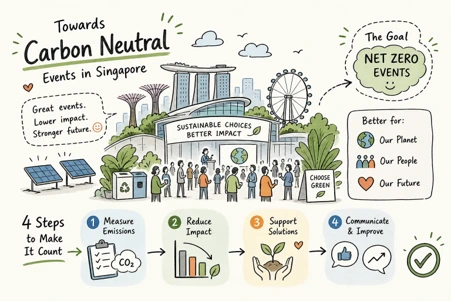
Carbon neutrality claims are increasingly visible in Singapore's events industry. Conference programmes...

Carbon offset solutions for hotel ballrooms and event spaces in Singapore are...
Find quick answers about the Event Carbon Calculator, your emissions estimate, and what happens next.
There is no official threshold. The most cited reference is approximately 14.13 kg CO2 per attendee for venue-related emissions, with energy the dominant contributor. Note this excludes attendee travel, so a full-scope per-attendee figure will typically be higher. Treat it as a comparative benchmark for the venue category rather than a pass mark for the whole event.
Yes. SACEOS has published WA 4: Sustainable MICE — Guidelines for Carbon Emissions Management, a Singapore Standards workspace agreement covering measurement, reduction, calculation, verification and offset. Separately, the Singapore MICE Sustainability Certification (MSC) provides GSTC-Recognised organisational certification, and STB and SACEOS will develop a MICE Decarbonisation Framework by 2028.
Air-conditioning, lighting and audiovisual systems run continuously through operating hours regardless of attendee behaviour, making venue energy a structural and relatively predictable load. In Singapore’s climate, cooling demand is both unavoidable and substantial. This is why the MICE Venue Sustainability Playbook points to emissions per square foot of venue area as a comparable metric.
Yes — and then raised them. By 2025 the original roadmap targets were exceeded, with all purpose-built MICE venues and over 80% of SACEOS member companies certified. Roadmap 2.0, unveiled in July 2026, commits to a MICE Decarbonisation Framework by 2028 and net zero by 2050.
No. MSC certifies the organisation across domains including carbon, waste, energy, water, social responsibility, HR competency and procurement, valid for two years. It does not produce a per-event footprint figure or evidence that a specific event’s emissions were addressed. Those are separate exercises.
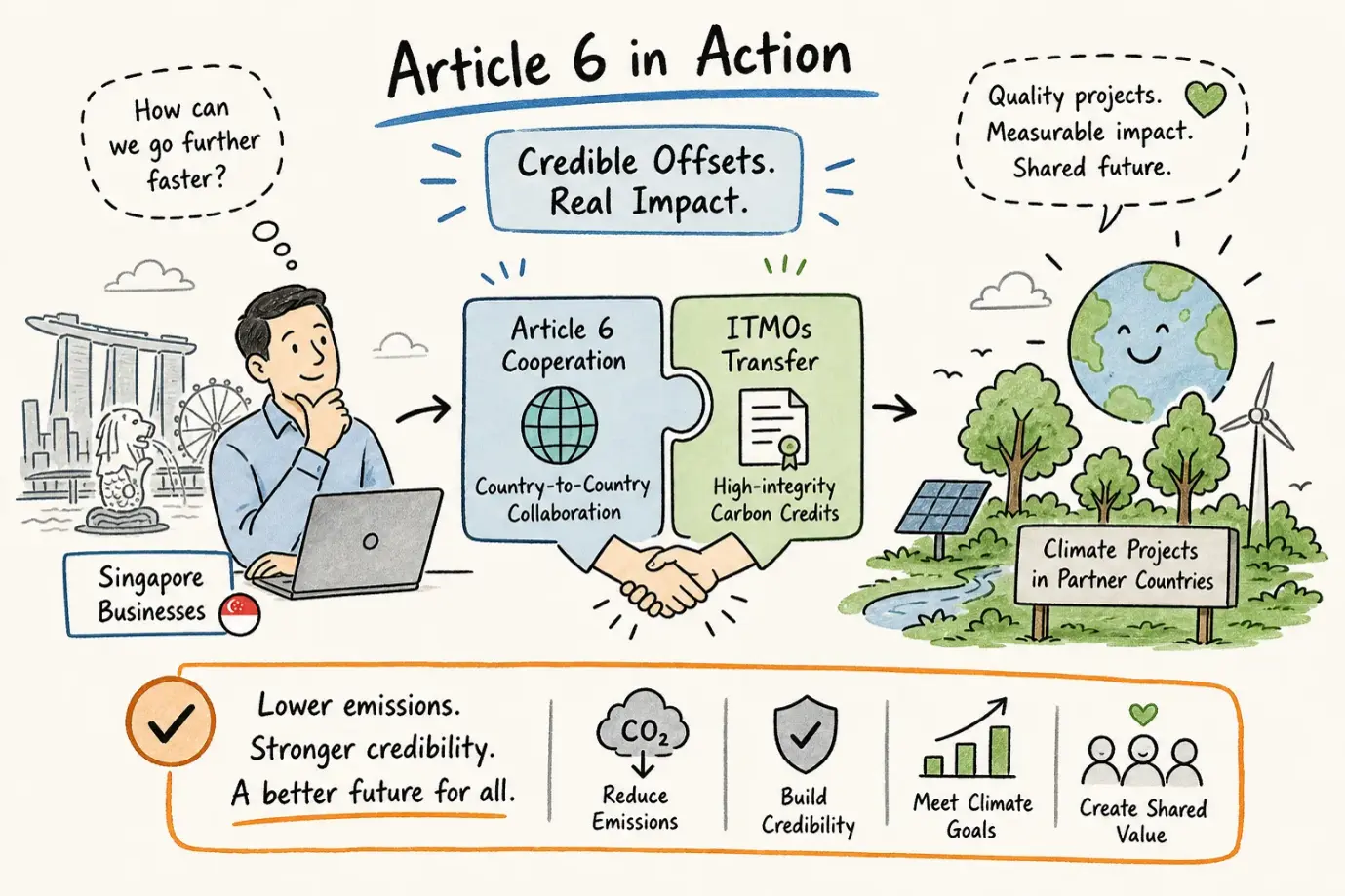
Article 6-aligned offsets are no longer just a conference talking point; they...
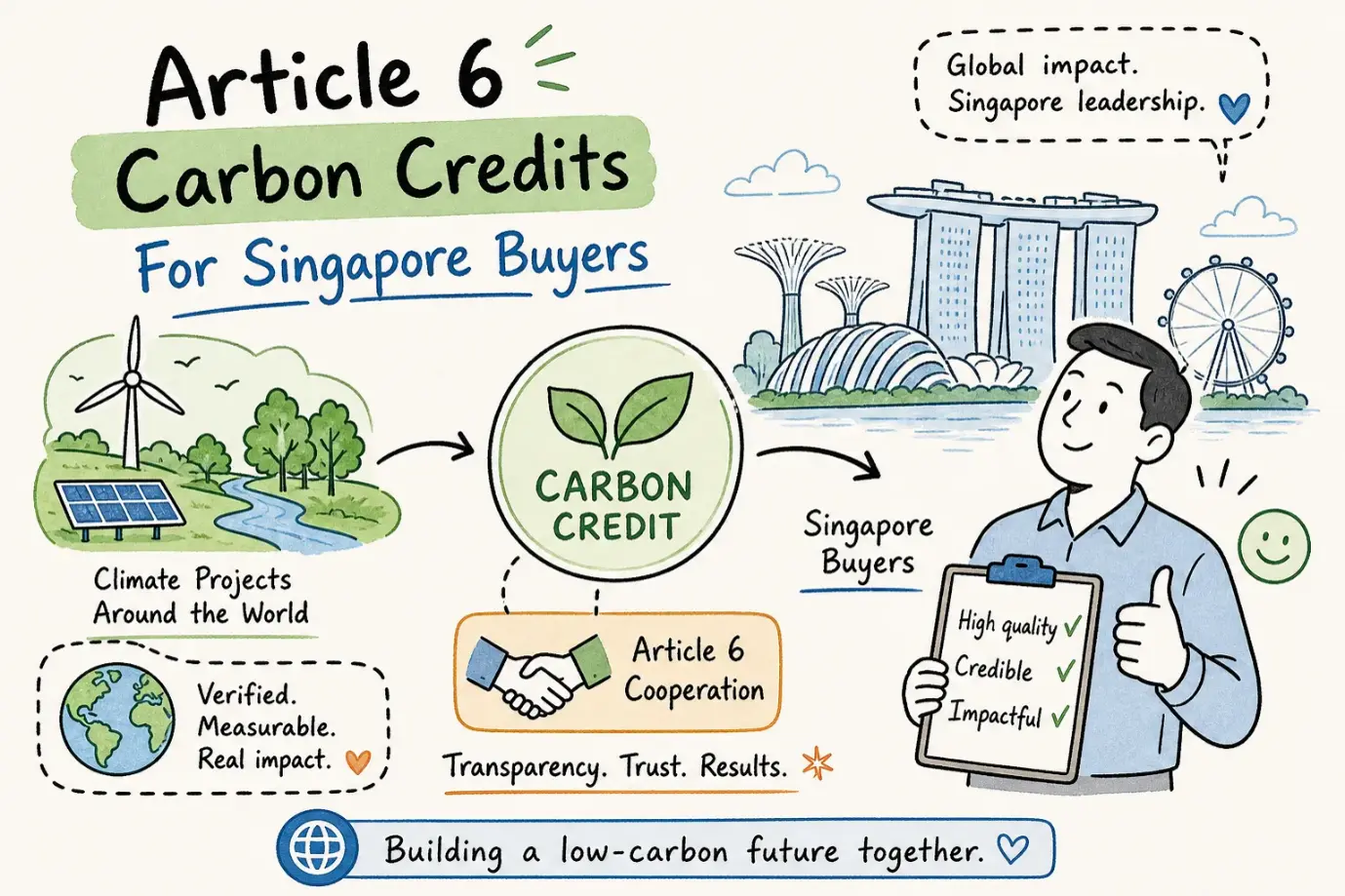
Article 6 carbon credits are fundamentally different from standard voluntary offsets, and...
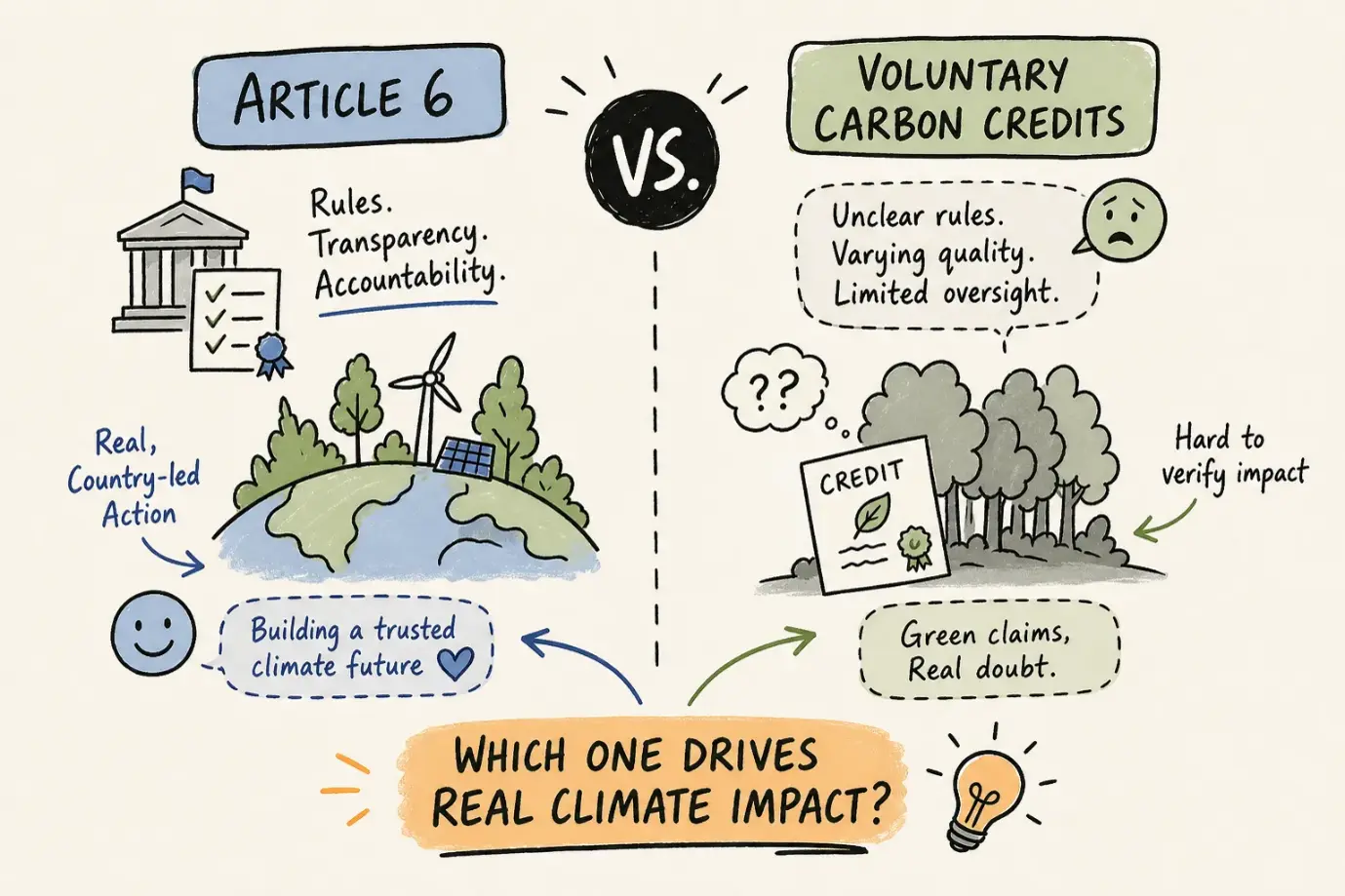
Understanding the difference between Article 6 and voluntary carbon market credits is...
Carbon neutral vs net zero: two terms, both sound green, both are...
For Singapore businesses, Article 6 carbon credits explained properly can mean the...
Carbon neutrality claims are increasingly visible in Singapore's events industry. Conference programmes...

Green Passport Carbon
Quick Links
More Information
 Optimized by Seraphinite Accelerator