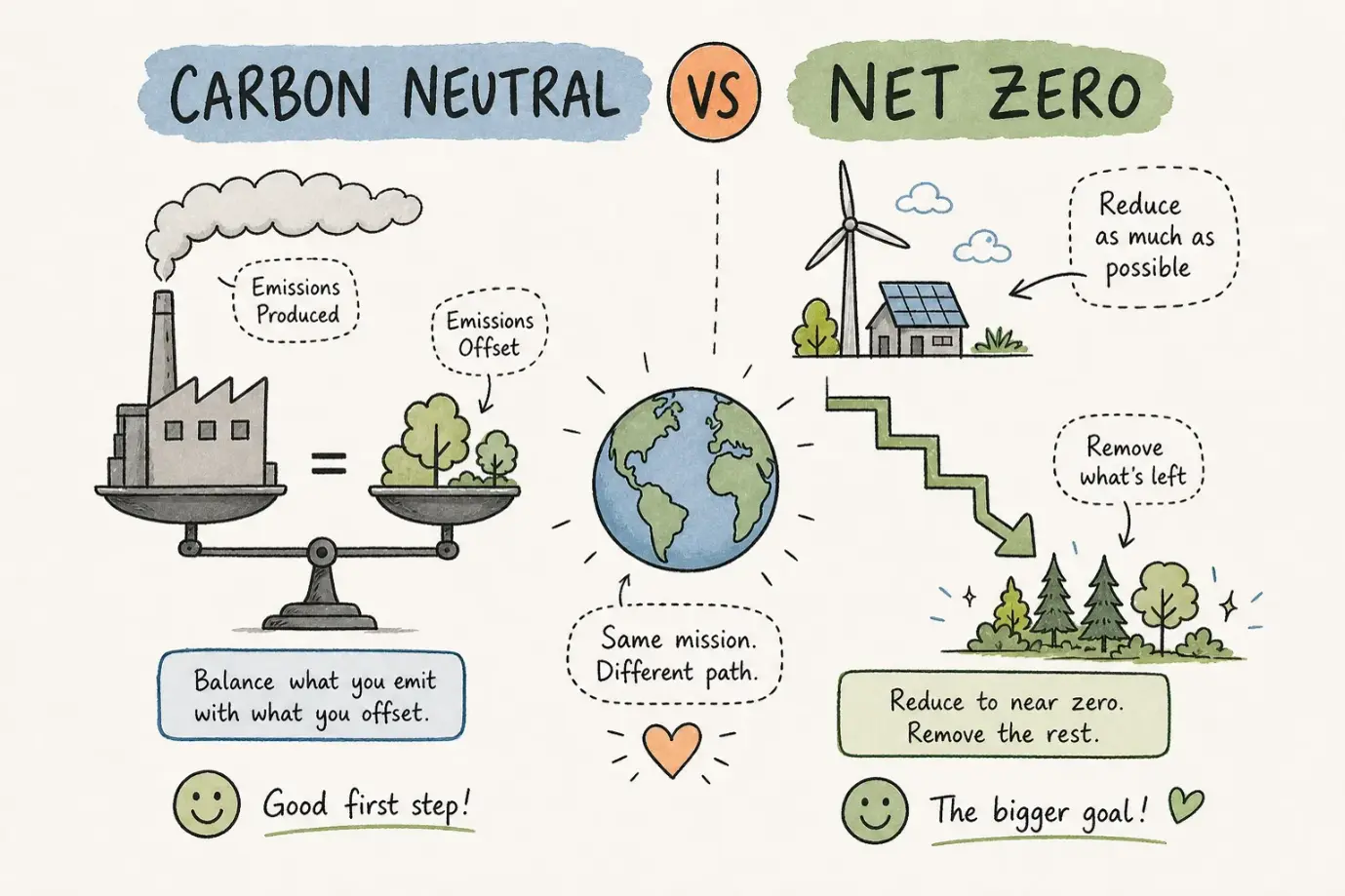
Carbon neutral vs net zero: what’s...
Carbon neutral vs net zero: two terms, both sound green, both are...

Green Passport Carbon , Singapore


Many of Singapore’s MICE clients are arriving at venue sales meetings with sustainability questionnaires, ESG checklists, and a growing expectation that the venue can support a carbon neutral event claim. The challenge is that many venue managers know they need to act but are unsure where to start. Is it solar panels? A carbon audit? A certification partner?
This guide cuts through the noise and lays out the full range of venue carbon solution options available, from operational quick wins to third-party certification partnerships, so you can build a credible programme rather than a patchwork of gestures. By the end, you will know which emissions to tackle first, which tools to use, and how to turn your sustainability effort into a green event package that clients will actually pay for.
Before choosing any venue carbon solution, you need an accurate picture of where your emissions sit. Some venues skip this step and end up spending budget on measures that move a small needle.
Purchased electricity typically accounts for the large majority of hotel emissions in Singapore’s cooling-heavy climate, with on-site fuel combustion from gas boilers, back-up generators, and commercial kitchens adding a smaller share. For conference centres and stadia, the picture is similar: HVAC systems, lighting rigs, AV equipment, and event-day catering loads all draw heavily from the grid. One industry benchmark for hotel portfolios found emissions of around 107 to 132 kgCO2e per square metre per year, giving venue managers a useful reference point when building their own baseline.
Scope 3 emissions cover attendee travel, catering supply chains, delegate accommodation, and outsourced services. When the full value chain is counted, these can represent 75 to 90% of the combined footprint of the events a venue hosts. Many venue managers spend their budget on LED retrofits while leaving the largest emission category completely unaddressed. Understanding this split early shapes which solutions deliver the most credible outcome for clients seeking genuine carbon action, not just a lower electricity bill.
Without a clear picture of where your Scope 1, 2, and 3 emissions sit, you risk misallocating resources. A simple venue carbon inventory, even one built on publicly available emission factors, gives you the prioritisation map that every subsequent decision should reference. That baseline is not optional; it is the foundation of every credible carbon management claim.
The standards landscape can feel overwhelming, but in practice you only need to understand three frameworks and how they interact. Each one addresses a different layer of your carbon management obligations.
The GHG Protocol Corporate Standard is the most widely used framework for classifying emissions into Scopes 1, 2, and 3. For venues, it defines what counts as your operational boundary and what sits in your supply chain, directly relevant when separating your venue’s footprint from an event organiser’s footprint. Most credible software platforms, advisors, and certification bodies build on this framework.
ISO 14064 strengthens the rigour of your emissions inventory and is the standard you need when a third party is assessing or verifying your data. ISO 14068-1 goes further: it sets the requirements for making a credible carbon neutrality claim, covering calculation methodology, reduction targets, and credit retirement.
For Singapore venues that want to offer clients a branded carbon neutral event certificate, aligning to ISO 14068-1 is strongly recommended. It is what separates a credible claim from a marketing statement, and it is what a growing number of ESG auditors and corporate procurement teams expect to see when reviewing supplier sustainability credentials.
Generic corporate carbon software is rarely built for event-level accounting. It typically lacks emission factors for attendee travel modes, catering categories, temporary builds, and event-day energy loads. Purpose-built event carbon calculators are a better fit for venues that need to calculate per-event footprints for clients, rather than just an annual corporate inventory. This distinction matters when your client needs a number they can put in their sustainability report.
Reducing your Scope 1 and 2 emissions is where most venues start, and for good reason: the savings are measurable, the payback periods are manageable, and several Singapore grant schemes directly offset your upfront costs.
LED lighting retrofits deliver consistent results across venue types, with energy savings of around 44 to 45% on lighting loads and payback periods of one to four years. HVAC optimisation through controls, scheduling, and maintenance tuning usually pays back in under three years because HVAC is one of the largest energy consumers in any event space. Building Management System upgrades layer on top of both, enabling continuous monitoring and reducing energy waste during low-occupancy periods.
Several schemes are directly relevant to venue operators. The Energy Efficiency Grant co-funds investments in pre-approved energy-efficient equipment, but its current eligible sectors are construction, data centres, food services, manufacturing, maritime and retail, so most venues qualify only for eligible food-service operations for now. The Government announced in April 2026 that the Base tier will be opened to all sectors, with details due later in 2026. The BCA Green Mark Incentive Scheme for Existing Buildings 2.0 (GMIS-EB 2.0) supports energy performance improvements with funding caps of S$600,000 for Platinum, S$900,000 for Super Low Energy, and S$1.2 million for Zero Energy certification, subject to 50% of qualifying costs, and is available until funds are fully committed or 31 March 2027, whichever is earlier. The BCA Retrofit Energy Efficiency Financing scheme covers upfront retrofit costs through an energy performance contract arrangement. For MICE-focused venues, the STB Business Improvement Fund can support sustainability certification costs including ISO 20121.
Switching to lower-carbon catering menus, reducing single-use packaging, partnering with food waste diversion services, and shifting procurement toward suppliers with verified environmental credentials can meaningfully reduce Scope 3 emissions without major capital outlay. These measures also signal to clients that your sustainability programme extends beyond the building itself, which is exactly what event organisers with ESG requirements are checking. The venues winning green event business in Singapore are those that address the full emissions picture, not just the meter cupboard.
The distinction between a credible green event package and a performative one comes down to documentation. Your venue carbon solution needs to produce something tangible that a client can file with their auditor.
Corporate event managers and professional conference organisers are not simply asking for lower energy bills. They need something that goes into their ESG report: a documented calculation of the event’s carbon footprint, evidence that credits were retired against that footprint, and a certificate they can show auditors and stakeholders. A venue that can hand a client all three at the end of an event has a meaningful commercial differentiator over one that only offers recycling bins and LED lighting.
Venues that do not have in-house capability to build a full carbon certification workflow have two practical options. They can build their own calculator and source credits independently, which is resource-intensive and requires ongoing compliance monitoring. Or they can partner with a specialist provider and offer that capability under their own brand or as a recommended add-on.
Green Passport Carbon offers Singapore venues a structured carbon solution covering an indicative emission calculation, the retirement of eligible carbon credits with documented retirement records, and a branded Green Passport Carbon certificate with a unique certificate ID and verification link, without the venue needing to build that infrastructure from scratch. The certificate documents the carbon action taken; it is not an ISO certification or an independent third-party verification. The certificate goes to the client; the venue earns the reputation and the commercial edge. For venues that host multiple events annually, this model scales cleanly without adding headcount. The calculator itself is free and gives a Free Event Carbon Estimate; the Full Event Carbon Assessment, carbon-credit retirement and the Green Passport Carbon Event Certificate are provided as part of Green Passport Carbon’s quote-based service.
A green event package needs a clear price point and a clear deliverable. A pragmatic commercial model is a per-event fee that covers the carbon certification process, presented as a line item in your event proposal. Framing it alongside your venue’s broader sustainability credentials, including your Green Mark rating, renewable energy use, or waste diversion data, creates a coherent story rather than a standalone add-on. Clients with ESG requirements will see it as a straightforward solution to a problem they already have.
The market for venue-focused carbon services has grown quickly, and not all providers are equally rigorous. A clear selection framework helps you avoid buying the wrong thing.
Venue-focused carbon solutions broadly fall into four types: carbon management platforms and advisors that handle measurement, credit sourcing, and reporting; energy-as-a-service and renewable energy partners that address Scope 1 and 2 reductions; sustainable catering and event supply chain partners that target Scope 3; and waste-to-resource specialists focused on diversion and circularity. Most venues need a mix, not a single provider, and understanding which category addresses which emission scope stops you from duplicating spend.
When evaluating any venue carbon solution, check whether the methodology aligns to a recognised standard such as the GHG Protocol or ISO 14068-1, not a proprietary approach that no one else can verify. Confirm the provider has experience with event-level accounting, not just corporate annual inventories. Ask which programme and registry their carbon credits come from, how quality is assessed, and whether the credits are authorised under Article 6 of the Paris Agreement with a corresponding adjustment. This is relevant in Singapore given the government’s active participation in international carbon cooperation, and Article 6-aligned credits carry specific accounting properties. However, Singapore’s guidance notes that corresponding adjustments are not required for voluntary corporate claims and do not by themselves indicate a credit’s quality.
Finally, check whether the vendor can integrate with your existing event management and reporting workflows. A certification process that adds significant administrative burden to your team will not scale across a full event calendar.
A plan without KPIs is a wish list. Here is how to build one that holds up to scrutiny.
A credible carbon action plan starts with a baseline inventory covering at least Scope 1 and 2 emissions, ideally extending into the Scope 3 categories most relevant to your venue type. Set the measurement year, document your methodology, and get the data signed off internally. Without a baseline, any reduction claim is unverifiable and exposes you to greenwashing risk. That is a reputational problem no venue can afford in a market as scrutinised as Singapore’s MICE sector.
Rank measures by cost per tonne of CO2e avoided, not by ease of implementation. For most venues, the priority order runs as follows: energy efficiency upgrades first for fastest payback and clearest ROI, then renewable energy procurement, then catering and waste improvements, and finally carbon credits to cover residual emissions. KPIs should be specific:
• Percentage reduction in kgCO2e per event-day against your baseline year
• Number of certified green events delivered per quarter
• Client satisfaction scores on sustainability performance
• Percentage of events with third-party carbon certificates issued
Report against your baseline annually, using the same methodology each time. Distinguish clearly between emissions you have reduced and emissions you have offset; conflating the two is the most common greenwashing trap venues fall into. If you are issuing carbon neutral event certificates to clients, make sure each certificate references the standard it aligns to and the type of credits used. Transparent, consistent communication protects your reputation and gives your clients exactly what their ESG auditors will ask for.
A robust venue decarbonisation strategy is not a single purchase. It is a layered programme built on an accurate emissions baseline and cost-effective operational measures, underpinned by credible accounting standards and a client-facing certification offering that stands up to ESG scrutiny.
Singapore venues are well-placed to act, with grant schemes that offset upgrade costs and a MICE market that is increasingly rewarding venues that can deliver verifiable green event outcomes. Whether you build your venue carbon solution in-house or partner with a specialist like Green Passport Carbon, the key is starting from verified data and ensuring every claim you make can be substantiated.
That combination is what turns a sustainability commitment into a commercial advantage. To discuss how a tailored venue carbon solution can work for your property and your clients, reach out to the Green Passport Carbon team.
Carbon neutral vs net zero: two terms, both sound green, both are...
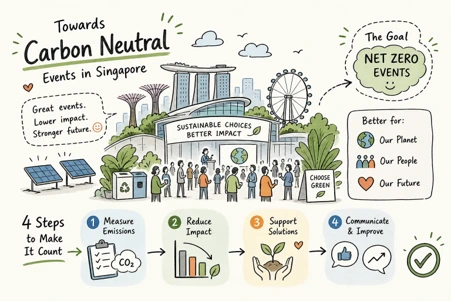
Carbon neutrality claims are increasingly visible in Singapore's events industry. Conference programmes...

Carbon offset solutions for hotel ballrooms and event spaces in Singapore are...
Find quick answers about the Event Carbon Calculator, your emissions estimate, and what happens next.
There is no official threshold. The most cited reference is approximately 14.13 kg CO2 per attendee for venue-related emissions, with energy the dominant contributor. Note this excludes attendee travel, so a full-scope per-attendee figure will typically be higher. Treat it as a comparative benchmark for the venue category rather than a pass mark for the whole event.
Yes. SACEOS has published WA 4: Sustainable MICE — Guidelines for Carbon Emissions Management, a Singapore Standards workspace agreement covering measurement, reduction, calculation, verification and offset. Separately, the Singapore MICE Sustainability Certification (MSC) provides GSTC-Recognised organisational certification, and STB and SACEOS will develop a MICE Decarbonisation Framework by 2028.
Air-conditioning, lighting and audiovisual systems run continuously through operating hours regardless of attendee behaviour, making venue energy a structural and relatively predictable load. In Singapore’s climate, cooling demand is both unavoidable and substantial. This is why the MICE Venue Sustainability Playbook points to emissions per square foot of venue area as a comparable metric.
Yes — and then raised them. By 2025 the original roadmap targets were exceeded, with all purpose-built MICE venues and over 80% of SACEOS member companies certified. Roadmap 2.0, unveiled in July 2026, commits to a MICE Decarbonisation Framework by 2028 and net zero by 2050.
No. MSC certifies the organisation across domains including carbon, waste, energy, water, social responsibility, HR competency and procurement, valid for two years. It does not produce a per-event footprint figure or evidence that a specific event’s emissions were addressed. Those are separate exercises.
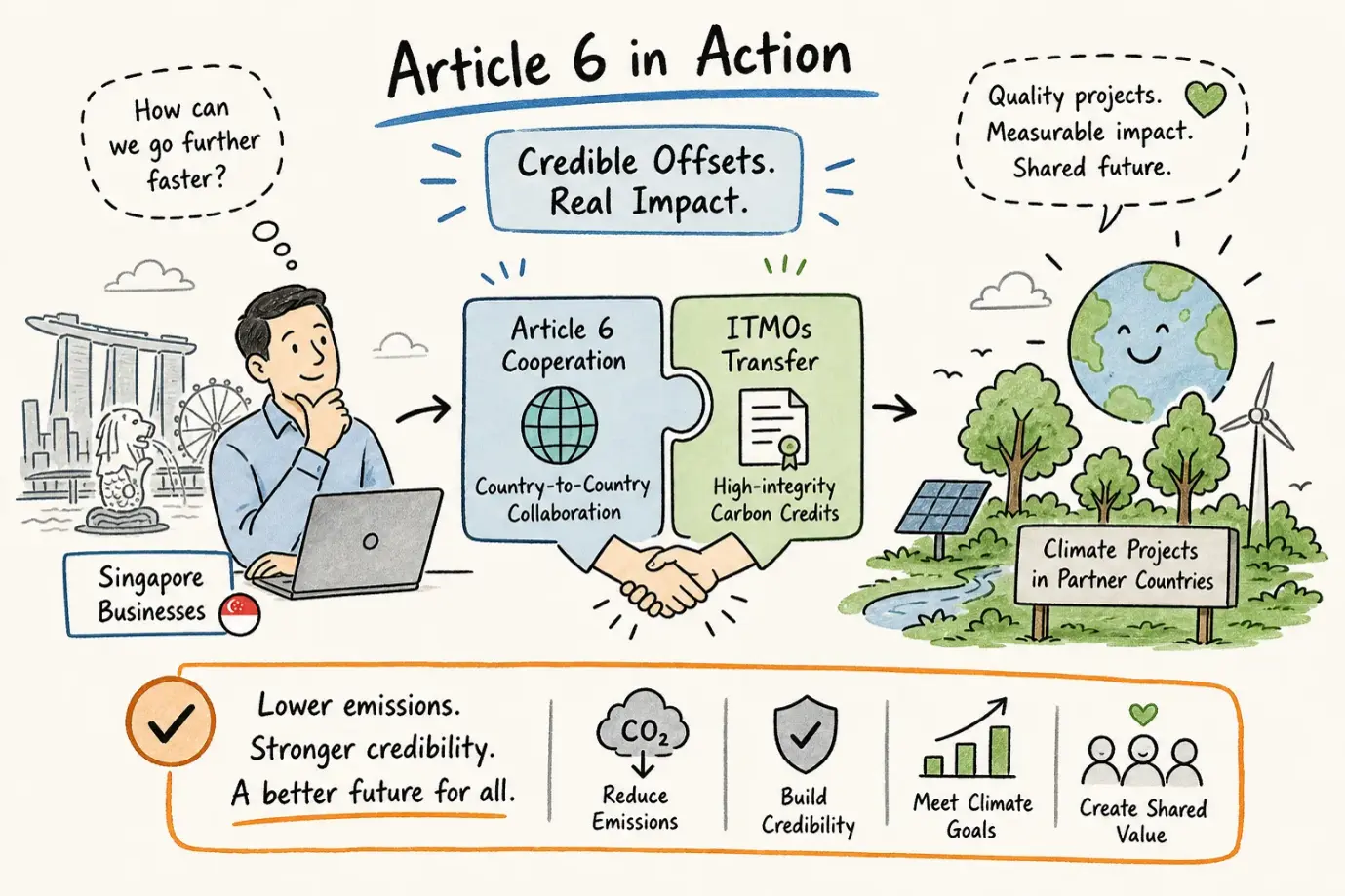
Article 6-aligned offsets are no longer just a conference talking point; they...
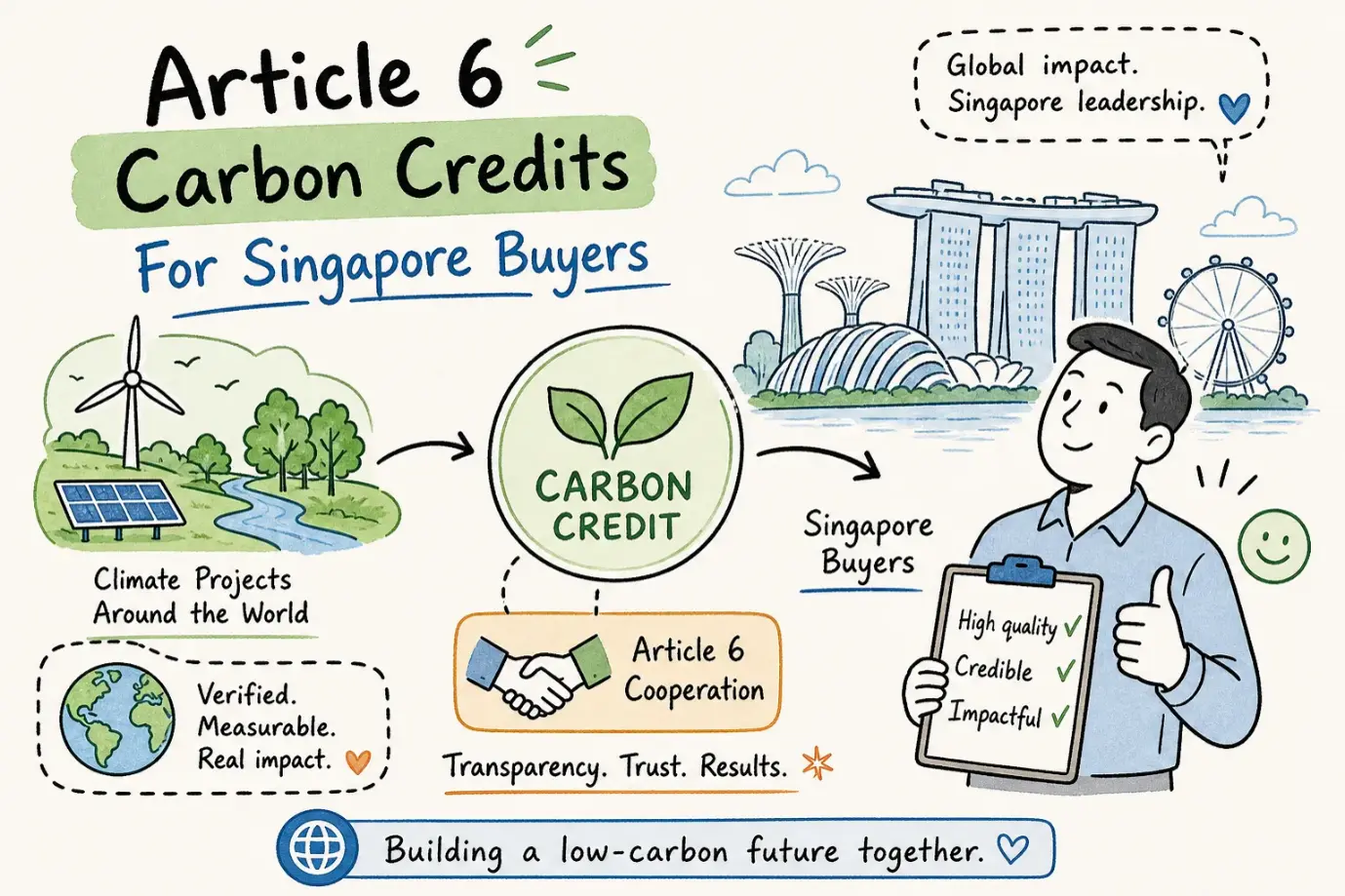
Article 6 carbon credits are fundamentally different from standard voluntary offsets, and...
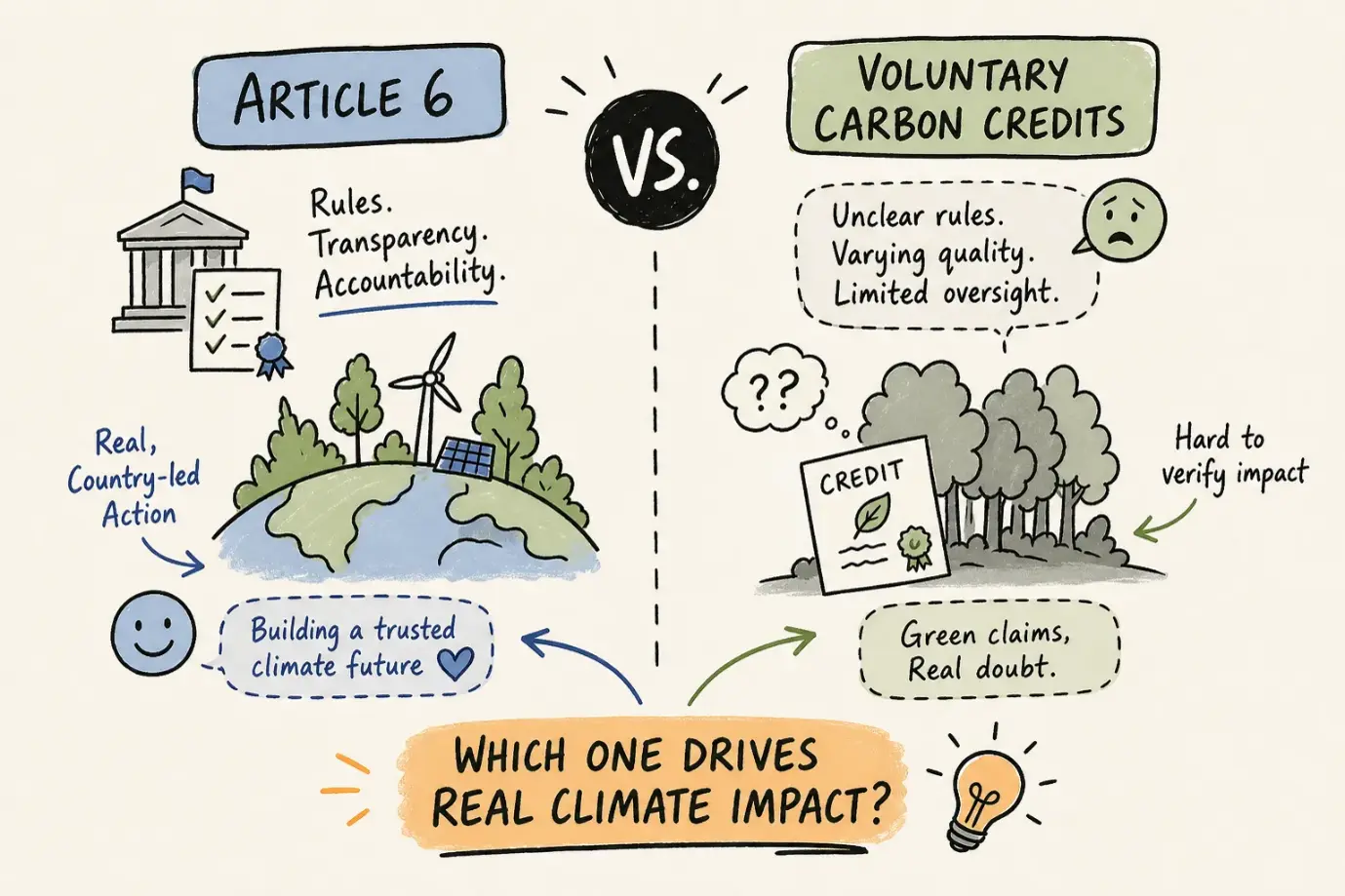
Understanding the difference between Article 6 and voluntary carbon market credits is...
Carbon neutral vs net zero: two terms, both sound green, both are...
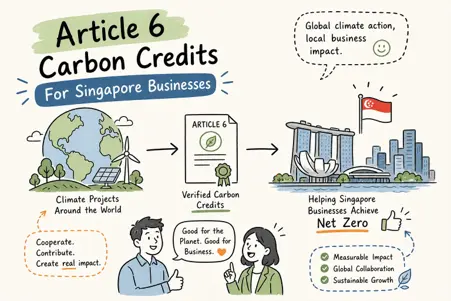
For Singapore businesses, Article 6 carbon credits explained properly can mean the...
Carbon neutrality claims are increasingly visible in Singapore's events industry. Conference programmes...

Green Passport Carbon
Quick Links
More Information
 Optimized by Seraphinite Accelerator